
Global Hydrogen Valve Market Report Covering Market Size, Key Players, Technology Innovations and Forecast Through 2033
Powering the Clean Energy Transition: Global Hydrogen Valve Market Set for Explosive Growth Through 2032
The global energy landscape is undergoing a monumental transition. As nations worldwide grapple with the pressing challenges of climate change, carbon neutrality mandates, and energy security, clean energy alternatives have moved from peripheral discussion boards to the center of global economic strategy. Among all green energy vectors, hydrogen has emerged as the ultimate frontier. Often hailed as the fuel of the future, hydrogen offers a zero-emission energy carrier capable of decarbonizing heavy industries, long-haul transportation, aviation, and power generation.
However, moving hydrogen from concept to commercial reality requires more than just production plants and fuel cells; it demands a highly specialized, ultra-reliable infrastructure capable of handling one of the most volatile and smallest molecules in the universe. At the heart of this physical and digital network lies a critical mechanical component: the hydrogen valve.
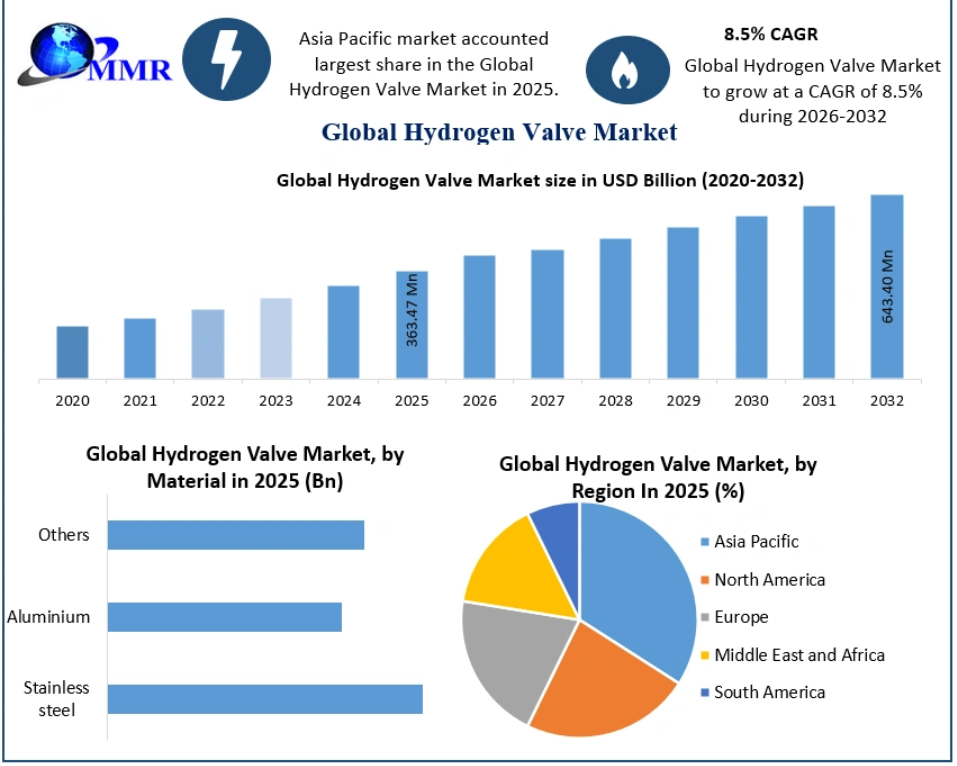
Recent comprehensive industry evaluations indicate that the Global Hydrogen Valve Market was valued at approximately USD 363.47 million and is projected to expand significantly, achieving a robust compound annual growth rate (CAGR of 8.5%) through the forecast period, heading toward a multi-million-dollar valuation milestone. This extensive press release report explores the vital market drivers, technological breakthroughs, structural segments, regional dynamics, and strategic business decisions shaping the global hydrogen valve ecosystem.
𝐃𝐨𝐰𝐧𝐥𝐨𝐚𝐝 𝐅𝐫𝐞𝐞 𝐏𝐃𝐅 𝐁𝐫𝐨𝐜𝐡𝐮𝐫𝐞 @https://www.maximizemarketresearch.com/request-sample/278530/
The Engineering Imperative: Why Hydrogen Valves are Uniquely Demanding
Hydrogen possesses unique physical and chemical properties that set it apart from conventional fossil fuels and industrial gases. Because it is the lightest element in existence, hydrogen molecules can easily slip through microscopic imperfections in metals and seals—a phenomenon known as permeation. Furthermore, high-pressure hydrogen gas can penetrate metal crystal lattices, causing hydrogen embrittlement, which drastically reduces the structural integrity and ductility of standard piping materials.
Consequently, standard industrial valves designed for water, oil, or natural gas are entirely inadequate for hydrogen service. The hydrogen valve market revolves around high-precision, heavily engineered components capable of withstanding extreme pressures (ranging up to 700 bar and beyond in fuel cell vehicles and refueling stations), cryogenic temperatures (for liquid hydrogen storage), and aggressive sealing requirements. Ensuring zero-leakage performance, long-term durability, and strict regulatory compliance is the foundational mandate driving valve manufacturers today.
Key Growth Drivers Propelling the Hydrogen Valve Ecosystem
1. Government Policy Frameworks and National Hydrogen Strategies
Global policy frameworks are acting as the primary launchpad for the hydrogen economy. Landmark legislative initiatives—such as the United States Inflation Reduction Act (IRA), the European Union’s REPowerEU plan targeting 10 million tonnes of domestic green hydrogen production, and ambitious roadmap targets across Asian economies—are injecting billions of dollars into clean energy infrastructure. These policy incentives spur massive investments in electrolysis plants, massive transmission pipelines, and localized distribution networks, directly fueling the procurement of heavy-duty hydrogen valves.
2. Escalating Adoption of Hydrogen Fuel Cell Vehicles (FCEVs) and Mobility Infrastructure
The mobility sector is transitioning rapidly toward zero-emission solutions, with hydrogen fuel cell technology serving as a vital counterpart to battery electric vehicles (BEVs), especially in commercial trucking, buses, trains, and maritime shipping. Global fleets of fuel cell passenger and commercial vehicles continue to expand, championed by automotive pioneers like Toyota and Hyundai.
To support these vehicles, thousands of high-pressure hydrogen refueling stations are being deployed across North America, Europe, and Asia-Pacific. These stations require specialized valves for compression, high-pressure storage banks, dispensing nozzles, and on-board vehicle fuel management systems, creating a massive, recurring demand loop for valve makers.
3. Industrial Decarbonization in Refining, Chemicals, and Steel
Beyond mobility, heavy industries are turning to clean hydrogen to replace fossil-derived feedstocks. The chemical and petrochemical industries utilize massive quantities of hydrogen for petroleum refining (such as hydroprocessing and fuel desulfurization), ammonia production, and methanol synthesis. Furthermore, emerging green steel initiatives are replacing coking coal with green hydrogen for direct reduction iron (DRI) processes. Because these industrial environments operate under extreme temperature and pressure parameters, high-performance hydrogen valves are indispensable for maintaining continuous operational safety and efficiency.
Comprehensive Market Segmentation Analysis
To capture clear market vision, stakeholders must examine the structural segmentation of the global hydrogen valve industry:
By Valve Type
-
Ball Valves: Widely deployed for rapid shut-off and reliable flow control in high-pressure transmission lines and refueling infrastructure.
-
Check Valves: Essential for preventing backflow in complex pipeline networks and compressor systems, safeguarding equipment integrity.
-
Pressure Relief Valves: Critical safety devices designed to automatically vent excess pressure, preventing catastrophic containment failures.
-
Needle and Globe Valves: Utilized for precise throttling, fine-tuning flow rates, and high-pressure sampling applications.
-
Cryogenic and Specialty Valves: Engineered specifically to handle liquefied hydrogen at ultra-low temperatures without thermal-induced material failure.
By Pressure Range
-
Low to Moderate Pressure (Up to 50 Bar): Common in early-stage production units, low-pressure storage, and standard chemical processing plants.
-
High Pressure (301 to 700 Bar & Above): Represents a dominant and fastest-growing market share segment. These valves are mandatory for hydrogen fueling stations, high-pressure onboard vehicle storage tanks, and industrial tube trailers where gas density must be maximized.
By Material Composition
-
Advanced Stainless Steel Alloys: The baseline standard for corrosion resistance and structural durability against hydrogen embrittlement.
-
Specialized Aluminum and Composite Materials: Increasingly adopted in weight-sensitive automotive and aerospace applications.
Competitive Landscape – Hydrogen Valve Market
The global Hydrogen Valve Market is characterized by intense competition, driven by the rapid expansion of the hydrogen economy and increasing investments in clean energy infrastructure. Market participants are focusing on developing high-performance valves capable of operating under high-pressure, cryogenic, and corrosive hydrogen environments while ensuring maximum safety, durability, and leak-proof performance. Manufacturers are investing significantly in research and development to improve material compatibility, sealing technologies, automation capabilities, and compliance with stringent international hydrogen safety standards. Strategic initiatives such as mergers and acquisitions, partnerships with hydrogen infrastructure developers, long-term supply agreements, and expansion of manufacturing facilities are enabling companies to strengthen their market position and capitalize on the growing demand for hydrogen production, storage, transportation, and refueling applications.
Hydrogen Valve Market, Key Players
1. Emerson Electric Co.
2. Crane Company
3. Parker Hannifin Corp
5. Swagelok Company
6. KITZ Corporation
7. Velan Inc.
8. Westport Fuel Systems Inc.
9. Kevin Steel
10. GSR Ventiltechnik GmbH
11. Adams Armaturen GmbH
12. Hartmann Valves GmbH
13. GEFA Processtecchnik GmbH
14. Maximator GmbH
15. HABONIM
16. OMB Saleri S.P.A.
17. CAM S.p.A.
18. Oliver Valves Ltd
19. Rotarex
20. Valmet
21. Vexve Oy
For full access to the comprehensive strategic report, visit:https://www.maximizemarketresearch.com/market-report/hydrogen-valve-market/278530/
Regional Market Dynamics and Geographic Hotspots
Asia-Pacific: The Undisputed Volume Leader
Asia-Pacific commands the largest market share (accounting for approximately 45% to 50% of global demand), anchored by aggressive national clean energy roadmaps in China, Japan, and South Korea. China has emerged as a global powerhouse in green hydrogen capacity, exemplified by mega-scale electrolysis projects in Inner Mongolia and Xinjiang, as well as thousands of kilometers of newly constructed inter-provincial hydrogen pipelines. Meanwhile, South Korea and Japan continue to lead consumer and commercial fuel cell vehicle adoption, driving immense regional demand for high-pressure refueling infrastructure valves.
North America: Innovation, Infrastructure Upgrades, and Federal Funding
North America represents a highly lucrative, technologically advanced market. Driven by U.S. federal clean energy grants, state-level zero-emission mandates, and massive private-equity backing, the region is modernizing its petroleum refining units and building robust green hydrogen corridors. Strict regulatory standards set by safety organizations mean that North American buyers prioritize certified, premium-grade, leak-proof valve architectures.
Europe: Regulatory Rigor and Green Hydrogen Corridors
Europe maintains a rigorous focus on sustainability, backed by stringent EU industrial emissions targets and cross-border clean energy networks. European engineering firms are pioneering advanced hydrogen-ready pipeline retrofits, ensuring existing natural gas transmission networks can safely blend and transport hydrogen. This structural shift requires widespread replacement and retrofitting of legacy valves with hydrogen-certified alternatives.
Strategic Business Decisions and Executive Recommendations
For valve manufacturers, industrial suppliers, and energy investors navigating this high-growth ecosystem, achieving competitive advantage requires calculated, forward-thinking execution:
-
Invest Aggressively in R&D and Material Science: Overcoming hydrogen embrittlement and permeation challenges requires continuous metallurgical innovation, specialized elastomeric seal testing, and strict compliance with global safety standards (such as ISO norms for hydrogen components).
-
Integrate Smart IoT and Real-Time Monitoring: Modern industrial operators increasingly demand intelligent valves equipped with embedded sensors for predictive maintenance, real-time leak detection, and remote pressure tracking. Integrating smart technology elevates product differentiation.
-
Forge Strategic Partnerships with Energy Giants: Collaborating closely with hydrogen producers, EPC contractors, and fuel cell vehicle original equipment manufacturers (OEMs) ensures early design-in wins and long-term, recurring supply contracts.
Conclusion
The global hydrogen valve market is a cornerstone of the clean energy transition. As governments and private enterprises commit billions of dollars to hydrogen production, storage, and mobility infrastructure, the demand for precision-engineered, ultra-safe, high-pressure valves will continue to skyrocket. Enterprises that prioritize strict compliance, material innovation, and smart automation will undoubtedly capture a dominant share of this multi-million-dollar growth frontier.
About Maximize Market Research
Maximize Market Research is a multifaceted market research and consulting company with professionals from several industries. Some of the industries we cover include medical devices, pharmaceutical manufacturers, science and engineering, electronic components, industrial equipment, technology and communication, cars and automobiles, chemical products and substances, general merchandise, beverages, personal care, and automated systems. To mention a few, we provide market-verified industry estimations, technical trend analysis, crucial market research, strategic advice, competition analysis, production and demand analysis, and client impact studies.
Contact Maximize Market Research
3rd Floor, Navale IT Park, Phase 2
Pune Bangalore Highway, Narhe,
Pune, Maharashtra 411041, India
sales@maximizemarketresearch.com
+91 96071 95908, +91 9607365656

 Arabic
 French
 Spanish
 Portuguese
 Deutsch
 Turkish
 Dutch
Dutch
 Italiano
 Russian
 Romaian
 Portuguese (Brazil)
 Greek
Greek
