
Pressure Washer Market Trends From Residential Cleaning to Industrial Maintenance
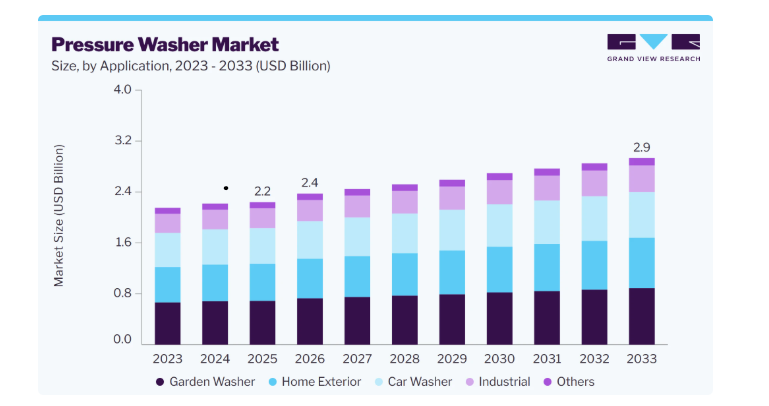
The pressure washer market is increasingly connected to the full lifecycle of property and equipment maintenance. What begins as a need to remove dirt from a surface can become a recurring requirement linked to appearance, asset preservation, hygiene, operational efficiency, and professional cleaning. The Pressure Washer Market generated USD 2.2 billion in 2025 and is forecast to reach USD 2.9 billion by 2033, advancing at a 3.1% CAGR. North America led with 35.4% revenue share in 2025, while Asia Pacific is positioned as the fastest-growing regional market.
Key Highlights
USD 2.2B market in 2025
USD 2.3B estimate for 2026
USD 2.9B forecast for 2033
3.1% CAGR
40.0% electric-based product share
30.7% garden washer application share
35.4% North America regional share
Dirt Appears → Cleaning Becomes Necessary → Manual Methods Become Inefficient → Pressure Washing Becomes Attractive → Maintenance Becomes Easier
This simple chain explains much of the market's demand.
As properties, vehicles, gardens, machinery, and commercial facilities accumulate contaminants, the cost of manual cleaning rises in terms of time and effort.
Pressure washers address that problem with controlled high-pressure water application.
The Residential Flow
Outdoor surface becomes dirty
↓
Manual cleaning requires more time
↓
Homeowner seeks faster solution
↓
Multipurpose pressure washer becomes attractive
↓
Regular cleaning becomes easier
↓
Equipment use expands across the property
This explains why residential users are increasingly applying pressure washers across gardens, vehicles, driveways, patios, decks, fences, and exterior walls.
Download a free sample report or claim your copy of this full market intelligence report
The Product Flow
Electric-based → Convenience
Electric-based models led the market with 40.0% revenue share in 2025.
Their strongest advantages are ease of operation, lower maintenance, quieter use, and suitability for many residential and commercial environments.
Fuel-based → Heavy-duty capability
Fuel-based models can provide higher power and are useful where electricity is unavailable or insufficient for demanding tasks. The segment is projected to grow at a 3.6% CAGR.
Gas-based → Industrial strength
Gas-powered systems remain relevant in industrial environments where stubborn contaminants and high-pressure requirements make power a priority.
The Application Flow
Garden washer → 30.7% share
Home exterior → fastest growth
Car washer → vehicle maintenance
Industrial → heavy-duty cleaning
The distribution shows how pressure washers have moved beyond one core application.
Garden: Growing outdoor maintenance and landscaping activity creates recurring demand.
Home exterior: The fastest-growing application benefits from renovation, curb-appeal, mold prevention, and property maintenance.
Car washing: Growing vehicle ownership and professional washing services support continued demand.
Industrial: Factories and equipment operators require machines capable of handling grease, dirt, residue, and heavy contamination. The industrial segment is projected to reach USD 416.1 million by 2033.
The Professional Cleaning Flow
More cleaning businesses → more frequent equipment use → greater equipment wear → stronger demand for durable professional machines
This creates a customer segment that evaluates pressure washers differently from occasional residential users.
Professional buyers typically prioritize:
Reliability
Cleaning speed
Pressure consistency
Mobility
Maintenance simplicity
Operating cost
Technology Flow
The industry is moving through another sequence:
Conventional machines
↓
Electric models
↓
Battery-powered equipment
↓
Portable designs
↓
More automated and connected systems
Water efficiency is also becoming increasingly relevant as manufacturers and consumers seek effective cleaning without unnecessary resource consumption.
The Construction Flow
More construction activity → more equipment and surface contamination → greater cleaning requirement → stronger demand for heavy-duty pressure washers
Construction sites can use pressure washers for equipment, vehicles, concrete surfaces, work areas, and building exteriors.
This creates demand outside the household market and supports professional-grade equipment sales.
Regional Flow
North America → Mature demand
The region's 35.4% share reflects strong consumer adoption, DIY maintenance, construction activity, and established product availability.
Asia Pacific → Expansion
Urbanization, industrialization, construction, and rising incomes are expected to support the fastest regional growth.
Europe → Efficiency and maintenance
Home improvement, professional cleaning, and demand for advanced equipment support the market.
Latin America → Developing adoption
Construction, automotive, and commercial cleaning offer multiple demand pathways.
Middle East & Africa → Emerging applications
Infrastructure, hospitality, industrial facilities, and commercial property maintenance provide long-term potential.
What Can Interrupt the Flow?
The market still faces:
High equipment prices for advanced models
Maintenance requirements
Water-use concerns
Competition from conventional cleaning
Limited awareness in some emerging markets
These factors can influence replacement cycles and purchase decisions.
Key Companies
- Revive Powerwashing Inc.
- Alfred Kärcher SE & Co. KG
- Generac Power Systems, Inc.
- AR North America
The End Result
The pressure washer market is evolving because cleaning itself is becoming more systematic.
A pressure washer can now be part of a broader maintenance routine rather than a machine used only when a surface becomes extremely dirty.
That shift can support recurring demand across homes, gardens, vehicles, commercial properties, construction sites, and industrial facilities, creating a steady market opportunity through 2033.
About us:
Grand View Research, a market research and consulting company, provides syndicated research reports, customized research reports, and consulting services. Grand View Research database is used by the world's renowned academic institutions and Fortune 500 companies to understand the global and regional business environment. Our database features thousands of statistics and in-depth analysis on 46 industries in 25 major countries worldwide.

 English
 French
 Spanish
 Portuguese
 Deutsch
 Turkish
 Dutch
Dutch
 Italiano
 Russian
 Romaian
 Portuguese (Brazil)
 Greek
Greek
