
Financial Analytics Market Expected to Reach USD 43.2 Billion by 2036, China, Italy and UK Show Rising CAGRs
Financial analytics is moving from a reporting function toward a core financial decision-support capability as banks, insurers, and enterprises increase investment in predictive intelligence, regulatory reporting, fraud monitoring, and cloud-based analytics. Fact.MR estimates the global financial analytics market at USD 17.9 billion in 2026, with the market forecast to reach USD 43.2 billion by 2036, expanding at a 9.2% CAGR during the period. The forecast represents an absolute dollar opportunity of USD 25.3 billion between 2026 and 2036.
Get detailed market forecasts, competitive benchmarking, and pricing trends: https://www.factmr.com/connectus/sample?flag=S&rep_id=7201
A major factor supporting this expansion is the growing requirement for financial institutions to strengthen risk and compliance analytics. Basel IV and IFRS 17 are encouraging banks and insurers to upgrade analytical infrastructure for regulatory reporting, risk assessment, and financial modeling. At the same time, increasing payment fraud, account takeover activity, and identity fraud are increasing demand for real-time fraud detection capabilities. Cloud migration is adding another layer of opportunity as financial institutions seek scalable analytics platforms that can support changing reporting requirements without relying entirely on legacy on-premise systems.
The market is also benefiting from a broader shift in how financial institutions use data. Instead of relying mainly on retrospective reporting, organizations are increasingly applying analytics to credit risk, customer profitability, financial planning, transaction monitoring, and regulatory compliance. Fact.MR notes that cloud-based analytics platforms can provide scalable infrastructure and automated regulatory updates while reducing long-term operating costs compared with traditional systems. However, integration with legacy IT environments and high total ownership costs for some enterprise deployments remain constraints on adoption.
By component, Financial Analytics Solutions are expected to account for approximately 64% of the market in 2026, making this the leading component category. The strong position of solutions reflects enterprise demand for software-driven analytics that can integrate with core banking and finance platforms. Financial institutions are looking for tools that can process financial information, support forecasting, improve risk analysis, and provide decision-ready intelligence within existing technology environments.
Application demand is particularly strong around financial crime management. Financial Fraud Detection and Prevention is expected to hold about 20% share in 2026, supported by anti-fraud and anti-money-laundering requirements across banking and payment ecosystems. Real-time transaction monitoring and advanced analytics are becoming increasingly relevant as financial institutions seek to identify suspicious activity and respond to emerging forms of payment and identity fraud.
Cloud infrastructure represents another important part of the market structure. Cloud-based deployment accounts for approximately 61% share in 2026, according to Fact.MR. The preference reflects the need for scalable analytics environments and continued migration away from traditional on-premise systems. Cloud platforms can also help financial organizations respond to evolving regulatory requirements and support analytics workloads across multiple functions.
Country-level growth varies considerably across major financial markets. China is forecast to record the fastest growth at 8.5% CAGR through 2036, supported by digital finance initiatives, fintech investment, and government-backed financial technology programs. Fact.MR points to the People’s Bank of China Financial Technology Development Plan 2024–2027, which directs banks toward real-time analytics for risk monitoring, liquidity management, and anti-money-laundering compliance.
Italy is expected to register a 7.2% CAGR, making it the fastest-growing European country covered in the report. Regulatory modernization and digital finance initiatives are supporting demand, while a Bank of Italy supervisory digitalization program is encouraging analytics upgrades among financial institutions. Italian insurers are also investing in analytics associated with IFRS 17 compliance.
The United Kingdom is projected to expand at a 6.5% CAGR through 2036. Regulatory analytics adoption is a major factor, with FCA data and analytics initiatives supporting stronger monitoring and oversight capabilities. The Prudential Regulation Authority's stress-testing framework also contributes to demand for advanced analytical tools, including climate-risk analytics.
Other major markets are also contributing to the global opportunity. Japan is projected to grow at 7.9%, South Korea at 7.7%, France at 6.4%, Germany at 6.3%, and the United States at 6.0% CAGR through 2036. Japan's growth is associated with stress-testing and financial risk reporting requirements, while South Korea benefits from open banking and data integration initiatives. France is supported by Basel IV compliance investment, Germany by risk analytics requirements, and the United States by regulatory reporting and enterprise analytics adoption.
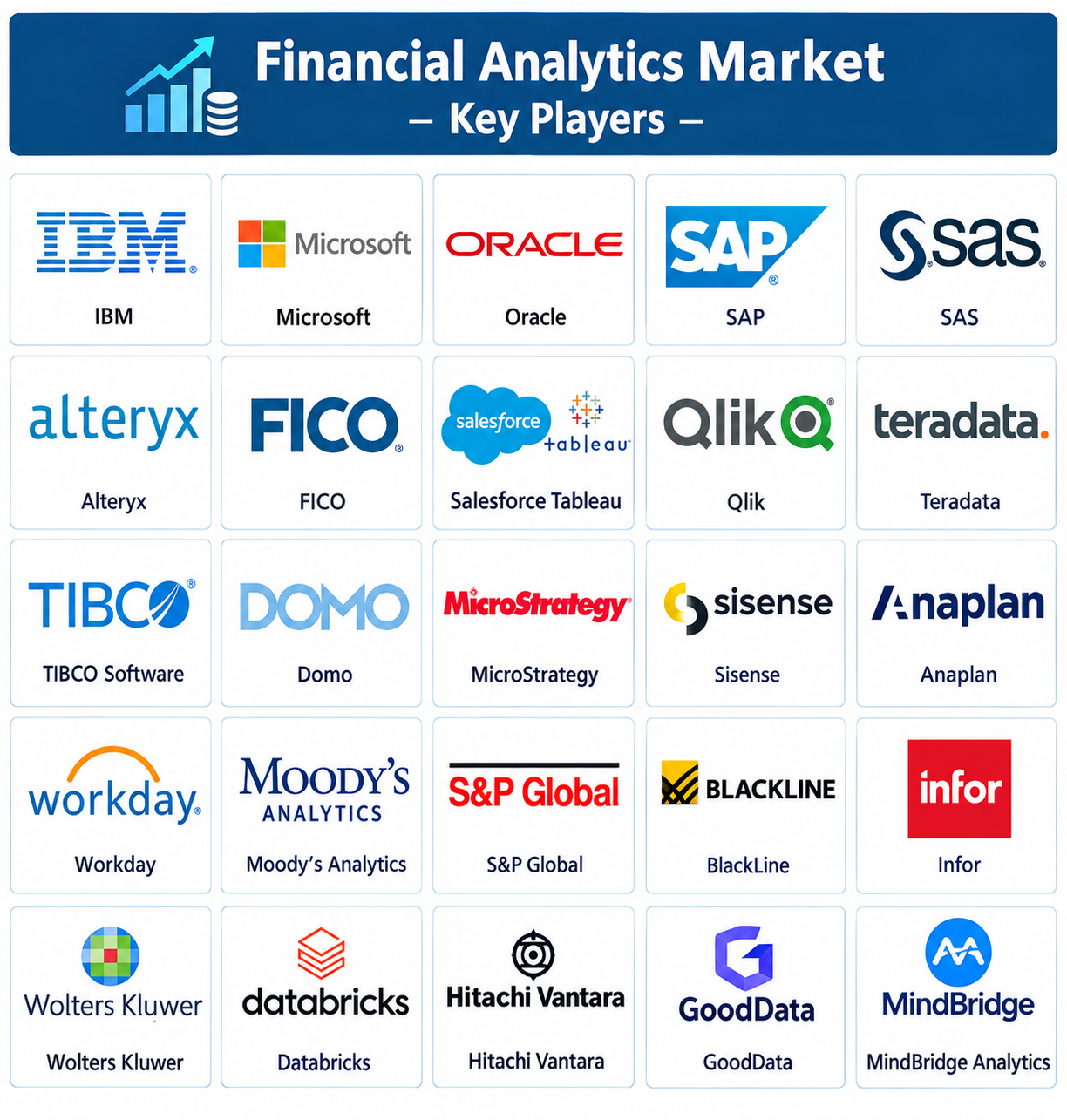
The competitive environment includes major enterprise technology and financial analytics providers. SAP SE, Oracle Corporation, SAS Institute Inc., and IBM Corporation maintain strong positions through their integration with enterprise financial systems and regulatory analytics capabilities. Other companies profiled by Fact.MR include FIS Global, Moody's Analytics, Tableau (Salesforce), Workday, BlackRock Solutions, and Qlik Technologies.
Fact.MR notes that large financial institutions frequently use multiple analytics platforms across risk management, compliance, and fraud detection rather than depending on a single provider. Procurement priorities include regulatory certification, platform reliability, and established vendor experience, creating opportunities for both large enterprise providers and specialized analytics companies.
With financial institutions facing expanding regulatory requirements, increasing fraud risks, and continued cloud migration, financial analytics is positioned to become a more central part of enterprise financial technology infrastructure. The market's projected increase from USD 17.9 billion in 2026 to USD 43.2 billion by 2036 highlights the scale of the opportunity for technology providers, financial institutions, insurers, and other organizations investing in data-driven financial decision-making.
Top Trending Reports:

 English
 French
 Spanish
 Portuguese
 Deutsch
 Turkish
 Dutch
Dutch
 Italiano
 Russian
 Romaian
 Portuguese (Brazil)
 Greek
Greek
