
Global Vibration Sensor Market Growth Analysis, Key Players & Forecast
Engineering Structural Reliability: Strategic Market Vision and Growth Trajectory of the Global Vibration Sensor Market
In the modern landscape of high-performance manufacturing, heavy processing, and automated industrial plants, equipment uptime is directly tied to enterprise profitability. As industrial facilities increasingly transition toward automated, data-driven ecosystems powered by Industry 4.0 principles, preventing catastrophic mechanical failures has become a primary boardroom objective. This operational urgency has propelled the Global Vibration Sensor Market into an era of rapid technological advancement and widespread market adoption.
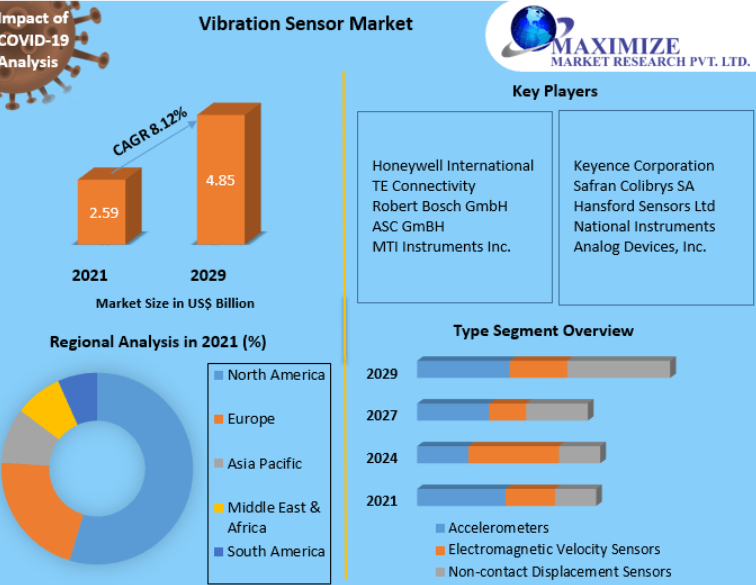
Valued significantly and expanding at a robust compound annual growth rate (CAGR of 8.12%), the market is projected to reach approximately US$ 4.85 billion. Backed by comprehensive industry research and clear market vision, this press release review provides an in-depth analysis of the drivers, segmentation, regional developments, and strategic decision-making frameworks shaping the future of global vibration sensing technologies.
𝐃𝐨𝐰𝐧𝐥𝐨𝐚𝐝 𝐅𝐫𝐞𝐞 𝐏𝐃𝐅 𝐁𝐫𝐨𝐜𝐡𝐮𝐫𝐞 @https://www.maximizemarketresearch.com/request-sample/32109/
The Industrial Imperative: Understanding Vibration Sensor Technology
Vibration sensors are precision measurement instruments engineered to monitor, evaluate, and record parameters such as linear velocity, displacement, and acceleration in industrial machinery. In complex mechanical systems—ranging from massive turbines in energy plants to high-speed conveyor belts in manufacturing lines—continuous vibration monitoring acts as an early warning system for wear and tear, misalignment, imbalance, and bearing faults.
By tracking these physiological parameters of machinery in real-time, facilities can move away from reactive, costly "run-to-failure" maintenance models or rigid, calendar-based servicing. Instead, they can deploy predictive maintenance (PdM) strategies. Predictive maintenance optimizes asset performance, minimizes unplanned downtime, extends machine lifespan, and drastically reduces operational expenditures.
Market Dynamics: Key Drivers Propelling Exponential Expansion
The sustained upward trajectory of the global vibration sensor market is anchored by several powerful macroeconomic and technological catalysts:
1. The Global Shift Toward Predictive Maintenance
Historically, industrial maintenance was performed reactively—fixing equipment only after it broke down—or scheduled blindly at fixed intervals. Both approaches carried heavy financial penalties in terms of lost production time, emergency labor costs, and damaged components. Today, predictive maintenance has transformed factory floors worldwide. Vibration sensors serve as the eyes and ears of predictive analytics platforms, capturing minor anomalies long before they manifest as critical mechanical failures.
2. The Rise of Smart Factories and Industry 4.0
The rapid convergence of Operational Technology (OT) and Information Technology (IT) has given birth to the smart factory. Industrial Internet of Things (IIoT) platforms require constant streams of telemetry data from factory assets to run machine-learning models and digital twins. Vibration sensors integrated with wireless communication protocols (such as Wi-Fi, Bluetooth Low Energy, and cellular IoT) enable seamless edge-to-cloud data transmission, giving plant managers unprecedented visibility into machine health.
3. Safety, Compliance, and Asset Longevity Mandates
In high-stakes industries like oil and gas, aerospace, and heavy processing, mechanical failure can lead to catastrophic safety hazards, environmental disasters, and severe regulatory penalties. Stringent workplace safety and environmental protection mandates require companies to maintain immaculate asset integrity, further driving the mandatory installation of robust vibration monitoring devices.
Market Restraints and Operational Challenges
Despite stellar growth forecasts, industry stakeholders must navigate specific technical hurdles that could temporarily impede market velocity:
-
Sensitivity Limitations with Heavy Loads: Certain conventional vibration sensors struggle to detect extremely minute or high-frequency vibrations when subjected to extreme operating loads. This limitation can occasionally reduce response precision or create processing delays.
-
Initial Deployment Costs: Upgrading legacy plants with comprehensive, networked vibration sensing systems requires significant upfront capital investment, which can pose a challenge for budget-constrained small and medium-sized enterprises (SMEs).
However, continuous research and development by leading technology providers are actively addressing these limitations through the introduction of ultra-sensitive MEMS accelerometers and advanced signal-processing algorithms.
Comprehensive Market Segmentation Analysis
To establish a clear market vision and make precise investment decisions, industry leaders must analyze the global vibration sensor market across key structural segments:
By Type
-
Accelerometers: Representing the backbone of the market, accelerometers are further segmented into Capacitive MEMS, Piezoresistive, and Piezoelectric models. Piezoelectric accelerometers are favored for high-frequency dynamic measurements, while capacitive MEMS variants are witnessing massive adoption due to their miniature size, cost-effectiveness, and low power consumption.
-
Electromagnetic Velocity Sensors: Widely utilized for measuring machine vibration velocity in heavy industrial rotating machinery.
-
Non-contact Displacement Sensors: Essential for measuring relative motion and distance between moving parts without physical contact, commonly deployed in high-precision engineering environments.
By End-User Industry
-
Processing Industry: Dominating the end-user landscape, processing sectors—including food and beverages, metals and mining, and paper and pulp—rely heavily on continuous vibration monitoring to keep continuous-flow production lines operational.
-
Automotive: Utilized extensively during vehicle testing, R&D, and manufacturing assembly plant automation.
-
Oil and Gas: Crucial for monitoring pumps, compressors, turbines, and drilling rigs operating in harsh, remote environments.
-
Consumer Electronics & Healthcare: Emerging application spaces leveraging compact vibration sensors for product quality testing and medical equipment monitoring.
-
Energy & Power / Aerospace & Defense: Vital sectors where equipment failure carries zero tolerance for error, making continuous vibration analysis a non-negotiable operational standard.
𝐃𝐨𝐰𝐧𝐥𝐨𝐚𝐝 𝐅𝐫𝐞𝐞 𝐏𝐃𝐅 𝐁𝐫𝐨𝐜𝐡𝐮𝐫𝐞 @https://www.maximizemarketresearch.com/request-sample/32109/
Regional Landscape: Asia-Pacific Leads the Charge
Geographically, the global market exhibits dynamic regional variations:
-
Asia-Pacific (APAC): APAC holds the largest market share (commanding over 33% of the global landscape) and is positioned as the fastest-growing regional market during the forecast period. This dominance is driven by rapid industrialization, the proliferation of manufacturing hubs in nations like China and India, and aggressive investments in smart factory automation.
-
North America and Europe: These mature markets maintain robust, steady growth propelled by early adoption of predictive maintenance technologies, strict regulatory frameworks regarding industrial safety, and the presence of advanced aerospace and automotive manufacturing clusters.
-
Latin America and Middle East & Africa (MEA): Witnessing stable adoption driven by modernizing oil and gas infrastructure, mining operations, and large-scale power generation projects.
Strategic Decision-Making: Navigating the Competitive Landscape
To achieve a strong Return on Investment (ROI) and maintain a competitive edge, industry participants must focus on several key strategic pillars:
-
Integration of AI and Machine Learning: Hardware alone is no longer enough; leading vendors are bundling vibration sensors with cloud analytics software that automatically diagnoses faults and predicts remaining useful life (RUL).
-
Wireless and Energy-Harvesting Innovations: Developing self-powered, wireless sensors reduces complex cabling costs and accelerates retrofitting across legacy industrial sites.
-
Strategic Partnerships: Collaborating with system integrators and cloud providers allows sensor manufacturers to offer end-to-end asset health management solutions tailored to specific vertical industries.
Competitive Landscape
The global vibration sensor market is highly competitive, with leading manufacturers focusing on technological innovation, product reliability, and expanding application areas across industrial automation, automotive, aerospace, energy, healthcare, and consumer electronics. Market participants are investing in MEMS (Micro-Electro-Mechanical Systems) technology, wireless vibration monitoring, IoT-enabled predictive maintenance solutions, and AI-powered condition monitoring systems to strengthen their competitive position.
Companies are adopting strategic initiatives such as mergers and acquisitions, partnerships, new product launches, and geographic expansion to enhance their market presence. The growing adoption of Industry 4.0, smart manufacturing, and predictive maintenance solutions has intensified competition, prompting vendors to develop high-precision, low-power, and real-time vibration sensing technologies. Integration with cloud-based analytics platforms and industrial IoT ecosystems has also become a key differentiator among leading players.
Vibration Sensor Market Key Players:
• Honeywell International, Inc.
• TE Connectivity Ltd
• Robert Bosch GmbH
• ASC GmBH
• MTI Instruments Inc.
• Keyence Corporation
• Safran Colibrys SA
• Hansford Sensors Ltd
• National Instruments Corporation
• Analog Devices, Inc.
For full access to the comprehensive strategic report, visit:https://www.maximizemarketresearch.com/market-report/global-vibration-sensor-market/32109/
Conclusion
The Global Vibration Sensor Market stands at the core of industrial digitalization and predictive maintenance excellence. As enterprises worldwide strive to eliminate unplanned downtime, optimize asset lifecycles, and protect operating margins, the deployment of advanced vibration monitoring systems will remain an indispensable strategy. By aligning with technology innovators and investing in smart, scalable sensing infrastructure, organizations can secure long-term operational resilience and sustainable market leadership.
About Maximize Market Research
Maximize Market Research is a multifaceted market research and consulting company with professionals from several industries. Some of the industries we cover include medical devices, pharmaceutical manufacturers, science and engineering, electronic components, industrial equipment, technology and communication, cars and automobiles, chemical products and substances, general merchandise, beverages, personal care, and automated systems. To mention a few, we provide market-verified industry estimations, technical trend analysis, crucial market research, strategic advice, competition analysis, production and demand analysis, and client impact studies.
Contact Maximize Market Research
3rd Floor, Navale IT Park, Phase 2
Pune Bangalore Highway, Narhe,
Pune, Maharashtra 411041, India
sales@maximizemarketresearch.com
+91 96071 95908, +91 9607365656

 English
 Arabic
 French
 Spanish
 Portuguese
 Deutsch
 Turkish
 Dutch
Dutch
 Italiano
 Russian
 Romaian
 Portuguese (Brazil)
