
Heat-to-Power Systems Market on Track to Reach USD 64.5 Billion by 2036
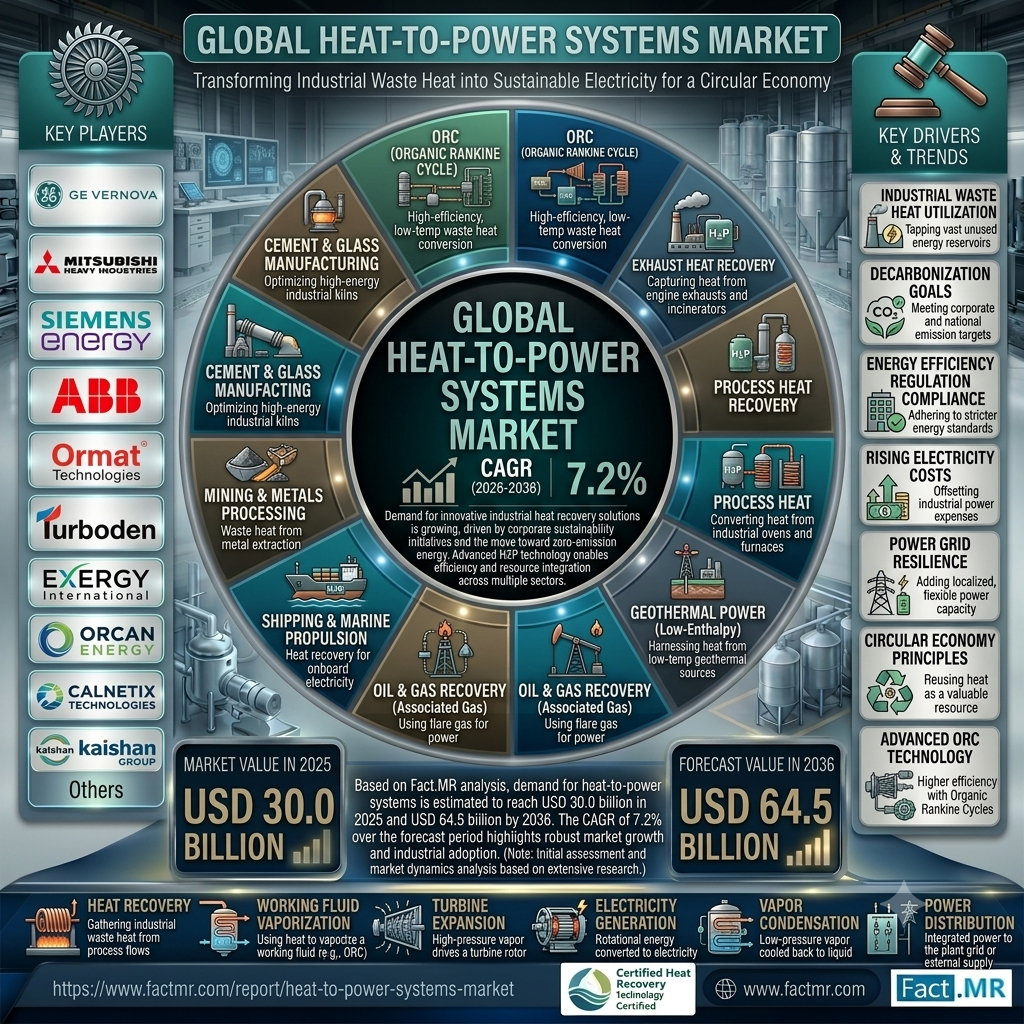
ROCKVILLE, Md., September 9, 2026 — The global Heat-to-Power Systems Market is projected to reach USD 64.5 billion by 2036, up from USD 32.2 billion in 2026, expanding at a 7.2% CAGR during 2026–2036, according to Fact.MR. The market was valued at USD 30.0 billion in 2025, with demand increasingly linked to industrial efforts to recover unused thermal energy, reduce electricity costs, and support decarbonization programs.
The market is expected to create an absolute dollar opportunity of around USD 32.3 billion between 2026 and 2036. Adoption is gaining ground across cement, steel, oil and gas, chemical, and power generation facilities where large quantities of waste heat remain available for conversion into electricity.
Get detailed market forecasts, competitive benchmarking, and pricing trends: https://www.factmr.com/connectus/sample?flag=S&rep_id=15171
Why are industries looking at waste heat differently?
Industrial facilities often produce heat that is not fully utilized during production. Heat-to-power systems provide a way to convert this otherwise unused thermal energy into electricity.
Fact.MR analysis indicates that rising electricity costs and greater emphasis on industrial energy efficiency are strengthening the business case for these systems. Decarbonization targets are adding another incentive, particularly for energy-intensive industries seeking to reduce emissions without relying solely on new power-generation capacity.
The opportunity is particularly relevant in developing industrial economies. Rapid industrialization in India, China, and other parts of Asia Pacific is increasing demand for technologies that can improve energy utilization while supporting expanding manufacturing capacity.
ORC technology takes the lead
Organic Rankine Cycle (ORC) technology is expected to account for 62.5% of the market in 2026, making it the leading technology segment.
Its position is linked to its ability to convert low- to medium-temperature waste heat into electricity. This gives ORC systems applications across industries where available heat may not be suitable for conventional high-temperature steam-based recovery.
Steam Rankine Cycle systems are expected to hold a 25.8% share in 2026, supported by high-temperature heat recovery and large industrial installations.
The medium-temperature range of 150–400°C represents another major part of the market, accounting for 53.1% share in 2026. Its compatibility with ORC systems and availability across industrial processes support its leading position.
Cement plants represent a major opportunity
The cement industry is expected to account for 27.4% of market value in 2026, the largest share among applications.
Cement plants generate recoverable heat from operations including preheaters and clinker coolers. These processes provide an established opportunity for waste heat recovery and power generation, making cement one of the most important application areas for heat-to-power systems.
Steel and metals follow with a 23.6% share, supported by continuous production processes involving blast furnaces and electric arc furnaces.
By heat source, industrial waste heat leads with a 53.4% share in 2026. Gas turbine exhaust accounts for 14.6%, supported by applications in power generation and oil and gas facilities.
Medium-scale systems balance cost and scalability
Medium-scale systems ranging from 1–10 MW are projected to hold 47.5% share in 2026.
Their position reflects a practical balance between system capacity, scalability, and applicability across industrial facilities. Large-scale systems above 10 MW are expected to account for 31.3% share, reflecting their use in large industrial facilities and solar power applications.
High initial investment remains one of the key constraints, particularly for smaller organizations. Variations in heat-source quality and consistency can also influence system performance. Limited technical knowledge in some markets may further slow deployment.
At the same time, improvements in ORC technology and low-grade thermal energy recovery are opening opportunities to utilize heat sources that were previously difficult to recover economically.
Asia Pacific leads growth
Asia Pacific is expected to remain the fastest-growing regional market, supported by industrialization, manufacturing expansion, energy demand, and greater emphasis on efficiency.
India is projected to grow at 8.8% CAGR through 2036, supported by industrialization, cement and steel production, and energy-efficiency initiatives. Japan follows at 8.5%, driven by technology innovation and energy-efficiency programs, while China is expected to expand at 8.2% amid extensive industrial activity.
In Europe, Italy is projected to grow at 7.1%, supported by the presence of ORC technology providers and increasing industrial acceptance. Germany is expected to expand at 5.8% CAGR.
The United States is projected to grow at 6.4% CAGR, supported by its established industrial base, refinery upgrades, oil and gas activity, and investments in waste heat recovery technology.
|
Country |
CAGR, 2026–2036 |
|
India |
8.8% |
|
Japan |
8.5% |
|
China |
8.2% |
|
Italy |
7.1% |
|
United States |
6.4% |
|
Germany |
5.8% |
|
South Korea |
5.7% |
Analyst view
Shambhu Nath Jha, Principal Consultant at Fact.MR, said:
“The heat-to-power systems market is anticipated to grow steadily on account of rising demand for industrial energy efficiency, increasing electricity costs, and strong focus on decarbonization. The growing need to utilize waste heat across industries such as cement, steel, oil & gas, and chemicals is driving adoption of heat-to-power systems.”
He added that advances in Organic Rankine Cycle technology and improved system integration are enabling more effective conversion of low- to medium-temperature heat into electricity.
Competitive landscape
Competition is centered on system efficiency, scalability, low- and medium-grade heat utilization, and total cost of ownership.
Leading companies profiled by Fact.MR include GE Vernova, Mitsubishi Heavy Industries, Siemens Energy, ABB, Ormat Technologies, Turboden, EXERGY International, Orcan Energy, Calnetix Technologies, and Kaishan Group.
Recent industry activity includes Turboden's commissioning of a waste heat-to-power ORC plant at Strathcona's Orion SAGD facility, while Siemens Energy has announced an agreement for a waste heat-to-power facility in Canada. Turboden has also been selected by Tallgrass for waste heat-to-power projects in Ohio and Indiana.
About the Heat-to-Power Systems Market Report
Fact.MR's Heat-to-Power Systems Market analysis covers heat sources, temperature ranges, capacity, technology, applications, and regions. The study uses a hybrid approach combining bottom-up and top-down analysis with primary interviews involving system manufacturers, EPC contractors, technology providers, industrial end users, and energy consultants.
The report covers the forecast period 2026 to 2036 and evaluates market opportunities across North America, Europe, Asia Pacific, Latin America, and the Middle East & Africa.
Top Reports:
https://adamaamresearch.blogspot.com/2026/09/hydraulic-workover-unit-demand-set-to.html
https://social.mytamam.com/blogs/38187/Hydraulic-Workover-Unit-Market-to-Reach-USD-13-89-Billion
https://zeuspage.org/blogs/51025/Hydraulic-Workover-Unit-Market-Set-to-Hit-USD-13-89
https://kaamkaaziclub.com/read-blog/47809
About Fact.MR
Fact.MR is a market research and consulting firm providing market intelligence across industries and regions. Its research combines primary interviews, secondary research, market modeling, and data validation to support strategic business decisions.

 English
 Arabic
 French
 Spanish
 Portuguese
 Deutsch
 Turkish
 Dutch
Dutch
 Russian
 Romaian
 Portuguese (Brazil)
 Greek
Greek
