
Concrete Trays: Uses, Benefits, Types, and Installation Considerations
Understanding Concrete Trays and Their Role in Construction
Concrete products are widely used in construction because they provide strength, stability, and long service life. Among the many concrete products used in residential, commercial, agricultural, and infrastructure projects, drainage and utility components play an important role in managing water and protecting essential services. Proper drainage helps prevent standing water, soil erosion, structural damage, and deterioration of paved areas. Choosing the right drainage component therefore requires an understanding of the site, expected water flow, installation conditions, and long term maintenance requirements.
A well planned drainage system is designed to collect and guide water toward a suitable discharge point. Open channels, underground pipes, surface drains, and precast drainage components can all be used depending on the requirements of a project. Concrete is particularly useful for drainage applications because it can withstand substantial loads and exposure to outdoor conditions. Its durability makes it suitable for locations where drainage structures are expected to remain functional for many years with regular inspection and maintenance.
A concrete tray is a practical component used to collect, control, and direct water across different types of sites. These trays can be incorporated into drainage systems around buildings, roads, pathways, industrial areas, agricultural locations, and other spaces where controlled water movement is necessary. Their design can vary according to the intended application, dimensions, expected flow, and loading conditions. Understanding these factors helps project planners select an appropriate drainage solution rather than relying only on appearance or size.
What Is a Concrete Tray?
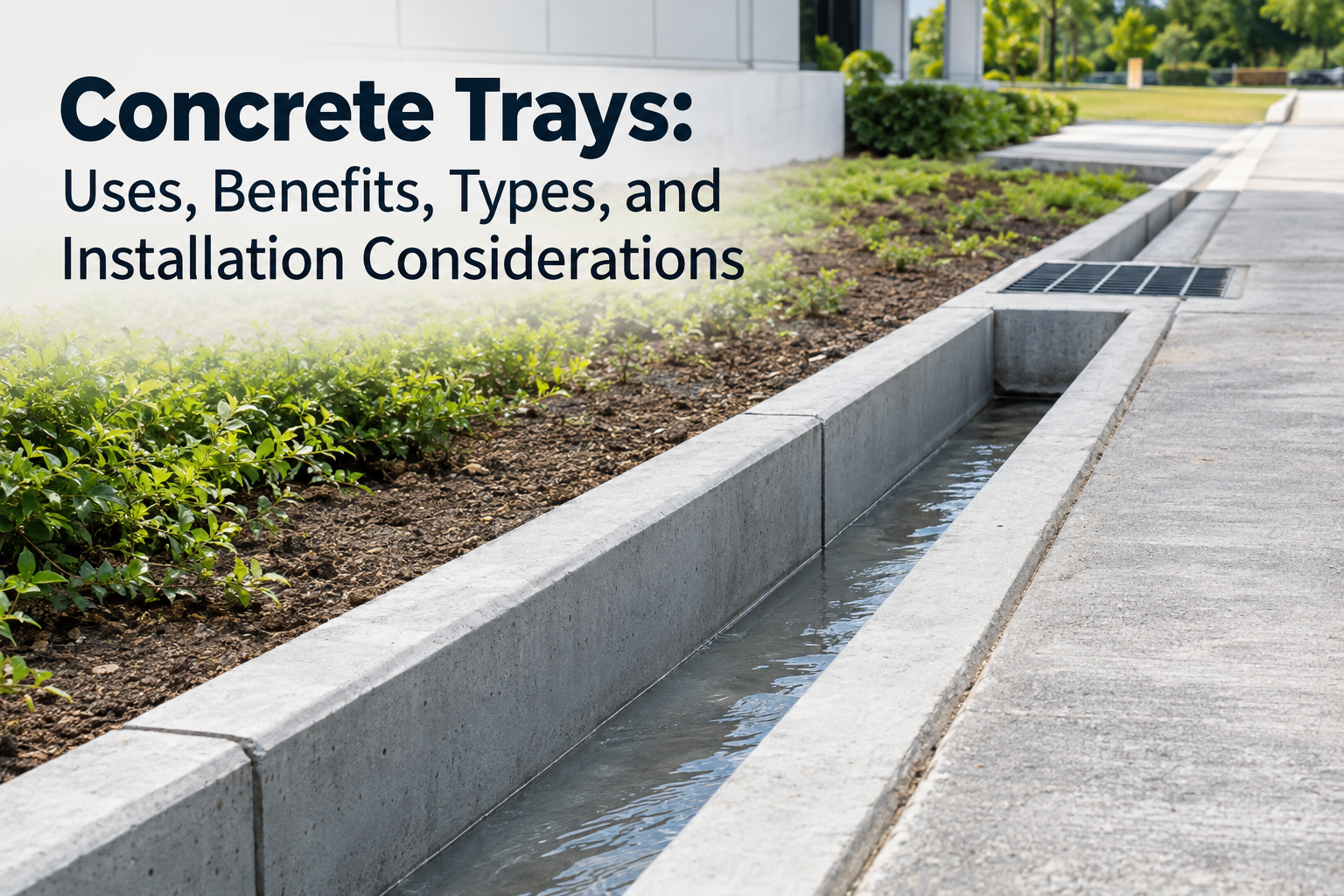
A concrete tray is generally a shaped concrete channel designed to provide a controlled route for surface water. It may have an open top that allows water to enter directly from the surrounding surface. Depending on the application, a tray may be installed at ground level, along the edge of a paved area, beside a road, around a building, or within a larger drainage arrangement.
The basic purpose is straightforward. Water naturally moves toward lower areas, but uncontrolled movement can cause problems. Rainwater flowing across a site can wash away soil, damage paving, enter unwanted areas, or collect around foundations. A properly positioned tray gives the water a defined path and helps move it toward an outlet or collection point.
Concrete trays can be produced in different shapes and dimensions. Some have relatively shallow channels intended for light surface drainage, while others are deeper and wider for areas where larger quantities of water may need to be carried. The shape of the internal channel also affects how efficiently water moves through the system.
Why Concrete Is Used for Drainage Applications
Concrete has several characteristics that make it suitable for drainage construction. One of the most important is its compressive strength. A properly manufactured concrete component can support significant loads, making it useful in locations exposed to pedestrians, vehicles, equipment, and stored materials.
Concrete is also relatively stable when installed correctly. Unlike some temporary drainage arrangements, a properly designed concrete channel is not easily displaced by normal surface water movement. This stability is particularly important where the surrounding ground is exposed to regular rainfall or changing moisture conditions.
Another advantage is resistance to many common outdoor conditions. Concrete can remain functional in environments exposed to sunlight, rain, temperature changes, and general outdoor activity. However, concrete is not completely immune to deterioration. Poor manufacturing, incorrect installation, inadequate drainage around the structure, and aggressive environmental conditions can reduce its service life.
Common Applications of Concrete Trays
Concrete drainage trays are used in many different environments. Their exact application depends on the dimensions of the tray, the expected water volume, and the loading conditions at the installation site.
Around residential buildings, trays can help direct rainwater away from entrances, driveways, patios, and other paved surfaces. They can also be used where sloped surfaces naturally direct water toward a specific collection point.
Commercial and industrial sites often require stronger drainage arrangements because large paved areas can produce considerable runoff during heavy rainfall. Water can also interfere with access routes and working areas. Properly positioned drainage channels help keep important surfaces usable and reduce the risk of uncontrolled water accumulation.
Roads and access routes may also require surface drainage. Water remaining on road surfaces can contribute to deterioration and create safety concerns. Drainage trays can be positioned along suitable sections to collect runoff and guide it toward an appropriate outlet.
Agricultural properties can benefit from controlled drainage around buildings, storage areas, livestock facilities, and access paths. Managing water in these areas can help protect surfaces and reduce muddy conditions.
Choosing the Right Tray Dimensions
The dimensions of a drainage tray should be determined according to the requirements of the site rather than selected solely on the basis of available space. Width, depth, length, and internal channel shape can all affect drainage performance.
The amount of rainfall expected in the area is an important consideration. A tray intended for occasional light runoff may not be suitable for an area that receives substantial rainfall or collects water from a large surface.
The catchment area also matters. A small paved section produces a different drainage requirement from a large parking area or extensive roof surface. Water from several surfaces may eventually enter the same drainage route, increasing the required capacity.
The slope of the installation area should also be considered. Water needs a suitable gradient to move toward the discharge point. If the channel is installed without adequate fall, water may remain inside the tray instead of flowing away efficiently.
Importance of Proper Installation
Even a well manufactured concrete drainage component can perform poorly if it is installed incorrectly. Installation begins with suitable preparation of the ground. The base needs to provide adequate support and should be stable enough to prevent excessive movement or settlement.
Uneven settlement can create low points within the drainage route. These areas may collect water and sediment, reducing the effectiveness of the system. Proper ground preparation helps maintain the intended level and slope.
The surrounding surface should also be designed to direct water into the tray. If the surrounding paving slopes away from the channel, rainwater may bypass the drainage system entirely.
Connections between trays and other drainage components should be carefully planned. Gaps, poorly aligned sections, or unsuitable outlets can cause leakage and reduce the overall effectiveness of the drainage arrangement.
Managing Water Flow Effectively
Drainage design is not simply about providing a channel for water. The system must also control the direction and speed of flow. Excessively fast water movement can contribute to erosion near the discharge area, while insufficient flow can cause sediment and debris to accumulate.
The outlet should therefore be capable of handling the water delivered by the tray. Sending water into an unsuitable location can create new drainage problems. For example, concentrated discharge near a building foundation or unstable soil can result in erosion or water penetration.
Where larger drainage systems are involved, several channels may connect to a main drainage route. The design should account for the combined flow rather than treating each section independently.
Concrete Tray Maintenance
Regular maintenance is important for keeping drainage channels functional. Leaves, soil, stones, litter, and other debris can gradually accumulate inside an open tray. If this material is not removed, the available space for water movement can become restricted.
Inspection should be carried out before and after periods of heavy rainfall where practical. Particular attention should be given to areas where debris naturally collects, such as bends, junctions, and outlet points.
The surface of the concrete should also be checked for visible cracking, damage, or movement. Small issues can sometimes be addressed before they become larger structural problems. Severe damage may require professional assessment to determine whether repair or replacement is appropriate.
Vegetation growing around or inside the drainage route should be controlled. Roots can interfere with drainage structures and surrounding ground conditions, particularly when they grow into joints or damaged areas.
Factors That Can Affect Service Life
Several factors influence how long a concrete drainage component remains effective. The quality of the concrete is one consideration, but it is not the only one.
Ground conditions have a major effect. Soil that moves significantly when its moisture content changes can place stress on drainage structures. Poorly compacted ground can also settle after installation.
Water exposure is another factor. Concrete can generally withstand normal outdoor moisture, but repeated exposure to certain chemicals or aggressive environmental conditions can contribute to deterioration.
Traffic loads should be considered when drainage channels are installed in areas used by vehicles. A component designed for pedestrian areas should not automatically be assumed to be suitable for heavy vehicle traffic.
Maintenance also affects service life. A drainage system that is regularly cleared and inspected is more likely to remain functional than one that is allowed to become blocked or damaged.
Concrete Trays Compared With Other Drainage Methods
Different drainage methods are suitable for different circumstances. Underground pipes can carry water away while keeping the surface clear, but they require suitable connections, access points, and installation depth.
Open concrete channels provide visible access for inspection and cleaning. This can be useful in locations where regular maintenance is necessary. However, an open drainage structure must be considered carefully in areas where pedestrians or vehicles may be present.
Other surface drainage products may be manufactured from materials such as plastic or metal. These materials can have advantages in particular applications, especially where weight, installation speed, or corrosion resistance is a major concern. The appropriate choice depends on the environmental conditions and structural requirements of the project.
Concrete is often considered where durability, stability, and load resistance are important. However, no single drainage method is suitable for every site. The complete drainage design should always determine the most appropriate component.
Safety Considerations
Safety should be considered during both installation and operation. Open drainage channels can create trip hazards if they are positioned incorrectly or if surrounding surfaces become damaged.
In areas used by vehicles, the drainage system should be designed to withstand the expected loads. The edges of the channel should also remain stable and properly supported.
Where people regularly walk across a drainage route, appropriate covers or other protective arrangements may be required. These should be selected according to the expected pedestrian or vehicle loading.
During maintenance, workers should take care around accumulated water, slippery surfaces, damaged concrete, and debris. A blocked drainage system can also create unsanitary conditions if standing water remains for extended periods.
Environmental Considerations
Effective drainage can help reduce several problems associated with uncontrolled surface water. By directing runoff toward appropriate collection or discharge areas, drainage systems can reduce erosion and limit water accumulation.
However, moving water from one location to another does not automatically solve every environmental problem. The discharge point should be selected carefully to prevent erosion, flooding, or damage to surrounding land.
Sediment can also become an issue. Soil carried by runoff may accumulate inside drainage channels. Regular cleaning helps maintain capacity and prevents excessive sediment from reaching downstream drainage systems.
Where a project covers a large area, the overall water management strategy should consider rainfall, surface materials, natural drainage patterns, soil conditions, and nearby water bodies.
Planning a Concrete Drainage System
Good planning begins with understanding where water comes from and where it needs to go. The size of the contributing surface, expected rainfall, slope, ground conditions, and intended use of the area should all be assessed.
The location of each drainage section should be marked before installation. This makes it easier to identify changes in level, junctions, access points, and outlet locations.
It is also important to consider future maintenance. A drainage channel that cannot be accessed easily may become difficult and expensive to clean. Access should therefore be considered during the original design rather than after problems develop.
For larger projects, drainage calculations may be necessary to determine the required channel capacity. Engineers and construction professionals can assess rainfall data, catchment areas, gradients, and discharge requirements to develop a suitable system.
Common Mistakes to Avoid
One common mistake is selecting a drainage tray based only on its physical size without considering water flow requirements. A channel that is too small can become overwhelmed during heavy rainfall.
Another mistake is ignoring the installation gradient. Without adequate slope, water may remain inside the channel and encourage sediment accumulation.
Poor base preparation is another frequent problem. If the supporting ground is unstable, the channel may move or settle, creating uneven sections.
It is also important not to overlook the outlet. A drainage channel is only effective when collected water has a suitable destination. Blocking or undersizing the outlet can create problems even when the channel itself has sufficient capacity.
Neglecting maintenance can also reduce drainage performance. Small amounts of debris can eventually become a significant obstruction if they are allowed to accumulate.
Final Considerations
Concrete drainage trays provide a practical way to control surface water in many construction and infrastructure environments. Their strength, stability, and suitability for outdoor applications make them useful for residential areas, commercial properties, industrial sites, roads, agricultural locations, and other settings where controlled drainage is required.
The effectiveness of a drainage system depends on more than the material used. Correct dimensions, suitable placement, adequate slope, stable ground preparation, appropriate discharge arrangements, and regular maintenance all contribute to reliable performance.
Before selecting a drainage component, the conditions of the site should be assessed carefully. Rainfall, catchment area, traffic loads, soil conditions, installation space, and maintenance requirements can all influence the final design.
When these factors are considered together, concrete drainage channels can provide a dependable method for managing surface water and protecting surrounding structures and surfaces. Proper planning at the beginning of a project can also reduce maintenance problems and help ensure that the drainage system continues to perform effectively over the long term.

 English
 Arabic
 French
 Spanish
 Portuguese
 Turkish
 Dutch
Dutch
 Italiano
 Russian
 Romaian
 Portuguese (Brazil)
 Greek
Greek
