
Towbar Market Research Report Featuring Market Dynamics, Growth Drivers, Competitive Landscape and Forecast 2026–2033
From Mechanical Hardware to Smart Mobility: Global Towbar Market Projected to Reach USD 12.44 Billion by 2032 at a 4.2% CAGR
The automotive landscape is experiencing a profound functional transformation. While vehicle propulsion systems shift toward electrification and cabin designs embrace futuristic digital interfaces, auxiliary component sectors are undergoing an equally remarkable evolution. Once viewed purely as industrial brackets or heavy-duty steel attachments, towbars are rapidly emerging as sophisticated mechatronic systems. Today's advanced towbars integrate smart sensors, lightweight composite metallurgy, automated actuation, and Advanced Driver Assistance Systems (ADAS) compatibility.
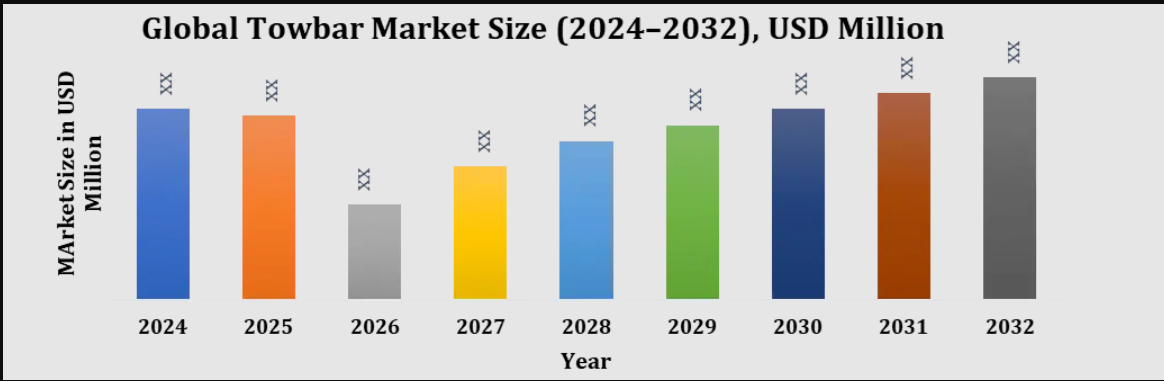
According to latest industry intelligence evaluations, the Global Towbar Market was valued at USD 8.95 billion in 2024 and is projected to expand steadily to USD 12.44 billion by 2032, demonstrating a robust Compound Annual Growth Rate (CAGR) of 4.2% over the forecast period. This comprehensive market overview explores the structural drivers, technological innovations, segmentation dynamics, and strategic business decisions shaping the global towbar industry.
𝐃𝐨𝐰𝐧𝐥𝐨𝐚𝐝 𝐅𝐫𝐞𝐞 𝐏𝐃𝐅 𝐁𝐫𝐨𝐜𝐡𝐮𝐫𝐞 @https://www.maximizemarketresearch.com/request-sample/286146/
Market Overview
The global Towbar Market is experiencing steady growth, driven by increasing vehicle ownership, expanding recreational and outdoor activities, and rising demand for towing solutions across passenger and commercial vehicles. Towbars are essential towing components that enable vehicles to safely pull trailers, caravans, boats, bicycles, and other equipment. They are widely used in passenger cars, sport utility vehicles (SUVs), light commercial vehicles (LCVs), and heavy commercial vehicles (HCVs) for both personal and commercial applications. Growing consumer interest in camping, road trips, recreational vehicle (RV) travel, and adventure tourism, combined with increasing logistics and transportation activities, is significantly boosting the demand for reliable and high-performance towbar systems worldwide.
The market is further supported by continuous advancements in automotive engineering and towing technology. Manufacturers are developing lightweight, corrosion-resistant, and high-strength towbars using advanced materials such as high-tensile steel and aluminum alloys to improve durability, towing capacity, and fuel efficiency. The growing adoption of detachable, retractable, and electrically deployable towbars is enhancing user convenience while preserving vehicle aesthetics when towing equipment is not in use. In addition, the integration of smart towing technologies, including trailer stability control, electronic towing assistance, and vehicle-specific wiring systems, is improving operational safety and driving performance, making modern towbar systems more attractive to consumers and fleet operators.
Core Market Drivers Propelling Industry Expansion
1. Surging Demand for SUVs, Crossovers, and Light Trucks
The global dominance of Sport Utility Vehicles (SUVs), pickups, and light commercial vehicles (LCVs) acts as a primary catalyst for the towbar market. Because these vehicle classes serve as the default platform for towing and heavy-duty tasks, high original equipment manufacturer (OEM) fitment rates and aftermarket retrofits continue to surge. In key regions like North America and Europe, factory-fitted towbar attachment options are increasingly standard on utility fleets.
2. The Rise of Recreational Tourism and Outdoor Lifestyles
Post-pandemic shifts in consumer behavior have triggered a lasting boom in outdoor tourism, road trips, and caravan ownership. The leisure sector requires robust, reliable, and user-friendly towing mechanisms capable of safely transporting heavy loads across diverse terrains. This sustained consumer demand provides a resilient revenue cushion for aftermarket towbar suppliers and specialty retailers.
3. Integration of Smart Mobility and ADAS Technologies
Modern towbars are no longer isolated mechanical attachments. Top-tier engineering firms are developing smart towbars equipped with integrated trailer stability control, electronic sway mitigation, sensor-based load monitoring, and automated electrical pin connection detection. Furthermore, motorized retractable towbars that disappear beneath the rear bumper at the push of a button cater to consumers demanding uncompromised vehicle aesthetics when towing equipment is not in use.
Segment Insights
The global Towbar Market is segmented based on product type, vehicle type, towing capacity, sales channel, application, and region, reflecting the diverse requirements of passenger, commercial, and recreational vehicle users.
By Product Type, the market comprises fixed towbars, detachable towbars, retractable (swan-neck) towbars, and electrically deployable towbars. Fixed towbars continue to hold a significant market share due to their durability, cost-effectiveness, and suitability for frequent towing applications. However, detachable and retractable towbars are witnessing faster growth as consumers increasingly prefer solutions that maintain vehicle aesthetics while offering greater convenience. Electrically deployable towbars are gaining traction in premium vehicles due to their advanced functionality and ease of operation.
Key Highlights – Towbar Market
- The global Towbar Market is witnessing steady growth, driven by increasing vehicle ownership, expanding recreational activities, and rising demand for towing solutions across passenger and commercial vehicles.
- Growing popularity of camping, caravanning, boating, cycling, and adventure tourism is significantly increasing demand for vehicle towing equipment worldwide.
- Rising sales of SUVs, pickup trucks, light commercial vehicles (LCVs), and recreational vehicles (RVs) are creating substantial opportunities for towbar manufacturers.
- Technological advancements in detachable, retractable, and electrically deployable towbar systems are improving convenience, vehicle aesthetics, and user experience.
- Manufacturers are increasingly adopting high-strength steel, aluminum alloys, and corrosion-resistant materials to enhance durability, towing capacity, and fuel efficiency.
Detailed Market Segmentation Analysis
To capture clear market vision and identify high-yield investment corridors, stakeholders must analyze the structural architecture of the global towbar market:
By Product Type
-
Detachable Towbars: Capturing dominant market preference, detachable systems offer maximum versatility. They allow users to remove the ball neck entirely when not in use, preserving clean vehicle aesthetics and preventing parking sensor interference.
-
Fixed Towbars: Permanently bolted systems preferred for heavy-duty commercial applications, fleet vehicles, and budget-conscious consumers seeking maximum structural rigidity and zero-maintenance reliability.
-
Retractable / Swiveling Towbars: Representing the premium, fastest-growing segment. Driven by luxury vehicle owners, these systems utilize electro-mechanical or hydraulic actuation to fold out of sight smoothly.
By Material Composition
-
Advanced Steel Alloys: Remains the foundational material due to superior tensile strength, durability, and cost-effectiveness, supported by advanced anti-corrosion powder coatings.
-
Aluminum and Lightweight Composites: Rapidly gaining traction, especially within the electric vehicle segment, where every kilogram saved translates directly into extended battery driving range.
By Sales Channel
-
OEM (Original Equipment Manufacturer): Factory-integrated installations that guarantee precise vehicle compatibility, electronic integration, and regulatory compliance.
-
Aftermarket: A robust and lucrative segment driven by individual vehicle retrofits, specialized service shops, and e-commerce platforms catering to DIY automotive enthusiasts.
Regional Landscape and Geopolitical Growth Hotspots
Europe: The Established Regulatory and Innovation Hub
Europe commands a significant share of the global towbar market (accounting for roughly 35% of total value). The region's culture of caravan tourism, combined with rigorous safety standards established by European regulatory frameworks (such as UNECE R55), makes it a fertile ground for high-end detachable and retractable towbar systems. European car buyers frequently specify factory towing packages upon purchasing new passenger vehicles.
North America: Pickups, Heavy Hauling, and Robust Utility
North America represents a massive, highly mature market dominated by full-size pickup trucks and large SUVs. Towing is an integral part of commercial trade and recreational lifestyle across the United States and Canada. High payload capacities and Class III/IV receiver hitch configurations drive steady, predictable demand across both OEM and aftermarket supply chains.
Asia-Pacific: The Fastest-Growing Frontier
The Asia-Pacific region is poised to record the fastest growth trajectory through 2032. Rapid economic development, surging disposable incomes, expanding middle-class vehicle ownership across China and India, and rising interest in outdoor leisure travel are supercharging regional demand. Additionally, Asia-Pacific's emergence as a global EV manufacturing hub creates vast opportunities for lightweight, aerodynamic towbar innovations.
Competitive Landscape
The global Towbar Market is highly competitive, with a mix of established automotive component manufacturers, trailer equipment specialists, and regional suppliers competing through product innovation, quality, and extensive distribution networks. Companies are increasingly focusing on developing lightweight, high-strength, and corrosion-resistant towbars using advanced materials such as high-grade steel and aluminum alloys to improve towing performance, fuel efficiency, and vehicle compatibility. Manufacturers are also investing in detachable, retractable, and electrically deployable towbar systems that enhance convenience, vehicle aesthetics, and safety. Continuous research and development, coupled with compliance with stringent automotive safety and regulatory standards, remains a key strategy for maintaining a competitive edge in the market.
Leading companies operating in the towbar market include Brink Group B.V., Westfalia Automotive GmbH, Bosal Group, CURT Manufacturing LLC, Horizon Global Corporation, B&W Trailer Hitches, AL-KO Vehicle Technology Group, GDW Group, Oris Automotive Systems GmbH, Tow-Trust Towbars Ltd., PCT Automotive Ltd., Hayman Reese, TAG Towbars, Reese Products, and Steinhof Sp. z o.o.
For full access to the comprehensive strategic report, visit:https://www.maximizemarketresearch.com/market-report/towbar-market/286146/
Strategic Business Decisions and Executive Recommendations
For towbar manufacturers, automotive suppliers, and industrial investors navigating the USD 12.44 billion market by 2032, executing precise operational decisions is vital:
-
Prioritize Lightweighting for Electric Vehicles: Investing in aluminum-alloy and composite-reinforced towbar designs mitigates the range-reduction penalty associated with EV towing, securing vital competitive advantage.
-
Embrace Mechatronic and Smart Integration: Developing plug-and-play wiring harnesses with built-in diagnostic sensors and ADAS camera calibration compatibility meets the software-driven demands of modern vehicle architectures.
-
Strengthen Omnichannel and B2B Distribution: Expanding digital e-commerce channels for aftermarket consumers while deepening direct partnerships with automotive OEMs ensures balanced, multi-stream revenue generation.
Conclusion
The global towbar market proves that even traditional mechanical hardware components can reinvent themselves through technological ingenuity and changing consumer lifestyles. Supported by a healthy 4.2% CAGR projection through 2032, the industry offers lucrative avenues for forward-thinking enterprises that prioritize lightweight metallurgy, smart connectivity, and rigorous safety compliance.
About Maximize Market Research
Maximize Market Research is a multifaceted market research and consulting company with professionals from several industries. Some of the industries we cover include medical devices, pharmaceutical manufacturers, science and engineering, electronic components, industrial equipment, technology and communication, cars and automobiles, chemical products and substances, general merchandise, beverages, personal care, and automated systems. To mention a few, we provide market-verified industry estimations, technical trend analysis, crucial market research, strategic advice, competition analysis, production and demand analysis, and client impact studies.
Contact Maximize Market Research
3rd Floor, Navale IT Park, Phase 2
Pune Bangalore Highway, Narhe,
Pune, Maharashtra 411041, India
sales@maximizemarketresearch.com
+91 96071 95908, +91 9607365656

 English
 Arabic
 French
 Spanish
 Portuguese
 Deutsch
 Turkish
 Dutch
Dutch
 Italiano
 Russian
 Romaian
 Portuguese (Brazil)
