
Global Managed Application Service Market Growth, Emerging Technologies, Competitive Analysis, Strategic Insights, and Forecast Through 2033
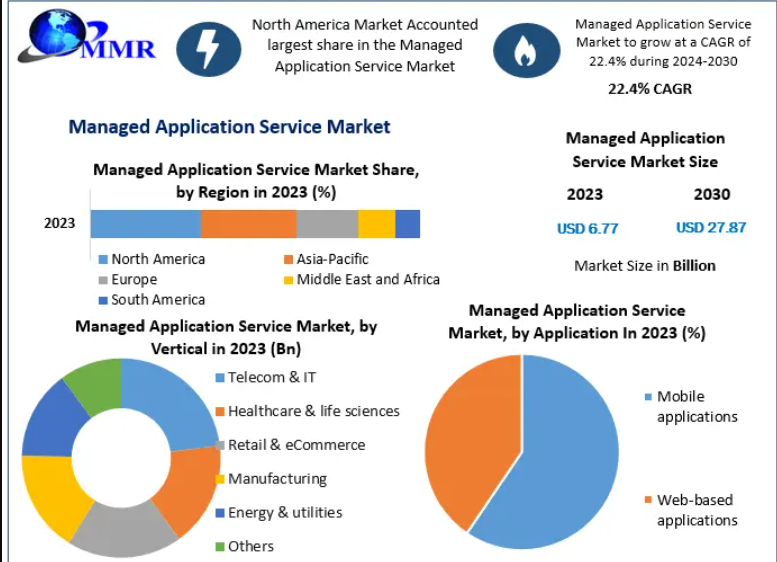
Global Managed Application Service Market Set for Explosive Growth, Projected to Surge Past USD 140 Billion
The global Managed Application Service Market is experiencing a monumental wave of digital transformation, fueled by the rising complexity of enterprise software ecosystems, widespread migration to cloud-native architectures, and an acute shortage of specialized internal IT personnel. According to comprehensive industry evaluations, the global market is poised to grow at a remarkable compound annual growth rate (CAGR) of over 12%, scaling from its baseline valuation toward an anticipated multi-billion-dollar milestone exceeding USD 140 billion in the coming years.
For Chief Information Officers (CIOs), Chief Technology Officers (CTOs), IT directors, and enterprise procurement executives, understanding the strategic trajectory of managed application services is no longer optional—it is a core business necessity. As modern businesses rely heavily on continuous software delivery, seamless user experiences, and airtight cybersecurity protocols, outsourcing application maintenance, monitoring, and optimization enables organizations to reallocate internal capital toward strategic innovation.
𝐃𝐨𝐰𝐧𝐥𝐨𝐚𝐝 𝐅𝐫𝐞𝐞 𝐏𝐃𝐅 𝐁𝐫𝐨𝐜𝐡𝐮𝐫𝐞 @https://www.maximizemarketresearch.com/request-sample/108451/
Defining Managed Application Services: The Engine of Digital Agility
Managed application services encompass a comprehensive suite of outsourced IT functions designed to manage, monitor, troubleshoot, update, and optimize enterprise applications throughout their complete lifecycle. Unlike traditional break-fix IT support models, managed service providers (MSPs) deliver proactive, round-the-clock administration covering custom software, legacy systems, commercial-off-the-shelf (COTS) applications, and modern containerized microservices hosted across hybrid and multi-cloud environments.
These specialized services typically incorporate several core operational pillars:
-
Application Performance Monitoring (APM): Real-time tracking of latency, error rates, and throughput to ensure optimal user experience.
-
DevOps and Continuous Integration/Continuous Deployment (CI/CD): Streamlining software release pipelines for faster, bug-free feature rollouts.
-
Security Patching and Vulnerability Management: Protecting applications against emerging cyber threats and ensuring compliance with data privacy regulations.
-
Database Administration and Optimization: Maintaining data integrity, tuning query speeds, and executing automated backup protocols.
Core Market Growth Drivers and Industry Catalysts
The rapid acceleration of the global managed application service market is propelled by several robust macroeconomic and technical forces:
1. Chronic Shortages of Skilled IT Talent
The global technology landscape faces a widening skills gap, particularly in specialized domains such as cloud architecture, Kubernetes orchestration, artificial intelligence integration, and legacy code refactoring. Hiring, training, and retaining in-house DevOps engineers and security specialists is increasingly costly and difficult for mid-market and enterprise organizations alike. Partnering with managed service providers grants instant access to certified, multidisciplinary expert teams without the overhead of full-time recruitment.
2. Complex Multi-Cloud and Hybrid Architecture Adoption
As enterprises migrate core workloads away from rigid on-premise data centers, they frequently adopt complex hybrid-cloud and multi-cloud environments spanning AWS, Microsoft Azure, and Google Cloud Platform. Managing disparate cloud environments requires sophisticated cross-platform expertise. Managed application service providers simplify this complexity, ensuring seamless interoperability, optimal cloud resource provisioning, and cost governance.
3. Imperative for High Availability and Zero-Downtime Operations
In the digital-first economy, application downtime translates directly to lost revenue, diminished customer trust, and brand erosion. Enterprises demand continuous, 24/7/365 operational availability. MSPs deploy advanced automated monitoring tools and follow-the-sun support models to identify and resolve performance bottlenecks before they impact end users.
𝐃𝐨𝐰𝐧𝐥𝐨𝐚𝐝 𝐅𝐫𝐞𝐞 𝐏𝐃𝐅 𝐁𝐫𝐨𝐜𝐡𝐮𝐫𝐞 @https://www.maximizemarketresearch.com/request-sample/108451/
Comprehensive Market Segmentation Analysis
To formulate a winning corporate strategy and capture high-margin opportunities, industry stakeholders must analyze the market through distinct segmentation lenses:
By Service Type: Managed Hosting vs. Application Maintenance and Support
-
Application Maintenance and Support: Accounting for the largest revenue share, this segment covers routine bug fixing, performance tuning, code refactoring, and user support. It ensures legacy systems remain stable while transitioning smoothly into modern workflows.
-
Managed Hosting and Infrastructure Administration: Encompasses cloud environment management, server provisioning, container orchestration, and disaster recovery planning.
By Deployment Model: Cloud-Based vs. On-Premises
-
Cloud-Based Managed Services: Representing the fastest-growing segment, cloud-native managed services dominate due to the scalability, flexibility, and cost-efficiency of public and hybrid cloud environments.
-
On-Premises Managed Services: Maintained primarily by highly regulated sectors (such as defense, government, and core banking) that require strict local data residency controls and physical hardware isolation.
By Enterprise Size: Small & Medium Enterprises (SMEs) vs. Large Enterprises
-
SMEs: Increasingly adopting managed application services to bridge internal resource gaps, allowing smaller companies to leverage enterprise-grade IT infrastructure and security without heavy capital investments.
-
Large Enterprises: Utilizing MSPs to optimize massive global portfolios, accelerate digital transformation initiatives, and manage multi-vendor software ecosystems.
Competitive Landscape
The Managed Application Service Market is highly competitive, with global IT service providers, cloud technology companies, and digital transformation specialists competing to deliver end-to-end application management, modernization, monitoring, and optimization services. Organizations across industries are increasingly outsourcing application management to improve operational efficiency, reduce IT complexity, and accelerate digital transformation initiatives. Market participants are focusing on integrating artificial intelligence (AI), machine learning (ML), automation, DevOps, and cloud-native technologies into managed application services to enhance application performance, security, scalability, and business continuity. Continuous innovation, flexible service models, and industry-specific expertise remain key competitive differentiators.
Leading companies are strengthening their market positions through strategic acquisitions, partnerships with hyperscale cloud providers, expansion of managed service portfolios, and investments in intelligent automation platforms. Vendors are offering comprehensive services that include application development, migration, maintenance, testing, security, performance monitoring, and lifecycle management across hybrid and multi-cloud environments. The growing adoption of Software-as-a-Service (SaaS), microservices architecture, containerization, and predictive analytics is encouraging service providers to develop customized, outcome-based managed application solutions. As enterprises continue to modernize legacy systems and embrace cloud-first strategies, competition is expected to intensify through innovation, customer-centric service delivery, and global delivery capabilities.
Managed Application Service Market Key Players
1. IBM
2. Microsoft
3. SAS
4. BMC Software
5. CenturyLink
6. Fujitsu
7. HCL
8. MS Management & Technology
9. Unisys
10. Virtustream
11. Wipro
12. YASH Technologies
13. Mindtree
14. Navisite
15. NTT DATA
16. Atos
17. Capgemini
18. Cognizant
19. CompuCom
20. DXC Technology
21. ServiceNow
22. Broadcom
23. Cherwell
24. Atlassian
25. Equinix
26. Comcast
27. Verizon
28. Sprint
For full access to the comprehensive strategic report, visit:https://www.maximizemarketresearch.com/market-report/global-managed-application-service-market/108451/
Regional Landscape: North America Leads, Asia-Pacific Accelerates
Geographically, the global managed application service market exhibits dynamic regional characteristics tied to regional IT maturity:
-
North America: North America commands a dominant share of the global market. Supported by an advanced technology sector, high cloud adoption rates, and a proliferation of leading MSPs and tech giants across the United States and Canada, the region remains a high-value hub for digital service innovation.
-
Europe: Driven by stringent data privacy laws (such as GDPR), a strong emphasis on cybersecurity compliance, and rapid digital adoption across manufacturing and financial services, Europe maintains steady, stable growth.
-
Asia-Pacific (APAC): Projected to register the highest growth rate during the forecast period. Rapid digitization in countries like India, China, Japan, and Singapore, coupled with a massive surge in tech startups and e-commerce platforms, fuels immense demand for external IT management.
Operational Challenges and Risk Mitigation
Despite stellar market prospects, enterprise buyers and service providers must navigate specific operational hurdles:
-
Data Security and Privacy Concerns: Outsourcing application management involves granting third-party providers access to sensitive corporate databases and customer records, necessitating rigorous compliance audits and secure access controls.
-
Service Level Agreement (SLA) Alignment: Miscommunication regarding performance metrics, resolution timeframes, and scope boundaries can lead to friction between enterprises and their chosen MSPs.
Strategic Recommendations for Decision-Makers
To maximize efficiency and secure competitive advantage, business leaders and IT executives should execute targeted strategic initiatives:
-
Adopt a Co-Managed IT Model: Rather than full outsourcing, many organizations benefit from a co-managed model where internal teams collaborate closely with external MSP specialists, retaining strategic control while offloading routine maintenance and monitoring.
-
Prioritize Automation and AIOps: Enterprises should partner with MSPs that leverage Artificial Intelligence for IT Operations (AIOps) and automated self-healing scripts to predict anomalies and resolve issues proactively.
-
Establish Rigorous Governance Frameworks: Define crystal-clear KPIs, security standards, and communication protocols within SLAs to ensure absolute alignment and accountability across the vendor lifecycle.
About Maximize Market Research
Maximize Market Research is a multifaceted market research and consulting company with professionals from several industries. Some of the industries we cover include medical devices, pharmaceutical manufacturers, science and engineering, electronic components, industrial equipment, technology and communication, cars and automobiles, chemical products and substances, general merchandise, beverages, personal care, and automated systems. To mention a few, we provide market-verified industry estimations, technical trend analysis, crucial market research, strategic advice, competition analysis, production and demand analysis, and client impact studies.
Contact Maximize Market Research
3rd Floor, Navale IT Park, Phase 2
Pune Bangalore Highway, Narhe,
Pune, Maharashtra 411041, India
sales@maximizemarketresearch.com
+91 96071 95908, +91 9607365656

 English
 French
 Spanish
 Portuguese
 Deutsch
 Turkish
 Dutch
Dutch
 Italiano
 Russian
 Romaian
 Portuguese (Brazil)
 Greek
Greek
