
Beyond Rankings: How Cognitive Resonance SEO (CRSEO) is Redefining Search Intelligence
For over two decades, the digital marketing playbook was straightforward: perform keyword research, optimize meta tags, build backlinks, and claim the top positions on search engine results pages. Higher rankings guaranteed visibility, visibility generated clicks, and clicks produced revenue.
However, in today's generative AI era, that traditional playbook is rapidly losing its edge.
Ranking #1 no longer guarantees user trust or conversions. AI search engines directly answer queries on the results page, changing user behavior entirely. Users don't search with purely mechanical logic; they search with human emotion—seeking safety, clarity, and reassurance. Meanwhile, modern search engines process queries through complex reasoning models.
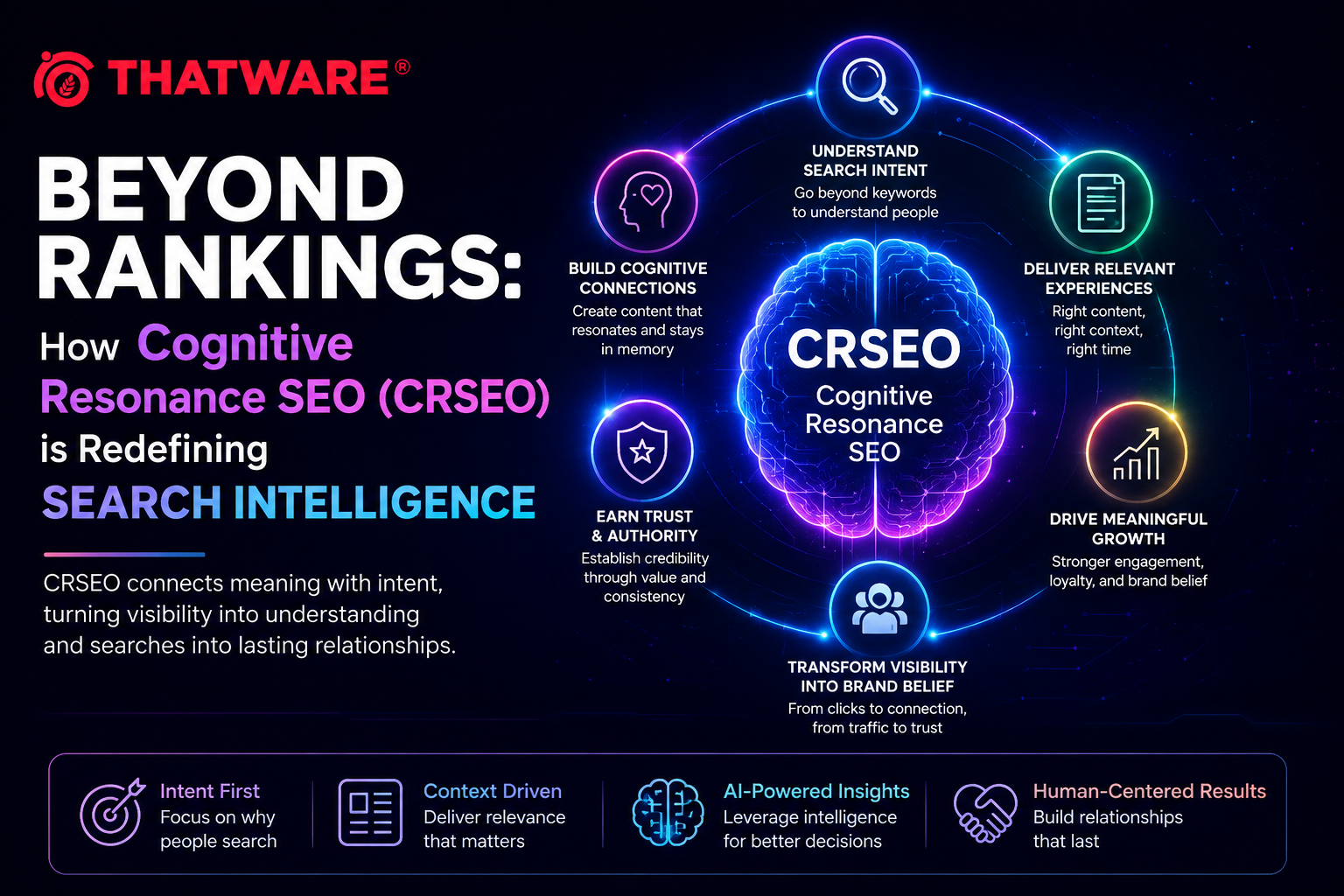
To bridge the gap between human emotional intent and artificial intelligence, Thatware LLP pioneered Cognitive Resonance SEO (CRSEO). By blending Cognitive SEO, AI Cognitive Search, and Advanced Semantic SEO, CRSEO shifts the goal of digital strategy from merely acquiring clicks to establishing deep, undeniable belief.
What is Cognitive Resonance SEO (CRSEO)?
Cognitive Resonance SEO (CRSEO) is a next-generation Search Intelligence framework engineered specifically for the AI-driven discovery landscape. Developed by modern search pioneers at Thatware LLP, CRSEO moves beyond surface-level keyword optimization to harmonize three critical layers:
- Human Emotional Intent: Addressing the unspoken fears, doubts, and expectations driving every search query.
- AI Logical Reasoning: Structuring information so LLMs and search engines easily interpret context and credibility.
- Brand Psychological Persuasion: Embedding authority signals and social proof that reduce hesitation and inspire decision-making confidence.
When these three layers operate in total harmony, content achieves cognitive resonance. Instead of triggering user skepticism or getting overlooked by generative algorithms, your brand becomes the most believable, natural answer across both human minds and AI Cognitive Search engines.
Why Traditional Tactics Fail in the Era of AI Cognitive Search
In the legacy era of search engine optimization, tools focused primarily on keyword density, exact-match phrases, and link volume. While those signals still carry baseline value, they fail to address how modern search engine algorithms evaluate authority.
Modern search engines leverage Search Intelligence systems that synthesize information from thousands of sources before generating a single answer. When your content relies solely on traditional strategies, several issues arise:
- High Bounce Rates: Users land on pages optimized for keywords rather than user intent, leaving immediately when their underlying psychological needs aren't met.
- Low Conversions: Visibility brings visitors, but without emotional alignment, visitors hesitate to take action.
- AI Engine Omission: Search algorithms look for structured relationships and factual clarity. Content lacking Advanced Semantic SEO architecture gets ignored by conversational search engines.
To thrive today, brands must adopt a strategy rooted in Cognitive SEO—one that understands how humans process information and how AI models evaluate truth.
The Three Pillars of CRSEO Architecture
At Thatware LLP, implementing CRSEO requires synchronizing three distinct operational layers.
1. Human Emotional Intent Vectors
Every search query originates from an emotional state. Whether a user is searching for business software or legal guidance, they carry hidden hesitations. CRSEO identifies these emotional intent vectors and structures content to soothe fears and provide immediate clarity.
2. AI Logical Reasoning Alignment
Generative search systems process content through reasoning paths. Utilizing Advanced Semantic SEO, CRSEO structures data, entities, and contextual relationships so AI Cognitive Search algorithms recognize your content as authoritative and easily cite it in direct answer summaries.
3. Persuasive Answer Sequencing
Information layout matters as much as information quality. CRSEO organizes content in a psychological sequence that reduces friction:
- Acknowledge the core problem and reduce risk perception.
- Provide logical, easy-to-understand solutions.
- Deliver proof points and authority signals.
- Offer a clear, low-friction call-to-action.
How Thatware LLP Implements CRSEO for Cognitive Dominance
To achieve lasting visibility, Thatware LLP executes a precise, data-driven CRSEO deployment strategy:
-
Identify Emotional Triggers: Map query data beyond volume to pinpoint what users feel and why they hesitate.
-
Build Semantic Entity Graphs: Apply Advanced Semantic SEO to establish clear relationships between your brand, concepts, and industry entities.
- Structure Content for AI Selection: Optimize information formatting so AI Cognitive Search tools identify your pages as trusted primary sources.
- Embed Psychological Trust Anchors: Incorporate case studies, verified statistics, expert authoritativeness, and transparent messaging across every touchpoint.
- Measure Cognitive Dominance: Monitor brand sentiment, AI citation frequency, user recall, and high-intent conversions alongside classic ranking metrics.
Key Advantages of Switching to Cognitive SEO and CRSEO
Adopting CRSEO delivers transformative business benefits that far surpass traditional traffic-building methods:
- Higher Quality Conversions: By addressing psychological friction upfront, incoming visitors feel confident and ready to engage with your offerings.
- Future-Proof Search Visibility: As AI engines replace traditional SERPs, CRSEO ensures your brand remains a preferred citation in answer engines.
- Stronger Brand Recall: Content that resonates emotionally creates lasting impressions, boosting direct traffic and word-of-mouth recommendations.
- Sustainable Authority: Rather than chasing volatile algorithm updates, Cognitive SEO builds foundational trust that stands the test of time.
Conclusion: Transform Your Search Strategy with Thatware LLP
The era of chasing superficial rankings is over. To dominate search today, your brand must cultivate belief, establish emotional connection, and align seamlessly with conversational AI systems.
Through Cognitive Resonance SEO (CRSEO), Thatware LLP helps forward-thinking brands harness the combined power of Cognitive SEO, AI Cognitive Search, and Advanced Semantic SEO to build true search intelligence.
Ready to elevate your online presence from simple visibility to lasting authority? Explore the official Cognitive Resonance SEO (CRSEO) Framework by Thatware LLP and start transforming your traffic into trust today.
Frequently Asked Questions (FAQs)
1. What is the main difference between traditional SEO and CRSEO?
Traditional SEO focuses on keywords, backlink counts, and ranking positions. CRSEO (Cognitive Resonance SEO) focuses on psychological alignment, combining human emotional intent, AI Cognitive Search logical reasoning, and brand trust signals to build user belief and drive conversions.
2. How does Advanced Semantic SEO support CRSEO?
Advanced Semantic SEO helps organize concepts, entities, and relationships within your content. This allows search engines and LLMs to understand the context of your content, making it far more likely to be cited in direct AI answers.
3. Why is Cognitive SEO crucial for AI-driven search engines?
AI search tools evaluate content based on logical structure, factual depth, and user intent satisfaction. Cognitive SEO ensures your content aligns with how both human minds process decisions and how AI algorithms process logic.
4. Who developed the CRSEO framework?
The CRSEO framework was pioneered by Thatware LLP, led by search innovation leader Tuhin Banik, as part of their advanced Search Intelligence solutions.
5. Can small or mid-sized businesses benefit from CRSEO?
Yes. CRSEO allows businesses of any size to compete against larger competitors by focusing on trust, psychological intent, and authoritative AI alignment rather than relying solely on massive backlink budgets.

 English
 Arabic
 French
 Spanish
 Portuguese
 Deutsch
 Dutch
Dutch
 Italiano
 Russian
 Romaian
 Portuguese (Brazil)
 Greek
Greek
