
Baby Care Purchases Shift Toward Higher-Quality and Specialized Products
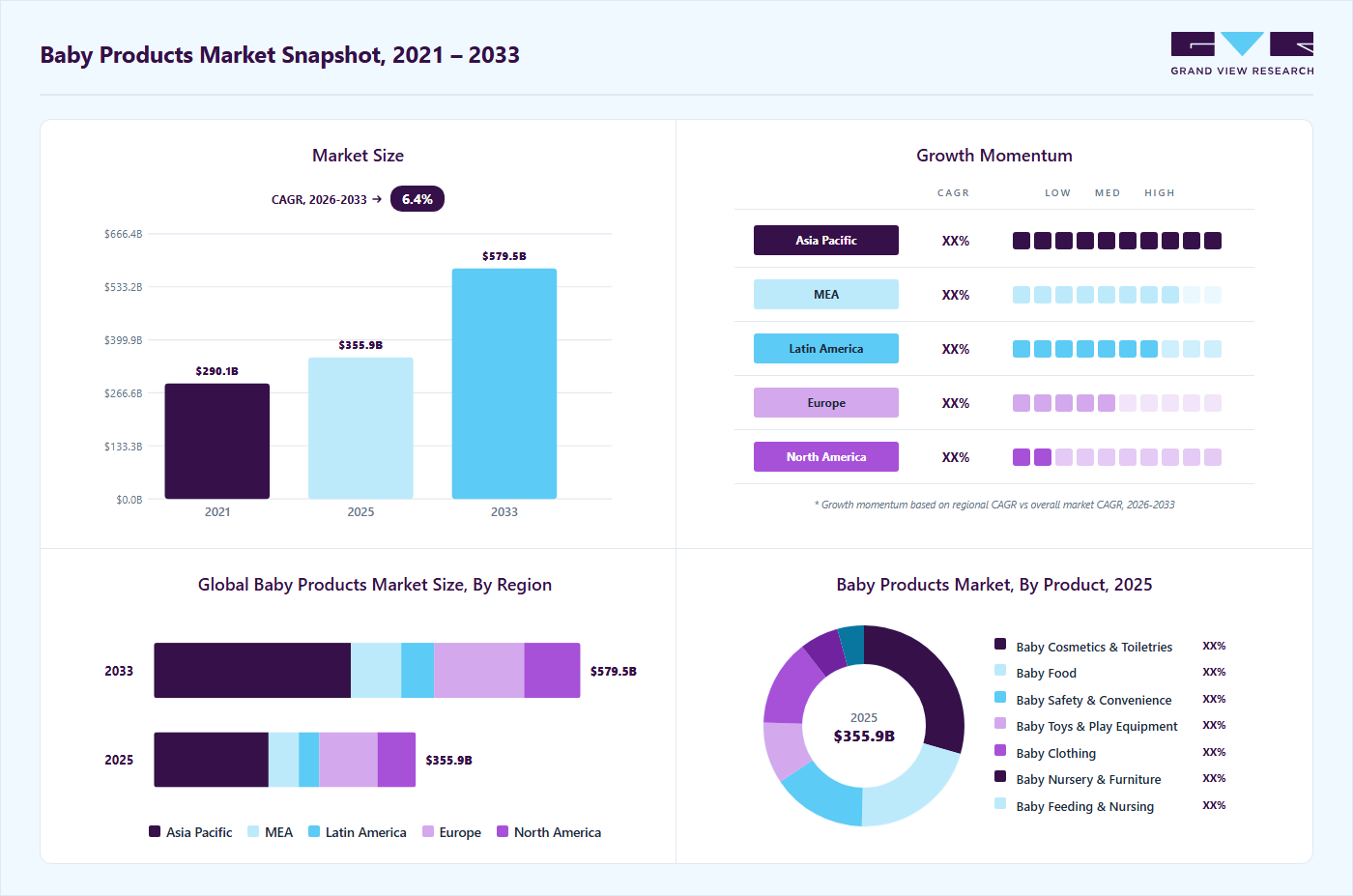
The baby products market is witnessing steady growth as parents and caregivers increasingly prioritize product quality, safety, convenience, and functionality when selecting products for infants and young children. The global baby products market size was valued at USD 355.9 billion in 2025 and is projected to grow from USD 375.8 billion in 2026 to USD 579.5 billion by 2033, at a CAGR of 6.4% from 2026 to 2033. The market in Asia Pacific dominated with a revenue share of 43.7% in 2025. One of the primary factors driving market expansion is the shift in consumer preferences toward high-quality, utility-driven, and premium baby products. Increasing awareness regarding infant care, hygiene, nutrition, and personal well-being is encouraging consumers to seek specialized products that offer greater functionality and convenience.
Another significant factor contributing to market growth is the increasing availability of baby care products across diverse retail channels. Parents are increasingly purchasing baby cosmetics, toiletries, feeding products, clothing, and other essentials through organized retail outlets that offer a broad selection of products and established brands. The growing preference for trusted and quality-focused baby care products is also encouraging manufacturers to strengthen product portfolios and introduce solutions designed around evolving consumer needs. As parents continue to prioritize convenience, product performance, and quality in everyday childcare, demand for baby products is expected to increase steadily throughout the forecast period.
Key Market Trends & Insights
• Regional analysis indicates that Asia Pacific dominated the market, accounting for the largest revenue share of 43.7% in 2025. The region's leadership is supported by a large consumer base, increasing demand for organized baby care products, growing awareness of infant hygiene, and expanding retail availability. By country, China held the largest market share in 2025, further strengthening the region's leading position in the baby products industry.
• Based on product, the baby cosmetics & toiletries segment held the largest market share of 29.5% in 2025. Growing awareness of infant hygiene and personal care is supporting demand for products designed specifically for babies, including cosmetics and toiletries that cater to routine care requirements.
• Based on type, the mass segment held the largest market share of 74.6% in 2025. The segment benefits from broad consumer accessibility and widespread availability across retail channels, making mass-market baby products an important part of everyday infant and childcare consumption.
• Based on distribution channel, the hypermarkets and supermarkets segment held the largest market share of 34.8% in 2025. These channels offer consumers access to a wide assortment of baby care products in a single location, supporting convenience, product comparison, and regular household purchases.
Key Companies & Market Share Insights
The baby products market is supported by a broad range of manufacturers and retailers offering products designed to address changing consumer expectations around quality, utility, safety, and convenience. Market participants are increasingly focusing on product portfolio expansion, premium product development, packaging improvements, and broader retail availability to strengthen their market positions. The growing shift toward high-quality and utility-driven products is encouraging companies to develop specialized solutions that cater to the evolving requirements of parents and caregivers.
Key Baby Products Companies:
· Johnson & Johnson
· Procter & Gamble (Pampers)
· Kimberly‑Clark (Huggies)
· Nestlé (Gerber)
· Unilever
· Abbott Laboratories
· Danone
· Munchkin
· Graco
· BabyBjörn
Grand View Research offers
· Focused market intelligence reports on specific geographies or high-growth segments.
· Extended forecast timelines for long-term planning.
· Competitor Benchmarking and Supply Chain Analysis
· Inclusion of regulatory and policy assessments.
· Inclusion of custom data models, KPIs, or applications unique to your business
· Specific high-impact Data Decks and Tables to support effective decision making
· And much more…

 English
 French
 Spanish
 Portuguese
 Deutsch
 Turkish
 Dutch
Dutch
 Italiano
 Russian
 Romaian
 Portuguese (Brazil)
 Greek
Greek
