
Active Network Management Market Analysis by Component, Deployment Mode, Application, and Global Forecast to 2033
Global Active Network Management Market Analysis: Transforming Enterprise Infrastructure, Automation Innovations, and Strategic Growth Prospects
Introduction to the Global Active Network Management Market
As digital transformation accelerates across global enterprises, telecommunications operators, and government institutions, organizational IT architectures are growing increasingly complex. The exponential expansion of cloud computing, Internet of Things (IoT) deployment, edge data centers, and remote workforces has rendered traditional, manual network administration obsolete. In this environment, the Global Active Network Management Market has emerged as an indispensable cornerstone of modern enterprise IT strategy.
Active network management encompasses sophisticated software platforms, automated monitoring tools, and intelligent control systems that dynamically configure, provision, secure, and optimize network infrastructure in real time. Unlike passive or reactive monitoring tools that merely flag anomalies after system failures occur, active network management solutions leverage artificial intelligence (AI) and machine learning (ML) to predict bottlenecks, automatically reroute traffic, and self-heal network vulnerabilities. Backed by surging demand for uninterrupted connectivity, zero-trust cybersecurity frameworks, and operational cost reduction, the global market is scaling robust growth trajectories. This comprehensive market overview provides enterprise executives, network architects, IT investors, and strategic decision-makers with a clear market vision, granular segmentation analysis, and an actionable decision-making framework.
𝐃𝐨𝐰𝐧𝐥𝐨𝐚𝐝 𝐅𝐫𝐞𝐞 𝐏𝐃𝐅 𝐁𝐫𝐨𝐜𝐡𝐮𝐫𝐞 @https://www.maximizemarketresearch.com/request-sample/28746/
Macroeconomic Drivers and Industry Catalysts
The steady commercial expansion of the active network management sector is propelled by a convergence of digital infrastructure demands, operational imperatives, and technological breakthroughs.
1. Explosion of Data Traffic and Cloud Migration
Modern enterprises rely heavily on multi-cloud environments, software-as-a-service (SaaS) applications, and real-time data analytics. This massive surge in data consumption creates unprecedented bandwidth demands and traffic congestion across enterprise wide-area networks (WANs) and local-area networks (LANs). Active network management systems dynamically optimize traffic flow, prioritize mission-critical workloads, and ensure consistent application performance without requiring constant manual intervention from IT teams.
2. Rise of Advanced Cyber Threats and Zero-Trust Mandates
Network perimeters have dissolved with the proliferation of remote workers, BYOD (Bring Your Own Device) policies, and decentralized cloud endpoints. Cybersecurity breaches, distributed denial-of-service (DDoS) attacks, and sophisticated malware pose constant threats to corporate data integrity. Active network management platforms integrate real-time threat intelligence and automated behavioral analytics to instantly isolate compromised nodes, enforce micro-segmentation, and neutralize security vulnerabilities before they escalate into enterprise-wide disasters.
3. Operational Cost Reduction Through Intelligent Automation
Manual network provisioning, troubleshooting, and configuration updates are labor-intensive, time-consuming, and prone to human error. Enterprises face mounting pressure to reduce operational expenditure (OpEx) while scaling their digital operations. Intelligent network automation minimizes human touchpoints, accelerates deployment cycles, slashes mean-time-to-repair (MTTR), and optimizes workforce allocation, enabling IT professionals to focus on high-value strategic initiatives.
Comprehensive Market Segmentation Analysis
To build a precise commercial vision and target high-yield operational deployments, the global active network management market is systematically analyzed across multiple key segments:
By Component
-
Solutions (Software Platforms): Encompassing automated provisioning software, traffic management engines, performance monitoring suites, and security orchestration tools. Software solutions command the largest market share as organizations prioritize intelligent dashboards and automated control layers.
-
Services: Divided into professional services (consulting, system integration, deployment) and managed services. As internal IT skills shortages persist, managed active network management services are experiencing rapid adoption among small and medium-sized enterprises (SMEs).
By Deployment Mode
-
Cloud-Based (SaaS): Representing the fastest-growing deployment model. Cloud-delivered active network management offers unmatched scalability, remote accessibility, rapid deployment, and predictable subscription-based pricing models.
-
On-Premises: Preferred heavily by large financial institutions, defense agencies, and government bodies operating under strict regulatory frameworks that mandate absolute control over sensitive enterprise data and physical infrastructure.
By Enterprise Size
-
Large Enterprises: Traditionally the dominant revenue contributor, large multinational corporations deploy comprehensive, enterprise-grade network management suites to oversee complex, globally distributed branch offices and data centers.
-
Small and Medium-Sized Enterprises (SMEs): An emerging high-growth segment driven by the affordability of cloud-based network automation tools, enabling smaller organizations to achieve enterprise-level network resilience.
By End-User Vertical
-
IT and Telecommunications: Telecommunications service providers utilize active network management to optimize 5G core networks, manage massive data traffic loads, and guarantee service-level agreements (SLAs).
-
BFSI (Banking, Financial Services, and Insurance): Prioritizes ultra-low latency, impenetrable cybersecurity compliance, and 24/7 uptime for critical financial transaction processing.
-
Healthcare, Retail, and Manufacturing: Healthcare organizations rely on secure IoT device tracking; retailers manage seamless point-of-sale connectivity; and manufacturers optimize industrial IoT (IIoT) plant networks.
Regional Market Dynamics and Geographic Landscape
Geographic analysis reveals distinct technology adoption curves, investment priorities, and regulatory environments across major global regions.
North America: Market Leadership and Technological Innovation
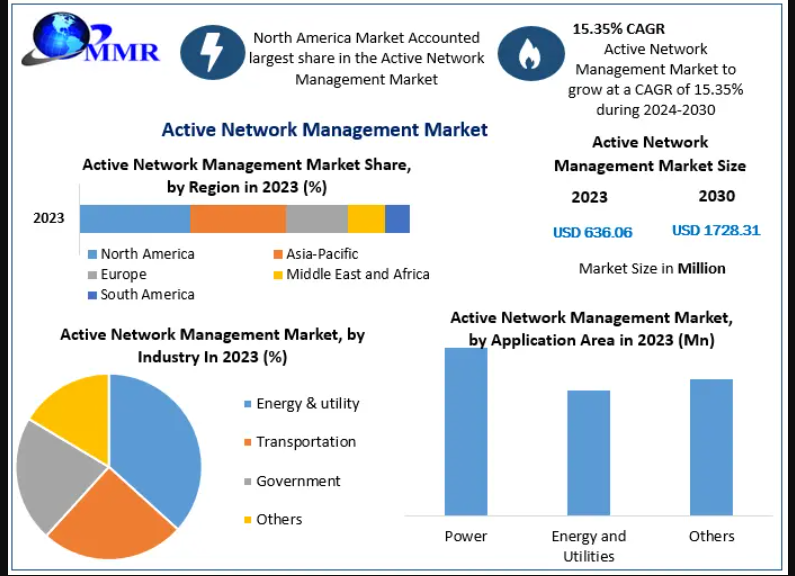
North America commands the largest share of the global active network management market. This regional dominance is underpinned by high concentrations of early technology adopters, advanced cloud computing infrastructure, widespread 5G rollouts, and the dominant market presence of leading enterprise software and networking vendors. Furthermore, rigorous corporate compliance mandates in the United States drive continuous investments in automated network security and resilience.
Asia-Pacific: The Fastest-Growing Regional Frontier
The Asia-Pacific (APAC) region is experiencing the most rapid compound annual growth rate (CAGR). Driven by massive digital transformation initiatives in emerging economic powerhouses such as China, India, Japan, and Southeast Asian nations, APAC is witnessing a surge in enterprise cloud adoption and smart city developments. Expanding mobile broadband penetration and government-backed digitalization programs are fueling massive demand for scalable network management solutions.
Europe, Latin America, and Middle East & Africa (MEA)
Europe maintains a mature and stable market, heavily influenced by strict regional data protection regulations (such as GDPR) that necessitate robust, transparent network monitoring and security protocols. Meanwhile, Latin America and the Middle East & Africa (MEA) represent high-potential emerging markets where telecommunications infrastructure modernization and expanding enterprise digitization are unlocking new commercial opportunities.
Key Challenges Facing the Ecosystem
Despite promising long-term growth forecasts, industry stakeholders must navigate notable operational hurdles:
-
Integration Complexity with Legacy Infrastructure: Many established enterprises still rely on legacy hardware and aging proprietary systems. Seamlessly integrating modern, AI-driven active network management software with legacy architecture requires meticulous planning and specialized technical expertise.
-
Shortage of Skilled IT Professionals: Managing sophisticated, automated network environments demands advanced technical competencies in artificial intelligence, machine learning, and cybersecurity orchestration—skills that remain in short supply within the global labor pool.
Competitive Landscape
The global active network management (ANM) market is highly competitive, with established energy technology providers, grid automation companies, and software developers focusing on intelligent grid management, renewable energy integration, and advanced distribution network optimization.
Competition is driven by continuous innovation in artificial intelligence (AI), machine learning (ML), cloud computing, Internet of Things (IoT), and real-time data analytics. Vendors are developing advanced Active Network Management platforms that enable utilities to optimize power flow, improve grid reliability, integrate distributed energy resources (DERs), and enhance demand response capabilities. The increasing adoption of renewable energy sources, electric vehicles, and smart grid infrastructure is further encouraging companies to invest in scalable and interoperable ANM solutions.
Leading Players in the Global Active Network Management Market are:
1. ABB LTD
2. Oracle Corporation
3. GE
4. IBM Corporation
5. Itron
6. Landis+GYR
7. Indra
8. Camlin
9. Smarter Grid Solutions
10. ZIV
11. Argand Solutions
12. Chemtrols Industries Pvt. Ltd.
13. Cisco Systems, Inc.
14. General Electric Company
15. IBM Corporation
16. Kelvatek Ltd.
17. Schneider Electric
18. Siemens AG
For full access to the comprehensive strategic report, visit:https://www.maximizemarketresearch.com/market-report/global-active-network-management-market/28746/
Strategic Business Decisions and Executive Roadmap
For software vendors, networking equipment manufacturers, IT service providers, and enterprise CIOs, capitalizing on the active network management market requires disciplined, forward-looking strategic decisions:
-
Prioritize AI and ML Integration: Software developers must embed advanced predictive analytics and automated self-healing algorithms into their product roadmaps to differentiate themselves in a competitive marketplace.
-
Embrace Hybrid and Multi-Cloud Architectures: Solutions must offer seamless visibility and unified control across on-premises data centers, private clouds, and public cloud environments (AWS, Azure, Google Cloud).
-
Focus on Robust Cybersecurity and Compliance: Integrating zero-trust network access (ZTNA) principles and automated compliance auditing directly into network management platforms ensures high enterprise adoption.
-
Expand Managed Service Offerings: Software vendors and channel partners should develop robust managed network services to lower adoption barriers for resource-constrained small and medium-sized enterprises.
Conclusion
The global active network management market represents a vital evolution in how organizations orchestrate, secure, and scale their digital infrastructure. By replacing manual administrative burdens with intelligent automation, predictive analytics, and self-healing protocols, active network management empowers enterprises to achieve unprecedented operational resilience and agility. Stakeholders who align their strategic investments with cloud scalability, advanced artificial intelligence, and rigorous security frameworks will secure definitive market leadership in the hyper-connected digital economy.
About Maximize Market Research
Maximize Market Research is a multifaceted market research and consulting company with professionals from several industries. Some of the industries we cover include medical devices, pharmaceutical manufacturers, science and engineering, electronic components, industrial equipment, technology and communication, cars and automobiles, chemical products and substances, general merchandise, beverages, personal care, and automated systems. To mention a few, we provide market-verified industry estimations, technical trend analysis, crucial market research, strategic advice, competition analysis, production and demand analysis, and client impact studies.
Contact Maximize Market Research
3rd Floor, Navale IT Park, Phase 2
Pune Bangalore Highway, Narhe,
Pune, Maharashtra 411041, India
sales@maximizemarketresearch.com
+91 96071 95908, +91 9607365656

 English
 Arabic
 French
 Spanish
 Portuguese
 Turkish
 Dutch
Dutch
 Italiano
 Russian
 Romaian
 Portuguese (Brazil)
 Greek
Greek
