
Smart Display Market Growth, Industry Trends, AI Integration, Smart Home Adoption, Competitive Analysis, and Forecast 2026–2033
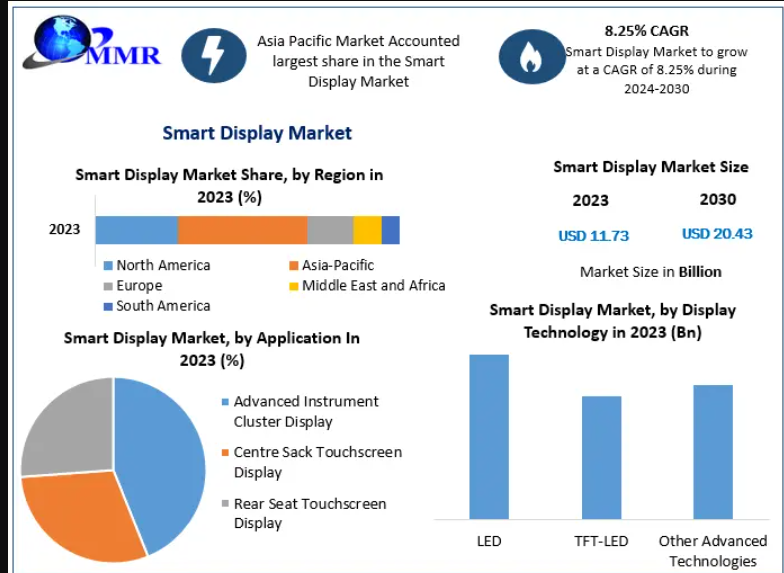
Global Smart Display Market Analysis: Transforming Connected Ecosystems, Edge AI Integration, and Strategic Growth Horizons
Introduction to the Smart Display Market
In an era defined by hyper-connectivity, ambient computing, and seamless digital interaction, the Global Smart Display Market has established itself as a foundational pillar of modern consumer electronics and commercial automation. Smart displays—touch-sensitive screens integrated with voice assistants, speakers, cameras, and internet connectivity—have rapidly evolved from novelty kitchen gadgets into sophisticated command centers for smart homes, corporate offices, healthcare facilities, and retail environments.
By merging the intuitive utility of visual interfaces with the conversational convenience of artificial intelligence (AI) voice assistants, these devices bridge the gap between abstract voice commands and data-rich visual feedback. Driven by rapid advancements in edge AI, IoT infrastructure, and expanding 5G network coverage, the global market for smart displays is scaling unprecedented revenue milestones. Industry forecasting indicates that the sector will continue its aggressive expansion trajectory over the coming decade. This comprehensive market overview provides industry executives, technology investors, product architects, and enterprise strategists with a clear market vision, granular segmentation analysis, and a structured decision-making framework.
𝐃𝐨𝐰𝐧𝐥𝐨𝐚𝐝 𝐅𝐫𝐞𝐞 𝐏𝐃𝐅 𝐁𝐫𝐨𝐜𝐡𝐮𝐫𝐞 @https://www.maximizemarketresearch.com/request-sample/2924/
Macroeconomic Drivers and Industry Catalysts
The steady commercial momentum of the smart display industry is propelled by several macro-environmental shifts, changing consumer expectations, and technological breakthroughs.
1. Proliferation of Smart Home Ecosystems and IoT Adoption
The rapid rise of smart homes is arguably the most dominant catalyst for smart display adoption. Consumers increasingly automate their living spaces with smart lighting, connected security cameras, automated thermostats, and smart kitchen appliances. Managing dozens of disparate IoT applications individually is inefficient. Smart displays serve as the centralized home dashboard, enabling users to monitor security feeds, control household appliances, view weather forecasts, and stream entertainment from a single intuitive touch or voice interface.
2. Integration of Advanced Generative and Edge AI
The integration of sophisticated conversational AI and machine learning models has radically enhanced the user experience. Modern smart displays do not merely execute rigid voice commands; they offer contextual intelligence, personalized recommendations, multi-modal interaction, and real-time natural language processing. Edge computing capabilities ensure that data processing happens locally, enhancing user privacy, reducing response latency, and decreasing dependency on constant cloud connectivity.
3. Expansion of Hybrid Work Models and Smart Offices
In the commercial domain, the widespread adoption of hybrid work models has accelerated the demand for intelligent communication tools. Smart displays function as compact, highly efficient video-conferencing units, interactive scheduling displays for meeting rooms, and digital signage solutions. Businesses are investing heavily in workplace modernization to foster seamless collaboration among remote and on-site teams.
Comprehensive Market Segmentation Analysis
To build a precise commercial vision and target high-yield verticals, the smart display market is systematically analyzed across multiple segments:
By Product Type and Screen Size
-
Small to Medium Displays (Under 8 inches): Primarily deployed on bedside tables, kitchen counters, or personal desks. These units focus on quick glanceable data, alarm clock functions, and light smart home control.
-
Large Displays (8 inches and Above): Dominating living rooms, family spaces, and corporate boardrooms, these larger form factors offer immersive media consumption, high-definition video calling, and detailed multi-device management dashboards.
By Resolution and Display Technology
-
LCD vs. OLED: While Liquid Crystal Display (LCD) variants continue to dominate the cost-sensitive mass market due to manufacturing efficiencies and bright output, Organic Light-Emitting Diode (OLED) and advanced mini-LED variants are gaining rapid traction in premium tier segments, delivering superior contrast ratios, deeper blacks, and vibrant color accuracy.
By Application and End-User Vertical
-
Residential Segment: Representing the largest share of overall market revenue. Homeowners utilize smart displays for entertainment streaming, virtual cooking tutorials, child-friendly educational engagement, and whole-home automation orchestration.
-
Commercial and Enterprise Segment: Encompassing corporate offices, hospitality suites, healthcare patient rooms, and retail environments. In healthcare, smart displays facilitate contactless patient-to-nurse communication and telemedicine check-ins. In hospitality, they act as virtual concierge desks providing guests with room controls and local tourist guides.
Regional Market Dynamics and Geographic Landscape
Geographic analysis reveals distinct consumption patterns, regulatory environments, and adoption curves across major global regions.
North America: Innovation Hub and Market Dominance
North America commands the largest share of the global smart display market. This regional leadership is supported by high consumer disposable incomes, early adoption rates for smart home automation, robust broadband infrastructure, and the dominant market presence of leading technology giants (such as Amazon, Google, and Apple) headquartered in the region. Furthermore, high consumer comfort with voice-activated ecosystems ensures sustained replacement and upgrade cycles.
Asia-Pacific: The Fastest-Growing Regional Frontier
The Asia-Pacific (APAC) region is experiencing the most aggressive compound annual growth rate (CAGR). Driven by a massive demographic base, rapid urbanization, rising middle-class disposable incomes, and the proliferation of affordable consumer electronics manufactured in economies like China, South Korea, and Taiwan, APAC is emerging as a powerhouse market. Additionally, government-backed smart city initiatives in countries like India and Japan are integrating public display and IoT technologies at scale.
Europe, Latin America, and Middle East & Africa (MEA)
Europe maintains a mature and steady market, with consumer preferences heavily inclined toward data privacy compliance (such as GDPR) and premium architectural designs that blend seamlessly into home aesthetics. Meanwhile, Latin America and MEA represent high-potential emerging markets where improving telecommunications infrastructure and expanding retail distribution channels are unlocking new pockets of consumer demand.
Competitive Landscape
The global smart display market is highly competitive, with leading technology companies competing through artificial intelligence (AI) integration, voice assistant capabilities, display quality, smart home ecosystem compatibility, and continuous product innovation.
Their strong investments in research and development enable the launch of feature-rich smart displays that enhance user experience and strengthen customer loyalty.
Competition is primarily driven by advancements in AI-powered voice assistants, touchscreen technologies, high-definition displays, video conferencing capabilities, and seamless connectivity with Internet of Things (IoT) devices. Manufacturers are focusing on integrating smart displays with home automation systems, entertainment platforms, security cameras, and productivity applications to create comprehensive smart home ecosystems. The increasing adoption of generative AI, personalized voice recognition, and edge computing is further differentiating products in the marketplace.
Smart Display Key Players:
1.Delphi Automotive PLC
2.Robert Bosch
3.Valeo SA
4.Continental
5.Japan Display Inc.
6.AU Optronics Corporation
7.Yazaki Corporation
8.Kyocera Display Corporation
9.LG Display Co. Ltd.
10. Magna International Inc.
11. Denso Corporation
12. Panasonic
13. Nippon Seiki Co. Ltd.
14. Alpine Electronics
15. Visteon Corporation
16. Pioneer Corporatio
For full access to the comprehensive strategic report, visit:https://www.maximizemarketresearch.com/market-report/smart-display-market/2924/
Key Challenges Facing the Ecosystem
Despite robust long-term projections, industry stakeholders must navigate notable operational challenges:
-
Data Privacy and Cybersecurity Concerns: Because smart displays feature built-in cameras, microphones, and continuous internet connectivity, consumers and enterprise IT departments remain sensitive to potential data breaches, unauthorized eavesdropping, and privacy vulnerabilities.
-
Ecosystem Fragmentation: The lack of universal interoperability standards between competing voice ecosystems (such as Google Assistant, Amazon Alexa, and Apple HomeKit) occasionally creates friction for consumers attempting to unify multi-brand smart home devices.
Strategic Business Decisions and Executive Roadmap
For hardware manufacturers, software developers, component suppliers, and retail distributors, capitalizing on the smart display market requires disciplined, forward-looking strategic decisions:
-
Prioritize Privacy-First Architecture: Manufacturers must embed physical camera shutters, local hardware mute switches, and robust on-device data processing protocols to build consumer trust and comply with stringent international privacy regulations.
-
Drive Cross-Platform Interoperability: Embracing universal smart home standards (such as Matter) ensures seamless integration with diverse third-party IoT devices, directly addressing consumer frustration regarding ecosystem lock-in.
-
Target Enterprise and Healthcare Verticals: Diversifying product portfolios away from purely consumer-centric models toward specialized commercial, medical, and hospitality applications unlocks high-margin, resilient revenue streams.
-
Enhance Multi-Modal User Experiences: Investing in touch-free gesture controls, advanced natural language processing, and personalized AI interfaces will distinguish premium brands in a crowded marketplace.
Conclusion
The global smart display market represents a dynamic convergence of consumer electronics, artificial intelligence, and IoT connectivity. As households and enterprises increasingly rely on centralized digital command centers to manage complex workflows and connected environments, the demand for sophisticated smart displays will continue to soar. Stakeholders who align their product roadmaps with edge AI integration, stringent privacy standards, and cross-platform compatibility will capture enduring market leadership and shape the future of ambient computing.
About maximize Market Research
Maximize Market Research is a multifaceted market research and consulting company with professionals from several industries. Some of the industries we cover include medical devices, pharmaceutical manufacturers, science and engineering, electronic components, industrial equipment, technology and communication, cars and automobiles, chemical products and substances, general merchandise, beverages, personal care, and automated systems. To mention a few, we provide market-verified industry estimations, technical trend analysis, crucial market research, strategic advice, competition analysis, production and demand analysis, and client impact studies.
Contact maximize Market Research
3rd Floor, Navale IT Park, Phase 2
Pune Bangalore Highway, Narhe,
Pune, Maharashtra 411041, India
sales@maximizemarketresearch.com
+91 96071 95908, +91 9607365656

 English
 Arabic
 French
 Spanish
 Portuguese
 Deutsch
 Turkish
 Italiano
 Russian
 Romaian
 Portuguese (Brazil)
 Greek
Greek
