
Global Carboxy Therapy Market Analysis Covering Market Size, Key Players, Treatment Applications, Industry Trends, and Future Opportunities
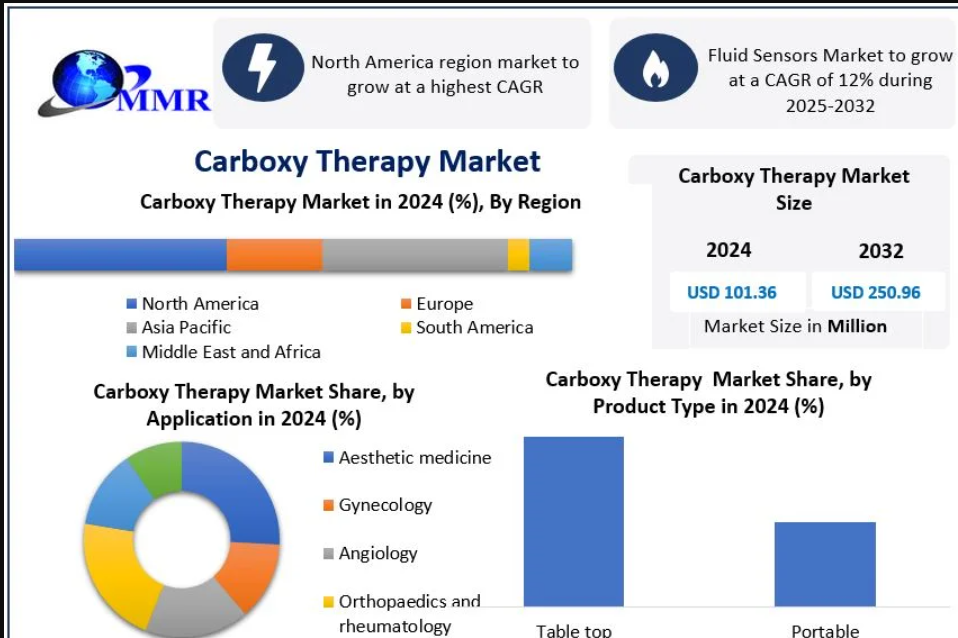
Global Carboxy Therapy Market Outlook (2025–2032): Strategic Growth, Aesthetic Trends, and Investment Analysis
Introduction to the Global Carboxy Therapy Market
The global medical aesthetics and dermatology sector has undergone a profound structural evolution over the past decade, driven heavily by consumer preferences transitioning away from invasive surgical operations toward high-efficiency, zero-downtime procedures. Among the leading modalities reshaping this landscape, carboxy therapy has emerged as a cornerstone treatment. Utilizing controlled micro-injections of medical-grade carbon dioxide ($\text{CO}_2$), carboxy therapy stimulates local tissue microcirculation, enhances cellular oxygenation, accelerates collagen synthesis, and facilitates localized adipose tissue reduction.
According to comprehensive industry valuations, the global carboxy therapy market was valued at USD 101.36 million in 2024. Propelled by surging demand for non-surgical cosmetic interventions, technological advancements in delivery hardware, and expanding clinical validation across therapeutic and aesthetic applications, the market is projected to reach USD 250.96 million by 2032, expanding at a robust compound annual growth rate (CAGR) of 12% throughout the forecast period from 2025 to 2032.
As a senior market analyst and SEO content specialist with over a decade of industry expertise, this review synthesizes the micro- and macroeconomic factors steering the sector. By examining growth catalysts, procedural volume trends, segmental distributions, and regional dynamics, industry stakeholders, clinicians, and investors can secure the clear market vision required to make sound, data-driven business decisions.
𝐃𝐨𝐰𝐧𝐥𝐨𝐚𝐝 𝐅𝐫𝐞𝐞 𝐏𝐃𝐅 𝐁𝐫𝐨𝐜𝐡𝐮𝐫𝐞 @https://www.maximizemarketresearch.com/request-sample/279714/
Macroeconomic Drivers and Core Market Dynamics
The steady upward trajectory of the global carboxy therapy market is governed by powerful behavioral shifts, technological integration, and structural industry forces.
Key Growth Drivers
-
Surging Preference for Non-Surgical and Minimally Invasive Procedures: Modern consumers increasingly prioritize aesthetic treatments that deliver tangible anti-aging and skin-rejuvenating results without the financial, physical, and operational costs associated with surgical facelifts or extensive liposuction. According to global aesthetic data repositories, minimally invasive procedure volumes continue to post double-digit annual increases.
-
Physiological Versatility and Cellular Oxygenation: Carboxy therapy is not merely limited to facial anti-aging; its clinical utility spans cellulite reduction, stretch mark amelioration, localized fat contouring, dark circle reduction, and the management of chronic alopecia. By triggering the Bohr effect—where local $\text{CO}_2$ infusion tricks hemoglobin into releasing a high volume of oxygen directly into the tissue—the treatment naturally stimulates the body's native healing cascades.
-
Social Media Influence and Digital Marketing Integration: Platforms like Instagram and TikTok have radically democratized consumer awareness regarding medical aesthetics. Before-and-after case studies, celebrity endorsements, and transparent clinic documentation shared by dermatology influencers have significantly reduced the psychological barrier to entry for needle-based treatments, fostering high recurring foot traffic across aesthetic clinics.
Restraints and Operational Challenges
-
High Per-Session Costs and Lack of Reimbursement: Because carboxy therapy sessions (typically ranging between USD 200 and USD 600 per session depending on the geographic zone and treatment zone) are categorized primarily as elective cosmetic procedures, they lack insurance coverage in most global markets. This creates an economic access barrier for price-sensitive consumer segments.
-
Intense Competition from Alternative Modalities: Aesthetic clinics frequently balance multi-technology platforms. Carboxy therapy faces direct competition from established laser resurfacing systems, radiofrequency micro-needling, cryolipolysis, and traditional dermal fillers, requiring manufacturers to continuously highlight carboxy therapy's unique physiological edge.
[Consumer Demand for Zero Downtime] ---> [Cellular Oxygenation Efficacy] ---> [Social Media Visibility] ---> [Rapid Market Expansion]
Technological Innovations and Strategic Opportunities
To maintain competitive differentiation and capture untapped market segments, device manufacturers and clinical operators are heavily investing in technological upgrades and protocol diversifications.
-
Development of Advanced Tabletop and Portable Units: Modern carboxy therapy hardware features sophisticated digital microprocessors, precise flow-rate regulators, and automated temperature control mechanisms that ensure patient comfort and minimize procedural discomfort. Tabletop and portable systems dominate clinic installations due to their compact footprint and operational ease.
-
Synergistic Treatment Combinations: Forward-thinking dermatology practices are successfully combining carboxy therapy with complementary procedures—such as botulinum toxin injections, chemical peels, and laser sessions—without adverse interactions, maximizing clinic revenue per patient visit.
-
Penetration into Tier-2 and Tier-3 Urban Centers: While metropolitan hubs have historically saturated early-adopter markets, rising disposable incomes across developing economies present massive greenfield opportunities for regional clinic expansions and device distribution partnerships.
Granular Segment Analysis
A detailed examination of the global carboxy therapy market reveals distinct structural classifications based on device type, application, and end-user distribution.
1. Market Analysis by Product/Device Type
-
Tabletop Carboxy Therapy Devices: Capturing the majority market share, tabletop units are the preferred infrastructure choice for dedicated aesthetic clinics, dermatology centers, and specialized medical spas. Their robust multi-functional capabilities, precise gas-metering controls, and professional aesthetic appeal justify their high deployment rates.
-
Portable and Handheld Units: Witnessing accelerated adoption due to their flexibility, cost-effectiveness, and suitability for smaller practice settings or multi-room clinic rotations.
2. Market Analysis by Application
-
Aesthetic Medicine and Anti-Aging: Commanding the leading revenue share, this segment encompasses facial rejuvenation, wrinkle smoothing, eyelid laxity correction, and scar management.
-
Body Contouring and Cellulite Reduction: Highly sought after by patients seeking non-invasive localized fat disruption and skin texture smoothing on thighs, abdomen, and buttocks.
-
Medical Therapeutics: Includes emerging applications in wound healing, localized ischemic disorders, and alopecia management.
Regional Landscape and Geographic Insights
Geographically, the global carboxy therapy market exhibits distinct consumption clusters aligned with healthcare expenditure and aesthetic maturity.
[North America: Market Leader] ---> [Europe: Established Clinical Base] ---> [Asia-Pacific: Fastest-Growing Frontier]
North America (Dominant Regional Leader)
North America anchors the global market, driven by high consumer spending on personal grooming, an established network of board-certified dermatologists, and deep-rooted consumer awareness of advanced anti-aging treatments. The United States leads regional procedure volumes, supported by high per capita disposable income.
Europe
Europe represents a mature and highly regulated market. Countries like Italy, France, and the United Kingdom boast long-standing clinical traditions utilizing carboxy therapy (which originally gained prominent therapeutic validation in European thermal spas decades ago), ensuring a steady, loyal patient base.
Asia-Pacific (Fastest-Growing Frontier)
The Asia-Pacific region is projected to register the fastest CAGR through 2032. Rapid urbanization, a booming middle class in countries like China, South Korea, India, and Japan, and a cultural prioritization of flawless skin health are fueling an explosive proliferation of state-of-the-art aesthetic clinics across the region.
Competitive Intelligence and Strategic Positioning
The global carboxy therapy market features an intensely competitive ecosystem comprised of specialized medical device manufacturers, multinational pharmaceutical conglomerates, and local equipment distributors. Key industry participants focus heavily on continuous software upgrades, ergonomic handpiece designs, and comprehensive clinical training programs for practitioners.
Prominent players shaping the competitive landscape include:
-
Fosun Pharmaceutical Co., Ltd.
-
Merz Pharma GmbH & Co. KGaA
-
Allergan plc
-
Alvi Prague
-
DTA Medical (Acea Medica)
-
Cosmo Pro Ltd.
-
Carbossiterapia Italiana
-
Mezopharma
These market leaders maintain competitive moats by securing regulatory clearances (such as CE-mark and FDA compliance) and establishing direct distribution agreements with elite medical spas and dermatology hospitals.
For full access to the comprehensive strategic report, visit:https://www.maximizemarketresearch.com/market-report/carboxy-therapy-market/279714/
Strategic Recommendations for Business Decision-Makers
To achieve sustainable profitability and outpace market competitors through 2032, executive leaders, clinic operators, and medical investors should implement the following strategic measures:
-
Invest in Practitioner Education and Clinical Validation: Fund robust clinical trials and publish peer-reviewed studies highlighting carboxy therapy’s long-term efficacy in collagen synthesis to build unshakeable trust among medical professionals.
-
Optimize Pricing and Membership Models: To counteract high per-session cost barriers, clinics should introduce bundled package memberships or loyalty programs that encourage multi-session compliance (crucial for optimal cellulite and anti-aging results).
-
Leverage Digital Ecosystems and Video Marketing: Implement aggressive digital marketing funnels utilizing video-first platforms to visually demonstrate the quick, virtually painless nature of carboxy therapy procedures to prospective younger demographics.
-
Target Emerging APAC Urban Centers: Form strategic distribution alliances in high-growth Asia-Pacific markets where demand for non-invasive cosmetic treatments is scaling exponentially.
Conclusion
The global carboxy therapy market represents a highly resilient, clinically validated, and rapidly expanding sector within medical aesthetics, projected to scale up to USD 250.96 million by 2032. Driven by unwavering consumer preference for non-surgical rejuvenation, superior cellular oxygenation benefits, and continuous hardware innovations, the market offers lucrative avenues for sustainable growth. Organizations and clinical operators that align their operational frameworks with high safety standards, transparent digital marketing, and patient-centric value models will undoubtedly secure long-term leadership.
About Maximize Market Research
Maximize Market Research is a multifaceted market research and consulting company with professionals from several industries. Some of the industries we cover include medical devices, pharmaceutical manufacturers, science and engineering, electronic components, industrial equipment, technology and communication, cars and automobiles, chemical products and substances, general merchandise, beverages, personal care, and automated systems. To mention a few, we provide market-verified industry estimations, technical trend analysis, crucial market research, strategic advice, competition analysis, production and demand analysis, and client impact studies.
Contact Maximize Market Research
3rd Floor, Navale IT Park, Phase 2
Pune Bangalore Highway, Narhe,
Pune, Maharashtra 411041, India
sales@maximizemarketresearch.com
+91 96071 95908, +91 9607365656

 English
 Arabic
 French
 Spanish
 Portuguese
 Deutsch
 Turkish
 Italiano
 Russian
 Romaian
 Portuguese (Brazil)
 Greek
Greek
