
Smart Factory Market Demand to Reach $508.7 Billion by 2036, Expanding at 8.5% CAGR
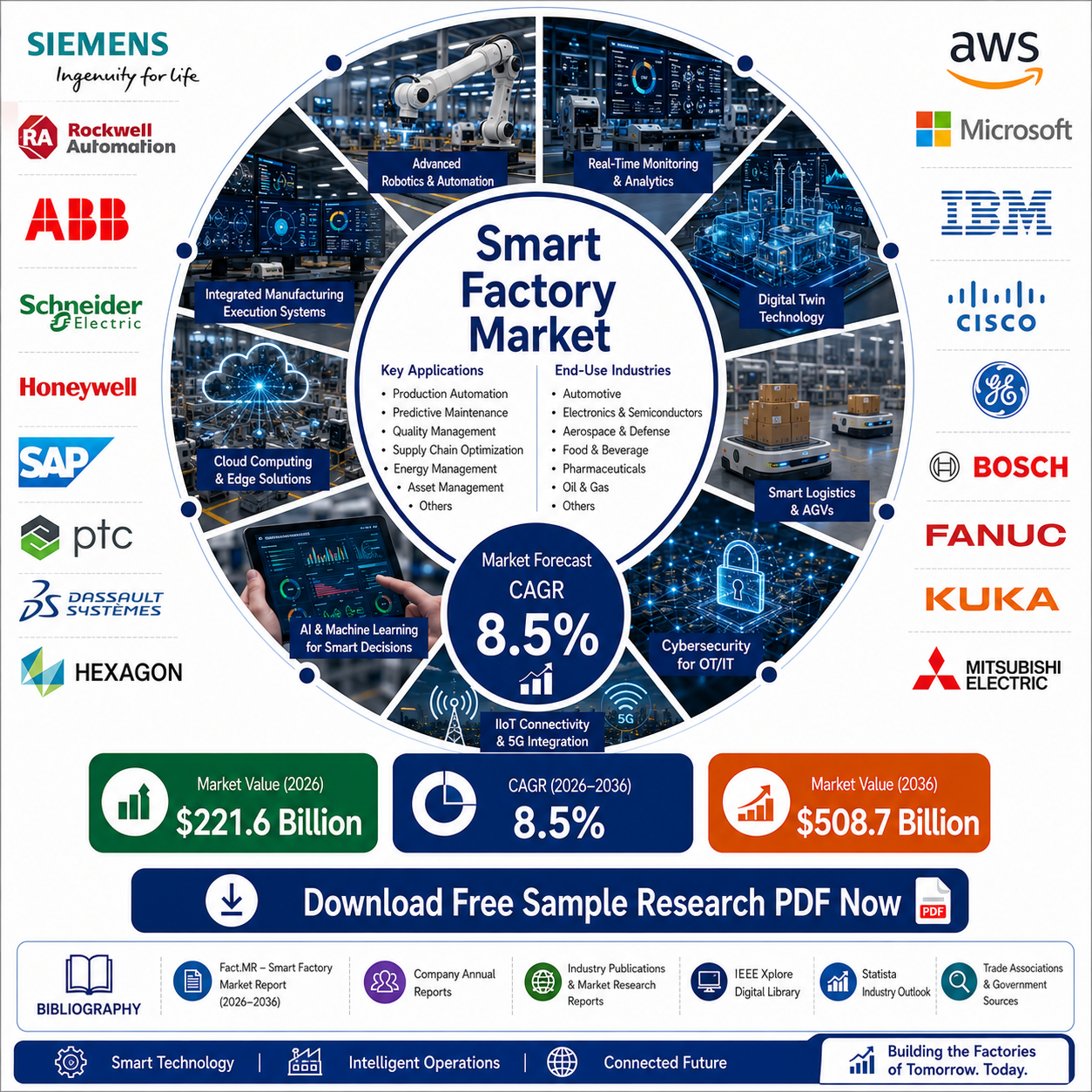
ROCKVILLE, Md., July 30, 2026 — The Smart Factory Market is projected to grow from USD 225.0 billion in 2026 to USD 508.7 billion by 2036, registering a CAGR of 8.5%, according to Fact.MR. The market was valued at USD 207.4 billion in 2025 and is expected to create an absolute dollar opportunity of USD 283.7 billion during the forecast period. Growing investments in industrial IoT, artificial intelligence, robotics, and digital twin technologies continue to transform manufacturing operations worldwide.
Manufacturers across automotive, electronics, aerospace, food processing, and healthcare industries are accelerating factory digitalization to improve productivity, reduce operating costs, and enhance product quality. Companies are increasingly integrating AI-powered process control, connected sensors, industrial robots, and manufacturing execution systems (MES) to enable real-time monitoring and predictive decision-making.
Government-backed industrial modernization programs are further supporting market expansion. China's Intelligent Manufacturing Development Plan, Germany's Industrie 4.0 framework, India's Production Linked Incentive (PLI) Scheme, and the U.S. CHIPS and Science Act continue encouraging manufacturers to modernize production facilities with advanced automation technologies. At the same time, growing labor costs and near-shoring strategies are increasing demand for highly automated production environments.
Get detailed market forecasts, competitive benchmarking, and pricing trends: https://www.factmr.com/connectus/sample?flag=S&rep_id=14553
Industry investments continue reinforcing this trend. The International Federation of Robotics reported approximately 590,000 industrial robot installations globally during 2023, with automotive and electronics representing nearly 65% of deployments. In addition, Siemens AG introduced its Sinamics G120X industrial drive platform integrated with the MindSphere IoT platform in October 2024, while Fanuc Corporation launched the AI-enabled CRX-25iA collaborative robot in January 2025 to support advanced manufacturing automation.
Key Market Numbers
|
Metric |
Value |
|
Market Size (2025) |
USD 207.4 Billion |
|
Market Size (2026) |
USD 225.0 Billion |
|
Forecast Value (2036) |
USD 508.7 Billion |
|
CAGR (2026–2036) |
8.5% |
|
Absolute Opportunity |
USD 283.7 Billion |
Market Segmentation Highlights
Hardware Leads the Component Segment
Hardware is projected to account for approximately 70% of the market in 2026. Industrial sensors, programmable logic controllers (PLCs), robotics, drives, industrial networks, and edge computing infrastructure remain the foundation of every smart factory deployment.
Discrete Industries Dominate End Users
Discrete industries are expected to hold around 61% market share in 2026. Automotive, electronics, aerospace, and precision manufacturing companies continue investing heavily in AI-enabled automation to improve productivity, reduce defects, and support flexible manufacturing.
Automotive Industry Leads Industry Verticals
The automotive sector remains the leading industry vertical due to extensive automation requirements across electric vehicle production, battery manufacturing, robotic assembly, quality inspection, and digital production planning.
Industrial AI and Digital Twins Gain Momentum
Manufacturers increasingly deploy AI analytics, predictive maintenance software, manufacturing execution systems, and digital twin platforms to improve operational efficiency while reducing equipment downtime and production costs.
Gain Full Access to Market Forecasts and Key Drivers: https://www.factmr.com/report/smart-factory-market
Country Growth Outlook
The Smart Factory Market is expected to witness strong expansion across Asia Pacific, Europe, and North America as manufacturers accelerate industrial automation, AI deployment, and digital transformation initiatives. China and India lead global growth through government-backed manufacturing programs, while South Korea, Germany, the United States, Japan, and the United Kingdom continue expanding investments in smart production facilities.
|
Country |
CAGR (2026–2036) |
|
China |
10.2% |
|
India |
9.8% |
|
South Korea |
9.1% |
|
Germany |
8.6% |
|
United States |
8.0% |
|
Japan |
7.5% |
|
United Kingdom |
6.8% |
China is projected to remain the fastest-growing market, supported by the MIIT Intelligent Manufacturing Development Plan (2024–2026), which targets 10,000 smart factories and provides subsidies covering up to 30% of industrial IoT equipment investments. India follows through the Production Linked Incentive (PLI) Scheme and increasing investments in EV battery and automotive manufacturing. South Korea benefits from semiconductor and battery manufacturing automation, while Germany continues advancing through Industrie 4.0 standards and automotive digitalization. The United States is supported by CHIPS Act-funded semiconductor facilities, whereas Japan and the United Kingdom continue modernizing automotive, electronics, and advanced manufacturing facilities.
Competitive Landscape
The Smart Factory Market remains moderately concentrated at the platform level but highly competitive across automation hardware, industrial software, robotics, AI analytics, and digital twin technologies. Leading vendors compete by offering integrated ecosystems combining automation hardware, cloud software, industrial AI, cybersecurity, and manufacturing execution systems.
Major market participants include:
- Siemens AG
- Rockwell Automation
- ABB Ltd.
- Schneider Electric
- General Electric
- Honeywell International Inc.
- Mitsubishi Electric Corporation
- Fanuc Corporation
- Bosch Rexroth AG
- Hitachi Ltd.
According to Fact.MR, Siemens maintains a competitive advantage through its Xcelerator platform integrating automation hardware, MES software, engineering tools, and IoT analytics into one ecosystem. ABB continues strengthening its position through robotics and industrial automation solutions, while Rockwell Automation expands recurring software revenue through Plex MES and FactoryTalk Analytics. Honeywell, Schneider Electric, Mitsubishi Electric, Fanuc, Bosch Rexroth, and Hitachi continue investing in AI-enabled automation, digital twins, industrial cybersecurity, and connected manufacturing technologies.
Note: The report identifies leading companies but does not publish individual company market-share percentages. Therefore, company share data has not been included.
Analyst Perspective
According to Shambhu Nath Jha, Principal Consultant at Fact.MR:
"CXOs will find this report helpful in understanding how AI-driven manufacturing intelligence and digital twin platforms are transforming factory automation and production optimisation."
The report further highlights that future competition will increasingly depend on integrated AI platforms, industrial cybersecurity, digital twins, cloud manufacturing software, and modular automation systems that enable manufacturers to modernize production facilities gradually rather than replacing complete production lines.
Frequently Asked Questions
What will the Smart Factory Market be worth by 2036?
The market is projected to reach USD 508.7 billion by 2036, growing from USD 225.0 billion in 2026 at a CAGR of 8.5%.
What is driving Smart Factory Market growth?
Growth is driven by industrial IoT adoption, AI-enabled manufacturing, robotics, digital twin technology, rising labor costs, government digital manufacturing initiatives, and near-shoring of production facilities.
Which component dominates the market?
Hardware is expected to account for approximately 70% of market demand in 2026 because sensors, PLCs, robotics, industrial networks, and edge devices form the foundation of smart factory deployments.
Which end-user segment leads the market?
Discrete industries are projected to hold around 61% market share in 2026, led by automotive, electronics, aerospace, and precision manufacturing automation.
Which country is expected to grow the fastest?
China is forecast to record the highest CAGR of 10.2% between 2026 and 2036, supported by national intelligent manufacturing programs, EV production expansion, and government automation subsidies.
To view Top reports :
https://www.openpr.com/news/4528302/autonomous-firefighting-drones-market-to-reach-usd-15-7-billion
https://www.openpr.com/news/4528308/global-insulated-packaging-market-to-expand-from-19-2-billion
https://www.openpr.com/news/4528348/ultrasound-probe-disinfection-market-to-reach-usd-1-58-billion
About Fact.MR
Fact.MR is a global market research and consulting firm providing market intelligence, competitive benchmarking, technology analysis, demand forecasting, and strategic insights across industrial automation, manufacturing, electronics, automotive, healthcare, chemicals, packaging, energy, and advanced technologies.

 Arabic
 French
 Spanish
 Portuguese
 Deutsch
 Turkish
 Dutch
Dutch
 Italiano
 Russian
 Romaian
 Portuguese (Brazil)
 Greek
Greek
