
Healthcare Information System Market Trends and Competitive Landscape
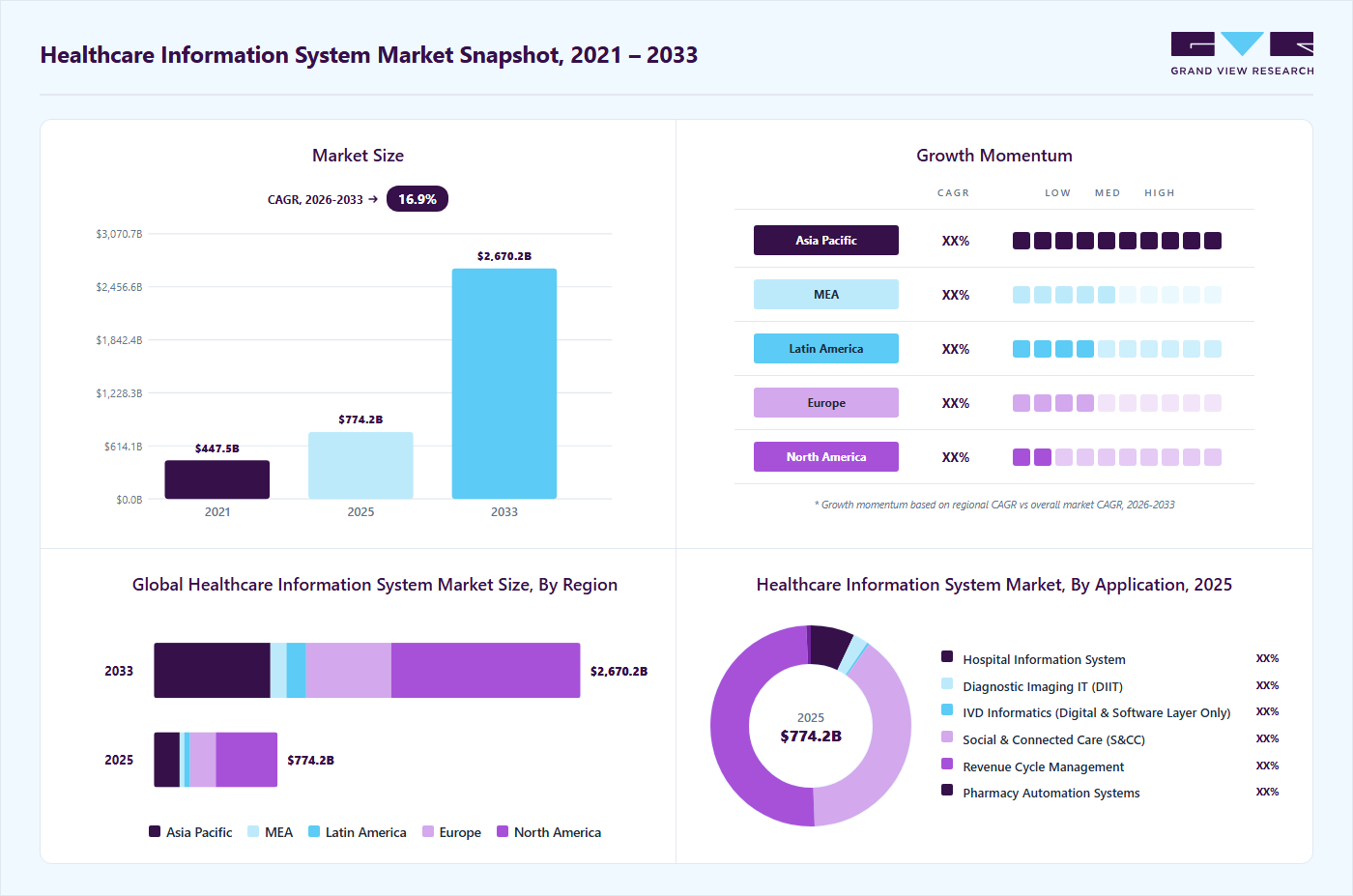
The healthcare information system market is experiencing rapid growth as healthcare organizations increasingly adopt digital technologies to improve care delivery, streamline administrative processes, and enhance healthcare management. The global healthcare information system market size was estimated at USD 773.9 billion in 2025 and is projected to grow from USD 892.8 billion in 2026 to USD 2,660.2 billion by 2033, at a CAGR of 16.9% from 2026 to 2033. North America held the largest share of 49.9% of the global market in 2025. Implementing Healthcare Information Systems (HIS), such as population health management significantly advances disease prevention and management, resulting in substantial financial savings. Growing demand for efficient healthcare administration, data-driven decision-making, and improved patient outcomes is further encouraging healthcare providers to adopt advanced information systems.
Another significant factor contributing to market growth is the increasing need for integrated digital healthcare infrastructure across hospitals, clinics, and other healthcare facilities. Healthcare information systems enable organizations to manage clinical information, financial operations, patient data, and administrative activities through connected digital platforms. The growing adoption of web-based solutions, mobile health technologies, and healthcare analytics is further supporting digital transformation across the healthcare sector. As healthcare providers continue focusing on operational efficiency, cost management, and improved patient care, demand for comprehensive healthcare information systems is expected to rise steadily throughout the forecast period.
Key Market Trends & Insights
• Regional analysis indicates that North America held the largest share of 49.9% of the global market in 2025. The region's leadership is supported by advanced healthcare infrastructure, strong adoption of digital health technologies, extensive healthcare IT investments, and the growing implementation of integrated healthcare information systems. Furthermore, Asia Pacific is expected to register the highest CAGR from 2026 to 2033, supported by increasing healthcare digitalization, expanding healthcare infrastructure, and growing demand for mobile health solutions.
• Based on application, the revenue cycle management (RCM) segment held the largest market share of 49.8% in 2025. Healthcare providers are increasingly adopting RCM solutions to streamline billing, claims processing, payment collection, and other financial processes while improving operational efficiency and revenue management.
• Based on deployment mode, the web-based segment held the largest market share of 45.2% in 2025. Web-based healthcare information systems provide healthcare organizations with flexible access to data and applications while supporting centralized management and integration across multiple healthcare facilities.
• Based on component, the services segment held the largest market share of 38.2% in 2025. Demand for implementation, consulting, maintenance, integration, and technical support services continues to increase as healthcare organizations require specialized expertise to deploy and manage complex information systems.
• Based on end use, the hospitals segment held the largest revenue share of 57.2% in 2025. Hospitals increasingly rely on healthcare information systems to manage clinical workflows, patient records, financial operations, and administrative activities while improving coordination across departments and care teams.
• By country, the U.S. held the largest market share in 2025. The country's position is supported by advanced healthcare infrastructure, widespread adoption of digital technologies, continued investments in healthcare IT, and the increasing focus on improving healthcare efficiency and patient outcomes.
Key Companies & Market Share Insights
The healthcare information system market is highly fragmented, with the presence of many country-level players. With the growing aging population and the need for mobile health, a few smaller competitors are entering the industry. Market participants are focusing on expanding their digital healthcare capabilities, improving system interoperability, and developing solutions that address the evolving requirements of healthcare providers and patients.
Companies operating in the healthcare information system market are increasingly emphasizing software innovation, cloud-based platforms, data analytics, mobile health solutions, and integrated healthcare management systems. The growing need for connected healthcare ecosystems is encouraging market participants to strengthen their offerings through technology development, strategic collaborations, and localized solutions. Increasing competition among established providers and emerging country-level companies is expected to support innovation and broaden access to healthcare information technologies.
With increasing digitalization across healthcare, growing demand for efficient revenue cycle management, expanding adoption of web-based systems, and rising investments in healthcare infrastructure, the healthcare information system market is poised for significant growth through 2033. Industry participants that focus on system integration, scalable digital solutions, mobile health technologies, and advanced healthcare management capabilities are expected to capitalize on emerging opportunities and strengthen their competitive positions in the years ahead.
Key Healthcare Information System Companies:
· athenahealth, Inc
· Oracle
· GE Healthcare
· Veradigm LLC
· Epic Systems Corporation
· eClinicalWorks
· Greenway Health, LLC
· NextGen Healthcare, Inc. (acquired by Thoma Bravo)
· Medical Information Technology, Inc. (Meditech)
· TruBridge, Inc. (formerly CPSI)
· AdvancedMD, Inc.
· CureMD Healthcare
· McKesson Corporation
· IQVIA
Grand View Research offers
· Focused market intelligence reports on specific geographies or high-growth segments.
· Extended forecast timelines for long-term planning.
· Competitor Benchmarking and Supply Chain Analysis
· Inclusion of regulatory and policy assessments.
· Inclusion of custom data models, KPIs, or applications unique to your business
· Specific high-impact Data Decks and Tables to support effective decision making
· And much more…

 English
 Arabic
 French
 Spanish
 Portuguese
 Deutsch
 Turkish
 Dutch
Dutch
 Italiano
 Russian
 Romaian
 Greek
Greek
