
CrSEO: Why Search Intelligence & Cognitive SEO Are Replacing Traditional Keyword Strategy
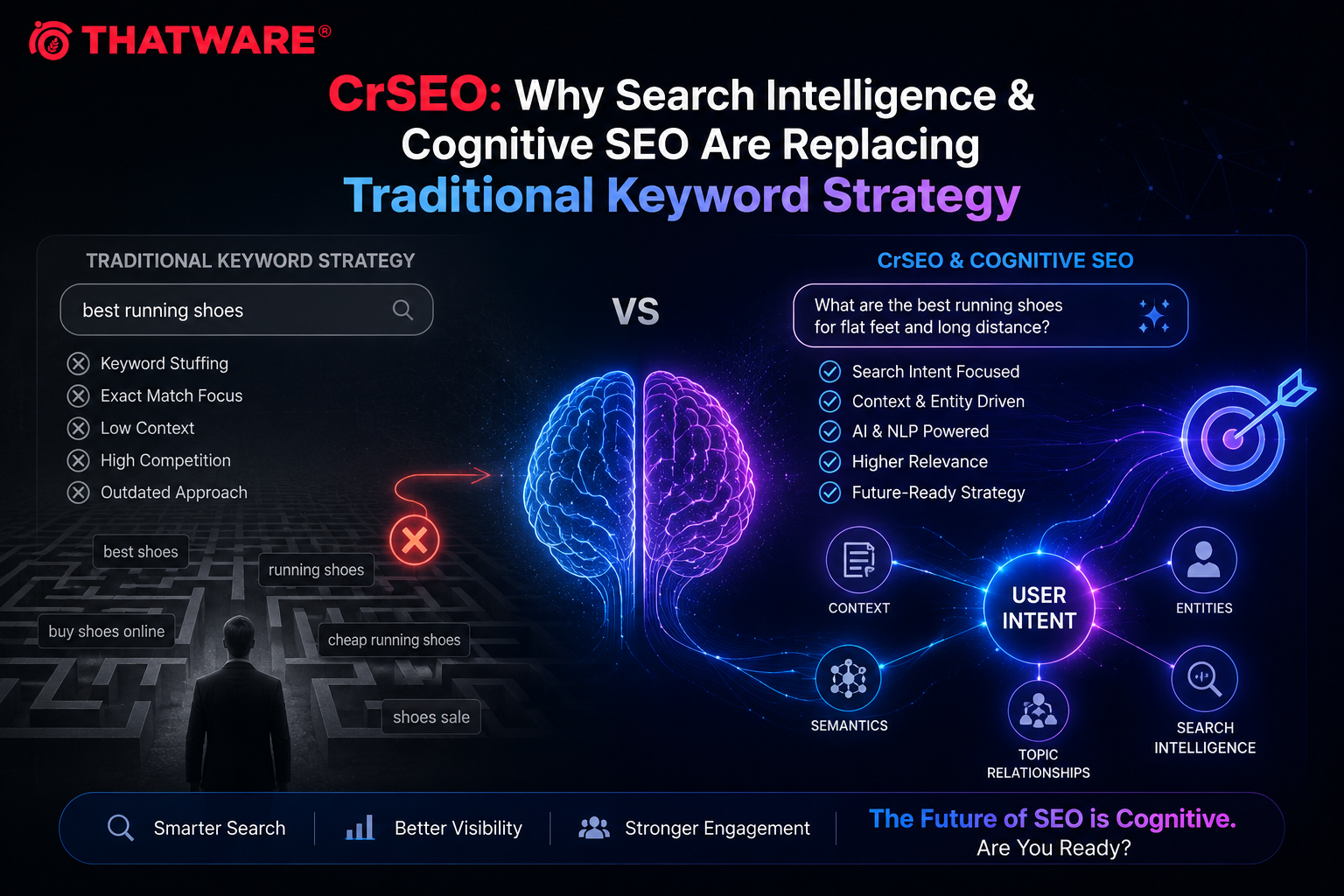
Search engine optimization is undergoing its most radical transformation in two decades. For years, the standard SEO playbook was straightforward: target high-volume keywords, optimize title tags, build backlinks, and secure a spot on the first page of Google. If you ranked #1, traffic and revenue naturally followed.
However, in today's digital ecosystem, that formula is officially broken.
With over 60% of Google searches ending without a click (zero-click searches driven by AI overviews and instant answers), simply being visible is no longer enough. High rankings no longer guarantee user trust, brand recall, or conversions. Modern searchers don't just want listicles—they want immediate reassurance, authority, and emotional alignment.
This shift has given rise to CRSEO (Cognitive Resonance Search Optimization)—a framework engineered by Thatware LLP that transforms search strategy from chasing rankings to building belief.
What is CRSEO (Cognitive Resonance SEO)?
CRSEO represents the next generation of search intelligence. While traditional optimization treats search engines like mechanical indexers, Cognitive SEO recognizes that discovery now happens across interactive, AI-driven environments.
At its core, CRSEO synchronizes three critical forces that traditionally operated in complete isolation:
-
Human Emotional Intent: Searchers rarely query with pure logic. They search when driven by anxiety, doubt, urgency, or a need for validation.
-
AI Logical Reasoning: Platforms like ChatGPT, Google Gemini, and Perplexity parse information using probability, structured semantic entities, and logical reasoning pathways.
-
Brand Psychological Persuasion: Converting a casual searcher requires trust signals, social proof, and risk reduction.
When these three dimensions align, you achieve cognitive resonance—a psychological state where the user feels deeply understood, the AI system validates your content as authoritative, and your brand becomes the default, trusted choice.
Why Traditional Optimization Fails in the Era of AI Cognitive Search
The rise of AI cognitive search engines has exposed massive flaws in old-school optimization strategies. Modern algorithms no longer evaluate pages based on repetitive keyword occurrences; they analyze context, user psychology, and semantic relationships.
Here is why old tactics are falling behind CRSEO:
-
Keywords vs. Emotional Intent Vectors: Standard SEO targets what users type (e.g., "best project management software"). CRSEO targets why they search—addressing underlying fears like "Will this software take weeks to learn and disrupt my team?"
-
Static Copy vs. Advanced Semantic SEO: Search engines now utilize vast knowledge graphs. Without advanced semantic SEO, your content lacks the structured relationships necessary for AI systems to understand its full context.
-
Traffic vs. Belief: Traditional strategies celebrate page views. Cognitive SEO focuses on decision confidence, brand memory, and conversion quality.
Key Takeaway: In an era where AI synthesizes answers instantly, being seen is easy—being believed is everything. CRSEO bridges the gap between AI understanding and human trust.
The Three Core Layers of Cognitive Resonance SEO
To achieve true market dominance, Thatware LLP built CRSEO around three interconnected layers:
1. Human Emotional Intent Layer
Every query begins with an emotional trigger. Whether a user is looking for financial advice or B2B enterprise software, hesitation and perceived risk are always present. CRSEO maps these subtle emotional intent vectors to create messaging that calms doubt before presenting a product or service.
2. AI Logical Reasoning Layer
AI cognitive search systems build answers step-by-step using logical flow paths. Advanced semantic SEO ensures that your content aligns directly with these reasoning patterns. By organizing topics logically and employing schema markup, your content becomes the ideal source for AI-generated overviews.
3. Brand Psychology Layer
Ranking high won't save a landing page if it lacks credibility. CRSEO integrates persuasive answer sequencing, case studies, authority credentials, and clear safety signals directly into the content structure, leading the user seamlessly from initial curiosity to confident decision-making.
How CRSEO Works: A 5-Step Search Intelligence Framework
Implementing CRSEO requires moving beyond keyword spreadsheets into sophisticated search intelligence. Here is how Thatware LLP approaches the process:
-
Map Emotional Intent Vectors: Identify the hidden anxieties, hesitations, and expectations driving your target audience.
-
Structure for AI Reasoning Paths: Organize content into clear hierarchy blocks, semantic entities, and schema markup so AI cognitive search systems can digest and cite it easily.
-
Apply Persuasive Answer Sequencing: Deliver information in a strategic order—address risk first, offer clarity second, establish authority third, and invite action last.
-
Leverage Advanced Semantic SEO: Build comprehensive topical networks that establish your domain as a primary topical authority in your niche.
-
Optimize for Cognitive Dominance: Measure success through brand recall, conversion velocity, user trust metrics, and AI citation rates rather than raw keyword rankings alone.
Transform Your Digital Strategy with Thatware LLP
As artificial intelligence redefines how users find, evaluate, and choose brands online, sticking to outdated digital strategies puts your business at risk. CRSEO isn't just another incremental update to search tactics—it's a comprehensive evolution in how brands communicate with both human audiences and intelligent machines.
At Thatware LLP, we pioneer advanced solutions in Cognitive SEO, CRSEO, and search intelligence to help businesses build long-term digital authority and maximize ROI.
Ready to transcend simple rankings and build unwavering brand belief? Explore our specialized CRSEO Services at Thatware LLP and lead the future of search today.
Frequently Asked Questions (FAQs)
1. What is the main difference between traditional SEO and CRSEO?
Traditional SEO focuses primarily on keyword targeting, backlink acquisition, and ranking position. CRSEO (Cognitive Resonance SEO) focuses on psychological alignment—synchronizing human emotional intent, AI logical reasoning paths, and brand trust signals to build user belief and drive higher quality conversions.
2. How does CRSEO help with AI-driven search engines like ChatGPT or Google Gemini?
CRSEO utilizes advanced semantic SEO and structured content formatting that mirrors how AI cognitive search systems process information. This increases the likelihood that AI discovery engines select, cite, and recommend your brand in generated answers.
3. Why is search intelligence replacing keyword density in modern strategy?
Keyword density is a legacy metric that search engines no longer rely on. Modern engines use search intelligence—evaluating natural language processing (NLP), semantic entity relationships, user intent satisfaction, and contextual relevance to deliver search results.
4. Can CRSEO improve conversion rates, not just traffic?
Yes! In fact, one of the primary objectives of CRSEO is reducing decision friction. By addressing user hesitations, fears, and doubts directly within the content flow, Cognitive SEO builds trust early in the buyer journey, leading to significantly higher conversion rates.
5. Who developed Cognitive Resonance SEO (CRSEO)?
CRSEO was developed by Tuhin Banik and the innovation team at Thatware LLP as part of their suite of next-generation frameworks designed for hyper-intelligent, AI-first search environments.

 English
 Arabic
 French
 Spanish
 Portuguese
 Deutsch
 Turkish
 Dutch
Dutch
 Italiano
 Russian
 Romaian
 Greek
Greek
