
Comprehensive Global Enterprise Asset Management Market Competitive Landscape Report Featuring Market Leaders, Revenue Analysis, and Strategic Developments
Global Enterprise Asset Management Market: Strategic Growth Vision, Industry Trends, and Competitive Landscape Insights
Introduction: The New Frontier of Physical Asset Optimization
In the contemporary landscape of global commerce, physical infrastructure dictates operational viability. Organizations across heavy industries, manufacturing, energy, utilities, and transportation face unprecedented pressures to optimize capital expenditure, eliminate unplanned downtime, and adhere to strict regulatory mandates. At the heart of this industrial evolution lies the Global Enterprise Asset Management (EAM) Market. EAM has transcended its traditional boundaries of simple reactive maintenance and work order logs. Today, it functions as an intelligent, data-driven ecosystem that governs the complete lifecycle of physical assets—from capital planning, design, procurement, and installation to operational maintenance, risk management, and ultimate decommissioning.
Driven by the advent of Industry 4.0, the Internet of Things (IoT), and cognitive artificial intelligence (AI), modern enterprises view asset management not merely as a cost center, but as a strategic lever for competitive differentiation. This comprehensive press release and market analysis examines the structural dynamics, segment trends, regional forecasts, and critical business decisions shaping the EAM market landscape.
𝐃𝐨𝐰𝐧𝐥𝐨𝐚𝐝 𝐅𝐫𝐞𝐞 𝐏𝐃𝐅 𝐁𝐫𝐨𝐜𝐡𝐮𝐫𝐞 @https://www.maximizemarketresearch.com/request-sample/7267/
Market Overview and Macroeconomic Trajectory
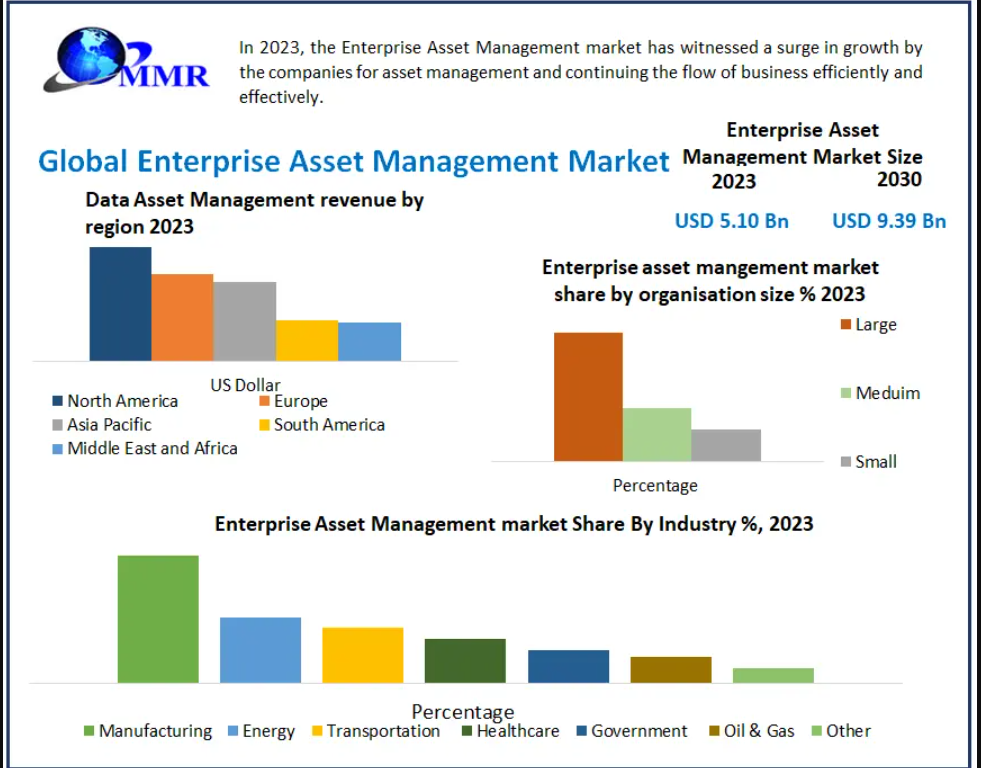
The global enterprise asset management market has demonstrated remarkable resilience and steady expansion. Valued at approximately USD 5.10 billion, the market is poised on a steep growth curve, projected to scale up significantly through the next decade. Industry analyses indicate a robust Compound Annual Growth Rate (CAGR) as organizations increasingly prioritize asset reliability, operational transparency, and digital transformation.
Several macro-economic and structural factors are fueling this upward trajectory:
-
Escalating Capital Intensiveness: Corporations manage vast portfolios of complex physical infrastructure. Ensuring maximum uptime for high-value machinery directly correlates with bottom-line profitability and customer satisfaction.
-
Regulatory Pressures: Government compliance regarding workplace health, safety, environmental protection, and carbon footprint reduction compels companies to maintain rigorous audit trails of asset performance.
-
The Shift from Reactive to Predictive: Traditional calendar-based maintenance models are rapidly being replaced by condition-based monitoring and AI-powered predictive maintenance frameworks that mitigate catastrophic failures before they occur.
Technological Integration: Industry 4.0 and the Evolution of EAM
The digital transformation wave has redefined what enterprise software can achieve. Modern EAM solutions are deeply integrated with enterprise resource planning (ERP), supply chain management, and human capital systems. This convergence provides a single source of truth for decision-makers.
1. IoT and Real-Time Asset Surveillance
The proliferation of low-cost industrial IoT sensors has fundamentally altered field operations. Sensors attached to turbines, fleet vehicles, and manufacturing robotics stream continuous streams of operational telemetry—such as vibration, temperature, and pressure—directly into EAM platforms. This capability enables facility managers to track asset health in real time, shifting operational strategies from guesswork to absolute certainty.
2. Generative AI and Predictive Analytics
Artificial intelligence acts as the cognitive engine within next-generation EAM suites. Machine learning algorithms analyze historical failure codes, environmental conditions, and maintenance logs to forecast remaining asset lifespans accurately. Furthermore, the introduction of generative AI copilots assists maintenance technicians by automatically synthesizing complex repair manuals, predicting required spare parts, and streamlining work-order execution.
Market Segmentation Analysis
Understanding the granular layers of the enterprise asset management market requires an evaluation across deployment models, enterprise scale, and end-use industries.
By Deployment Strategy: Cloud vs. On-Premises
-
Cloud-Based Deployment: The cloud segment is experiencing explosive adoption. Organizations favor cloud EAM architectures for their scalability, rapid deployment cycles, lower initial capital expenditure, and seamless capacity for remote multi-site management. Real-time analytics and global visibility across distributed supply chains are more easily achieved via cloud infrastructure.
-
On-Premises Deployment: Despite the rapid growth of cloud solutions, the on-premises segment maintains a substantial revenue share. Large-scale industrial enterprises, defense contractors, and government entities with highly sensitive data, strict sovereignty requirements, and legacy infrastructure integration needs heavily rely on on-premise EAM deployments.
By Enterprise Size
-
Large Enterprises: Large multinational corporations command the largest share of EAM adoption. These organizations manage massive, highly distributed asset networks across international borders, necessitating sophisticated enterprise-grade platforms to govern risk, compliance, and multi-tier maintenance schedules.
-
Small and Medium-Sized Enterprises (SMEs): SMEs are increasingly adopting lightweight, subscription-based cloud EAM tools. As operational efficiency becomes non-negotiable for smaller players competing against industry giants, simplified EAM solutions offer an accessible gateway to professionalized asset upkeep.
By End-Use Industry Vertical
The versatility of EAM ensures deep penetration across diverse economic sectors:
-
Manufacturing: Commanding the largest market share, the manufacturing sector leverages EAM to optimize plant floor equipment, reduce unplanned downtime, and integrate smart factory automation.
-
Energy and Utilities: Power grids, oil and gas pipelines, and renewable energy installations rely heavily on EAM to monitor linear assets, ensure regulatory compliance, and avert hazardous infrastructure failures.
-
Transportation and Logistics: Fleet operators, rail networks, and aviation bodies utilize EAM to track mobile assets, manage complex schedules, and enforce rigorous safety standards.
-
Healthcare & Facility Management: Hospitals and large commercial real estate operators use EAM platforms to manage critical life-support equipment, HVAC systems, and building infrastructure efficiently.
Regional Market Dynamics: Geographic Insights
The global EAM footprint exhibits distinct regional characteristics driven by infrastructure maturity, technology adoption rates, and industrial policies.
-
North America: North America remains the dominant regional market, anchored by early technology adoption, a mature manufacturing and utility sector, and substantial federal investments in aging infrastructure revitalization. The heavy presence of leading EAM software vendors in the region accelerates continuous software innovation.
-
Asia-Pacific (APAC): Projected to exhibit the fastest growth rate during the forecast period, the APAC region is propelled by rapid industrialization, massive smart city initiatives, and expansive manufacturing hubs in nations such as China, India, and Southeast Asian countries. The shift toward digitized industrial practices is unlocking immense market potential here.
-
Europe: Europe maintains a prominent market position, driven by stringent regulatory frameworks regarding environmental sustainability, worker safety, and energy efficiency. European enterprises heavily invest in EAM tools that facilitate green practices and circular economy standards.
-
Latin America, Middle East, and Africa (LAMEA): These regions are gradually modernizing traditional resource extraction, mining, and oil & gas operations, shifting toward cloud-based asset tracking to minimize logistical bottlenecks and operational overheads.
Strategic Challenges and Restraints
Despite robust market fundamentals, industry participants must navigate certain constraints:
-
High Initial Implementation Costs: Comprehensive EAM rollouts often involve substantial upfront software licensing, hardware retrofitting (IoT sensors), and employee training expenses, which can deter resource-constrained SMEs.
-
Data Security and Privacy Concerns: Moving sensitive operational data to cloud-centric networks exposes organizations to potential cyber threats, making robust cybersecurity protocols an absolute prerequisite.
-
Organizational Resistance to Change: Transitioning legacy workforces from conventional maintenance habits to advanced, data-driven software frameworks requires rigorous change management and cultural alignment.
Competitive Landscape
The global Enterprise Asset Management (EAM) market is highly competitive, with a mix of established enterprise software providers and specialized asset management vendors competing through AI-powered predictive maintenance, cloud-native EAM platforms, IoT integration, mobile workforce management, and industry-specific solutions. Leading companies are focusing on strategic acquisitions, product innovation, cloud migration, and partnerships to strengthen their market presence. The market remains moderately consolidated, with major vendors such as IBM, SAP, Oracle, IFS, Hexagon, and ServiceNow holding significant market shares, while regional and niche providers continue to expand across manufacturing, energy, utilities, transportation, healthcare, and government sectors.
Key Players in the Enterprise Asset Management Market
1. IBM Corporation
2. ABB
3. CGI Group, Inc.
4. eMaint
5. Dude Solutions, Inc.
6. IFS AB
7. Infor
8. Ramco Systems
9. SAP SE
10. Vesta Partners, LLC
11. Schneider Electric SA
12. Oracle Corporation
13. CARL International SA
14. AssetWorks LLC
15. Ultimo Software Solutions Bv
16. MAINTENANCE CONNECTION
17. AVEVA Group plc
18. Aptean
19. UpKeep Maintenance Management
20. RFgen Software
21. FUJITSU
For full access to the comprehensive strategic report, visit:https://www.maximizemarketresearch.com/market-report/global-enterprise-asset-management-market/7267/
Strategic Business Decisions and Executive Recommendations
To capitalize on the lucrative expansion of the enterprise asset management market, business executives, IT leaders, and asset managers must execute precise, forward-looking strategies:
-
Prioritize Hybrid and Cloud-Native Migration: To enhance operational agility and data accessibility across remote workforces, organizations should evaluate phased transitions toward cloud-enabled EAM platforms.
-
Invest in AI-Driven Predictive Maintenance: Moving beyond basic work-order tracking is essential. Leaders must embed machine learning and predictive diagnostics to minimize catastrophic asset failure and extend equipment lifespans.
-
Bridge the Skills Gap: Technology is only as effective as the people operating it. Enterprises must fund continuous upskilling programs to empower maintenance engineers to interpret advanced analytics dashboards and IoT diagnostic outputs.
-
Align EAM with ESG Goals: Leverage asset tracking data to optimize energy consumption, reduce waste, and demonstrate verifiable environmental, social, and governance (ESG) compliance to regulators and stakeholders.
Conclusion
The global enterprise asset management market stands at a crucial crossroads of digital maturity and industrial necessity. As physical assets grow increasingly complex and operational margins tighten, traditional management methodologies are no longer sufficient. By embracing integrated, AI-driven, and cloud-enabled EAM solutions, forward-thinking enterprises can unlock unprecedented levels of efficiency, safeguard their capital investments, and secure long-term competitive advantage in a volatile global economy.
About Maximize Market Research
Maximize Market Research is a multifaceted market research and consulting company with professionals from several industries. Some of the industries we cover include medical devices, pharmaceutical manufacturers, science and engineering, electronic components, industrial equipment, technology and communication, cars and automobiles, chemical products and substances, general merchandise, beverages, personal care, and automated systems. To mention a few, we provide market-verified industry estimations, technical trend analysis, crucial market research, strategic advice, competition analysis, production and demand analysis, and client impact studies.
Contact Maximize Market Research
3rd Floor, Navale IT Park, Phase 2
Pune Bangalore Highway, Narhe,
Pune, Maharashtra 411041, India
sales@maximizemarketresearch.com
+91 96071 95908, +91 9607365656

 Arabic
 French
 Spanish
 Portuguese
 Deutsch
 Turkish
 Dutch
Dutch
 Italiano
 Russian
 Romaian
 Portuguese (Brazil)
 Greek
Greek
