
Global Wi-Fi Hotspot Market Competitive Landscape Analysis by Top Manufacturers, Innovation Trends, Partnerships, and Market Share
Global Wi-Fi Hotspot Market Forecast to 2030: Strategic Insights, Growth Drivers, and Comprehensive Market Review
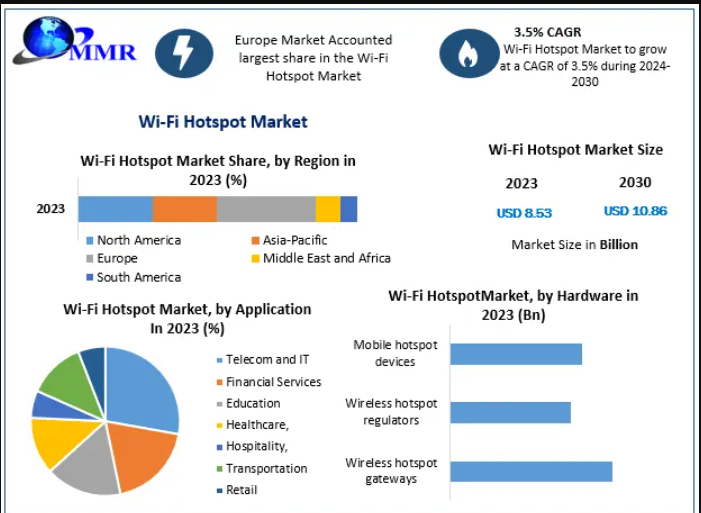
The Global Wi-Fi Hotspot Market was valued at USD 8.53 Billion in 2023 and is projected to expand steadily at a Compound Annual Growth Rate (CAGR) of 3.5% throughout the forecast period, culminating in a robust market valuation by 2030.
Driven by the explosive proliferation of smartphones, tablets, and Internet of Things (IoT) ecosystems, along with corporate shifts toward enterprise mobility and Bring Your Own Device (BYOD) policies, Wi-Fi hotspots have evolved from basic connectivity tools into essential strategic infrastructure for modern businesses. This comprehensive review analyzes current market drivers, structural restraints, segment dynamics, regional outlooks, and actionable decision-making frameworks for industry stakeholders, investors, and technology providers.
𝐃𝐨𝐰𝐧𝐥𝐨𝐚𝐝 𝐅𝐫𝐞𝐞 𝐏𝐃𝐅 𝐁𝐫𝐨𝐜𝐡𝐮𝐫𝐞 @https://www.maximizemarketresearch.com/request-sample/8024/
Executive Summary: Bridging the Digital Divide with Advanced Connectivity
In today’s hyper-digitized global economy, reliable internet access is no longer a luxury but an absolute operational necessity. Wireless Local Area Networks (WLANs) powered by advanced routers, gateways, and cloud management platforms enable verified users to connect seamlessly in transit, public venues, and corporate offices.
The market's steady progression is anchored by continuous improvements in hardware performance, software customization, and third-party managed services. Enterprises across retail, hospitality, healthcare, and education are leveraging Wi-Fi hotspots not only to provide internet access but also to gather consumer analytics, enhance operational efficiency, and deliver hyper-personalized customer engagement. Despite facing hurdles such as security vulnerabilities and data interception risks, ongoing advancements in 5G-integrated modems and robust encryption protocols continue to fortify market resilience and long-term expansion.
Market Drivers: What is Propelling Wi-Fi Hotspot Adoption?
1. Enterprise Mobility and the Rise of BYOD Policies
Modern organizations are rapidly adopting Bring Your Own Device (BYOD) frameworks and enterprise mobility strategies to optimize operational efficiency and elevate employee satisfaction. Permitting employees to utilize personal smartphones and tablets reduces upfront hardware procurement costs while fostering a more flexible, responsive workforce. Consequently, organizations are upgrading their internal network architectures with high-capacity Wi-Fi hotspots to bridge the gap between desk-bound personnel and remote or mobile teams.
2. Proliferation of Connected Devices and Cloud Components
The relentless surge in consumer demand for connected mobile gadgets, coupled with the rapid integration of cloud-based management applications, acts as a major catalyst for market growth. Modern Wi-Fi hotspots seamlessly interface with traditional cellular networks (3G, 4G, and emerging 5G technologies), delivering superior bandwidth, lower latency, and uninterrupted data flow across multi-user environments.
3. Commercialization of 5G Technology and Advanced Gateways
The commercial rollout of 5G infrastructure is redefining wireless capabilities. 5G-powered Wi-Fi modems and routers offer unprecedented data transmission speeds and superior bandwidth capacity. This technical leap is proving particularly attractive to small and medium-sized enterprises (SMEs) looking to upgrade their connectivity infrastructure without incurring prohibitive capital expenditures.
Market Restraints and Operational Challenges
While market prospects remain positive, certain structural challenges require strategic mitigation:
-
Cybersecurity and Data Privacy Risks: Wireless networks remain vulnerable to malicious activities such as data interception, rogue access points (APs), and wireless phishing. These security threats can compromise organizational privacy and erode user trust.
-
High Deployment and Maintenance Expenses: Establishing enterprise-grade wireless infrastructures across sprawling commercial spaces requires substantial capital investment and ongoing maintenance, which can present a barrier for smaller organizations.
-
Massive Data Volumes: Handling astronomical volumes of mobile traffic without compromising network speed or stability places heavy operational demands on legacy network hardware.
Competitive Landscape
For full access to the comprehensive strategic report, visit:https://www.maximizemarketresearch.com/market-report/global-wi-fi-hotspot-market/8024/
Comprehensive Segment Analysis
The global Wi-Fi hotspot market is meticulously segmented by hardware, component, application, and region, providing decision-makers with precise market visibility:
By Hardware
-
Wireless Hotspot Gateways: Dominates the hardware segment. Gateways provide essential authentication, authorization, and accounting (AAA) services, bridging wired and wireless networks. The rising volume of IP traffic and adoption of cloud access points continue to drive gateway deployment.
-
Wireless Hotspot Regulators: Essential for managing traffic load and ensuring equitable bandwidth distribution across congested enterprise environments.
-
Mobile Hotspot Devices: Highly favored by remote workers, travelers, and field personnel seeking portable, on-the-go broadband connectivity.
By Component
-
Software: Projected to register an exceptional growth trajectory, expanding at a CAGR exceeding 15% during the forecast period. Customized software solutions allow administrators to manage user access, enforce security compliance, encrypt data traffic, and differentiate between registered and guest users.
-
Services: Expected to achieve a steady annual growth rate of over 13%. Organizations increasingly outsource their IT infrastructure management to third-party managed service providers (MSPs) to minimize operational overhead, reduce maintenance costs, and refocus internal teams on core business objectives.
By Application
-
Retail Sector: Commands the largest market share, accounting for over 40% of the application segment. Retailers utilize Wi-Fi hotspots as powerful proximity marketing tools, offering free guest Wi-Fi to attract foot traffic while gathering valuable insights into shopper behavior and dwell times.
-
Telecom and IT: Leverages robust hotspots to offload cellular traffic and maintain continuous network availability.
-
Hospitality and Tourism: Hotels, restaurants, and resorts view high-speed Wi-Fi as a fundamental customer satisfaction metric.
-
Healthcare & Education: Rapidly deploying secure wireless zones to support digital learning platforms, electronic health records (EHR), and patient monitoring devices.
-
Transportation & Financial Services: Ensuring secure, uninterrupted connectivity for commuters across airports, railway stations, banking institutions, and corporate financial networks.
Regional Insights: Europe Leads, Asia-Pacific Accelerates
-
Europe: Claimed a leading market share of approximately 35%, supported by advanced telecommunications frameworks, high public acceptance of open-access Wi-Fi networks, and proactive government digitization initiatives. For instance, public sector campaigns such as the UK’s GovWifi initiative have successfully modernized government office networks with unified, secure wireless access.
-
Asia-Pacific (APAC): Poised to record the most dynamic expansion, growing at a robust CAGR of 4.7% through the forecast period, with annual growth rates in specific sub-segments exceeding 15%. This rapid growth is propelled by massive smartphone penetration, soaring internet user numbers, and aggressive government-led digitalization programs—such as large-scale public railway station Wi-Fi deployment partnerships across developing economies like India.
-
North America & Latin America / MEA: Supported by mature IT spending, high enterprise cloud adoption, and expanding telecommunications investments aimed at closing rural connectivity gaps.
Strategic Recommendations for Decision-Makers
To navigate competitive pressures and secure sustainable market positioning through 2030, industry participants should prioritize the following strategies:
-
Invest in Advanced Cybersecurity Protocols: Implement multi-factor authentication, robust encryption, and AI-driven anomaly detection to neutralize rogue access points and protect enterprise data.
-
Expand Managed Service Offerings: Capitalize on the rising corporate preference for IT outsourcing by bundling hardware deployment with comprehensive cloud-based managed services.
-
Leverage Location Analytics: Develop value-added software features that transform basic guest Wi-Fi networks into sophisticated consumer behavior analytics tools for retail and hospitality clients.
-
Embrace 5G-Ready Architecture: Future-proof product portfolios by integrating 5G capabilities into next-generation routers and gateways to meet escalating bandwidth demands.
About Maximize Market Research
Maximize Market Research is a multifaceted market research and consulting company with professionals from several industries. Some of the industries we cover include medical devices, pharmaceutical manufacturers, science and engineering, electronic components, industrial equipment, technology and communication, cars and automobiles, chemical products and substances, general merchandise, beverages, personal care, and automated systems. To mention a few, we provide market-verified industry estimations, technical trend analysis, crucial market research, strategic advice, competition analysis, production and demand analysis, and client impact studies.
Contact Maximize Market Research
3rd Floor, Navale IT Park, Phase 2
Pune Bangalore Highway, Narhe,
Pune, Maharashtra 411041, India
sales@maximizemarketresearch.com
+91 96071 95908, +91 9607365656

 English
 Arabic
 French
 Spanish
 Portuguese
 Deutsch
 Turkish
 Dutch
Dutch
 Italiano
 Russian
 Portuguese (Brazil)
 Greek
Greek
