
How MCA Master Data Helps Detect Dormant, Struck-Off, and Non-Compliant Companies Before Business Engagement
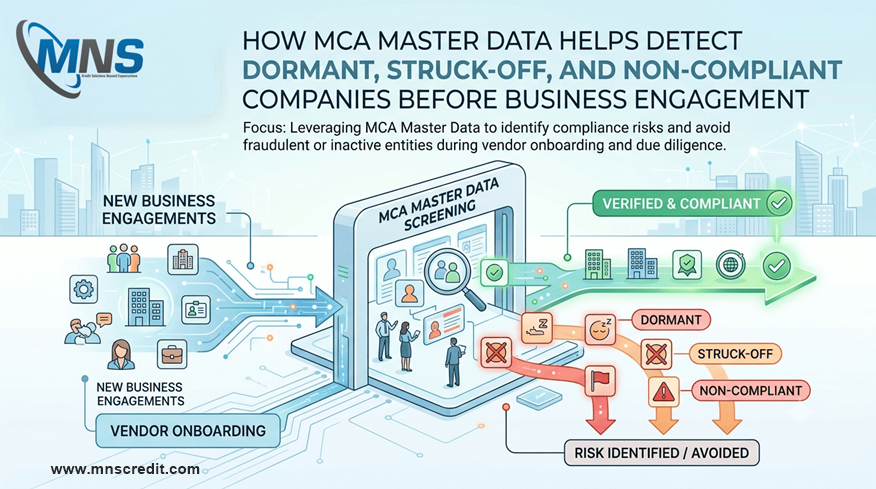
Onboarding a vendor, distributor, or corporate customer without first checking their standing on the Ministry of Corporate Affairs registry is one of the most avoidable mistakes a business can make. A contract signed with a struck-off entity may not be legally enforceable. Payments routed to a dormant company can trigger banking and compliance queries. And a chronically non-compliant counterparty is often carrying financial or governance problems that surface only after the relationship is already in motion. MCA Master Data – accessible through the MCA21 portal – gives businesses a way to catch all three of these problems before a single rupee or contractual commitment changes hands.
Understanding Dormant, Struck-Off, and Non-Compliant Status Under the Companies Act
These three statuses are distinct legal categories, and each carries different implications for anyone considering business with the entity. A dormant company, under Section 455 of the Companies Act, 2013, is one formed for a future project or holding an asset, with no significant accounting transactions – it exists on paper but is not conducting active business. A struck-off company, under Section 248, has been removed from the register of companies either by the RoC for failing to commence business or file returns, or voluntarily by the company itself; once struck off, the company ceases to exist as a legal entity, and any agreements entered into with it afterward are on extremely uncertain legal footing. A non-compliant company remains legally active but has failed to meet statutory obligations – commonly late or missing AOC-4 (financial statements) and MGT-7 (annual return) filings, or director KYC lapses reflected in DIN deactivation. Non-compliance is often the precursor stage to strike-off, which is exactly why catching it early matters.
Why This Matters Before Business Engagement
The consequences of missing these statuses are not theoretical. A vendor contract signed with an entity that is later found to have been struck off at the time of signing can leave a business with no enforceable recourse for goods or services not delivered. Invoices raised by a dormant company may not withstand scrutiny during a tax or banking audit. And for regulated entities – banks, NBFCs, insurers – onboarding a non-compliant counterparty can itself create a compliance gap under RBI KYC Master Directions or PMLA obligations, since the onboarding entity is expected to have completed vendor due diligence on who it is transacting with. The risk, in other words, does not stay contained to the vendor – it transfers to the business that failed to check.
Key Signals in MCA Master Data That Reveal Risk
A handful of registry fields do the heavy lifting in this kind of screening:
● Company status field: this is the single most direct signal – active, dormant, under liquidation, struck-off, or amalgamated are all explicitly recorded and should be the first thing checked against any counterparty's CIN.
● ROC filing history: repeated defaults or multi-year gaps in AOC-4 and MGT-7 filings indicate a company sliding toward non-compliance, often well before any public strike-off action.
● DIN status of directors: a disqualified or deactivated Director Identification Number attached to a company's listed directors is a strong warning sign, particularly if the same directors appear across other struck-off or defaulting entities.
● Open charges never satisfied: charges that remain open for years without a corresponding satisfaction filing can point to unresolved financial distress or asset disputes.
● Registered office changes: frequent, unexplained shifts in registered address, especially shortly before a filing default, are a pattern worth flagging.
The Vendor Onboarding Due Diligence Workflow Using MCA Data
A structured onboarding check typically follows a consistent sequence. First, confirm the company's CIN and pull its current status directly from MCA21 – active status is the baseline requirement before proceeding further. Second, review the filing compliance history for at least the past three years to identify defaults or late filings. Third, verify the DIN status of every listed director, checking for disqualification or deactivation. Fourth, cross-check any charges registered against the company's assets, particularly for vendors being extended credit terms or advance payments. Fifth, reconcile the MCA data against GST registration status and PAN details to confirm consistency across regulatory identifiers. Building this into a standard onboarding checklist, rather than treating it as a one-off exercise for high-value vendors only, closes a gap that many procurement and vendor management processes still leave open.
Detecting Non-Compliant Companies Before They Become a Liability
Not every filing delay signals serious risk – a single late AOC-4 filing can happen for administrative reasons and does not automatically indicate a troubled counterparty. What matters is the pattern: chronic, multi-year non-compliance, defaults that coincide with director resignations, or non-compliance combined with unsatisfied charges paints a materially different risk picture than an isolated lapse. Distinguishing between an administrative delay and a structural compliance failure is where registry data, read carefully over time rather than as a single snapshot, adds the most value.
The Case for Ongoing Monitoring, Not Just One-Time Checks
A company that was active and compliant at the point of onboarding can slide into default or even strike-off well into an ongoing commercial relationship. This is particularly relevant for long-term vendor contracts, distributor agreements, and recurring supply arrangements, where the initial due diligence check can be months or years out of date by the time a dispute or payment issue arises. Periodic re-verification of counterparty status – ideally on a quarterly or annual cycle for high-value or long-term relationships – catches this drift before it becomes a live problem, rather than after a payment default forces a reactive check.
How a Structured MCA-Based Screening Approach Supports Vendor Risk Management
Registry checks are most effective when they sit within a broader vendor and business due diligence process rather than standing alone. Combining MCA status verification with PAN, GST, and address consistency checks, alongside AML and PEP screening where regulatory obligations require it, gives procurement, compliance, and credit teams a single structured view of counterparty risk instead of a scattered set of manual searches. For businesses onboarding vendors or distributors at volume, building this verification into a repeatable due diligence report – rather than relying on ad hoc portal searches – is what turns a one-time compliance box-tick into a genuine early-warning system.
Dormant, struck-off, and non-compliant statuses are exactly the kind of risk that a financial statement or a sales pitch will never reveal, and exactly the kind of risk that a five-minute MCA21 registry check will. For any business extending credit terms, signing a vendor agreement, or onboarding a new distributor, verifying counterparty status against MCA Master Data before engagement – and periodically after – is one of the simplest, highest-leverage steps available to avoid inheriting someone else's compliance failure.

 English
 Arabic
 French
 Spanish
 Portuguese
 Deutsch
 Dutch
 Italiano
 Russian
 Romaian
 Portuguese (Brazil)
 Greek