
Vinci Technologies Advances North America Gas Hydrate Formation Systems Market with Industry Revenue Expected to Reach USD 205.0 Mn by 2036
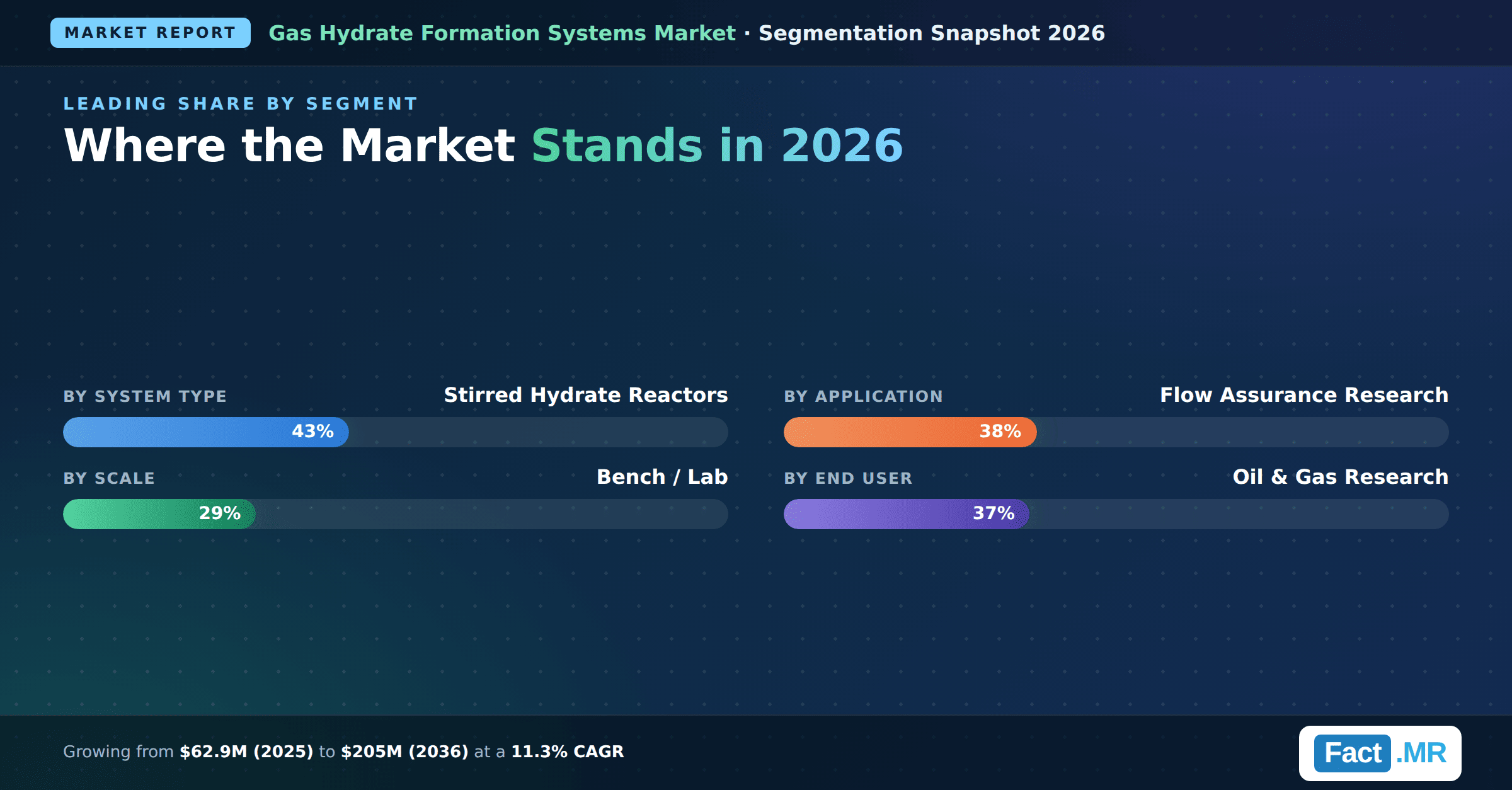
The global Gas Hydrate Formation Systems Market is poised for robust expansion as energy companies, research laboratories, and academic institutions increase investments in advanced hydrate testing technologies. According to the latest market analysis, the market is projected to grow from USD 70.0 million in 2026 to USD 205.0 million by 2036, registering a strong 11.3% CAGR during the forecast period. The market was valued at USD 62.9 million in 2025, reflecting growing laboratory and pilot-scale demand for hydrate formation studies.
Get detailed market forecasts, competitive benchmarking, and pricing trends: https://www.factmr.com/connectus/sample?flag=S&rep_id=15679
The increasing focus on pipeline flow assurance, offshore energy development, methane hydrate resource research, and carbon capture initiatives is creating sustained demand for systems capable of reproducing hydrate formation under controlled pressure and temperature conditions. Laboratories increasingly require equipment that delivers repeatable experimental conditions, accurate measurements, and enhanced safety, making gas hydrate formation systems indispensable for modern energy research.
Key Market Highlights at a Glance
- Market Value (2025): USD 62.9 Million
- Estimated Market Value (2026): USD 70.0 Million
- Forecast Market Value (2036): USD 205.0 Million
- Forecast Period: 2026–2036
- CAGR (2026–2036): 11.3%
- Absolute Dollar Opportunity: USD 135.0 Million
- Leading System Type: Stirred Hydrate Reactors (43.0% share in 2026)
- Leading Application: Flow Assurance Research (38.0% share in 2026)
- Leading Scale: Bench/Lab Systems (29.0% share in 2026)
- Leading End User: Oil & Gas Research (37.0% share in 2026)
- Fastest-Growing Country: United States (12.9% CAGR)
- Countries Profiled: USA, Australia, Norway, Japan, UK, along with additional countries across North America, Latin America, Europe, East Asia, South Asia, Oceania, and the Middle East & Africa
- Research Base:
- 120+ data sources
- 35+ company portfolios
- 25+ countries analyzed
- 20+ industry interviews
Why Is the Gas Hydrate Formation Systems Market Growing?
The market is experiencing significant momentum as offshore exploration, subsea infrastructure, methane hydrate studies, and carbon management projects require increasingly sophisticated laboratory equipment capable of accurately reproducing hydrate formation and dissociation.
Major demand drivers include:
- Growing investments in flow assurance research for subsea and pipeline integrity.
- Increasing need for high-pressure pressure-temperature testing for hydrate formation and inhibitor evaluation.
- Rising adoption of laboratory systems supporting CO₂ hydrate storage and sequestration research.
Shambhu Nath Jha, Sr. Consultant at Fact.MR, commented:
"Gas hydrate formation systems must give researchers stable pressure control, reliable mixing, and repeatable temperature behavior. Purchase decisions are expected to depend on whether each system matches the required hydrate study rather than on vessel capacity alone."
Which System Type Leads the Gas Hydrate Formation Systems Market?
Stirred hydrate reactors are expected to dominate the market because they provide highly repeatable mixing conditions during hydrate nucleation and crystal growth, making them the preferred choice for laboratory research.
Researchers increasingly favor stirred hydrate reactors because precise control of temperature, pressure, and mixing produces consistent experimental outcomes across multiple hydrate studies.
Key highlights include:
- Stirred Hydrate Reactors: 43.0% market share (2026)
- Rocking-cell systems remain important for inhibitor screening.
- High-pressure view cells support visual hydrate observation.
- Flow-loop hydrate rigs are increasingly used for dynamic pipeline simulations.
- Bulk hydrate reactors serve larger-scale research applications.
Why Does Flow Assurance Research Lead Application Demand?
Flow assurance research remains the largest application because hydrate blockages continue to pose major operational risks for offshore pipelines and subsea transportation systems.
Operators increasingly invest in laboratory validation before commissioning expensive offshore assets, making hydrate testing a standard engineering requirement.
Application highlights include:
- Flow Assurance Research: 38.0% share (2026)
- Hydrate Gas Storage emerging as an important research area.
- CO₂ Capture & Sequestration studies expanding.
- Desalination research utilizing similar pressure-controlled systems.
How Does Scale Influence Equipment Demand?
Bench and laboratory systems represent the largest equipment category because nearly every hydrate research program begins with controlled laboratory experiments before scaling to pilot operations.
Laboratory systems remain the preferred investment due to lower capital requirements, faster testing cycles, and greater flexibility for multiple research programs.
Scale highlights include:
- Bench/Lab Systems: 29.0% share (2026)
- Pilot rigs support technology validation.
- Semi-industrial systems enable scale-up testing.
- Field-test units serve advanced demonstration projects.
Why Does Oil & Gas Research Dominate End-User Demand?
Oil and gas research organizations remain the largest buyers because hydrate formation directly affects pipeline safety, production efficiency, and offshore asset reliability.
Laboratories supporting upstream operators require advanced systems capable of evaluating hydrate formation, inhibitor performance, and dissociation behavior under realistic operating conditions.
End-user highlights include:
- Oil & Gas Research: 37.0% share (2026)
- Academic Institutions remain significant buyers.
- National laboratories support strategic hydrate studies.
- Environmental research organizations continue expanding hydrate-related projects.
Market Dynamics
Market Drivers
Growing offshore developments continue to increase demand for hydrate testing before field deployment. Pipeline operators require reliable laboratory validation to minimize hydrate blockage risks and optimize flow assurance strategies.
Primary growth drivers include:
- Flow assurance testing
- Stable pressure-temperature control
- Hydrate gas storage research
- Bench/lab equipment replacement
- Custom engineering capabilities
Market Restraints
Despite strong demand, adoption remains constrained by the specialized nature of high-pressure hydrate research systems.
Major restraints include:
- High custom engineering costs
- Strict pressure safety certification requirements
- Limited replacement purchases
- Scale-up uncertainty from laboratory to field applications
Market Trends
Several technology trends are reshaping the competitive landscape.
Key trends include:
- Increasing deployment of high-pressure visual cells
- Rising adoption of flow-loop hydrate rigs
- Growing CO₂ hydrate research
- Expansion of pilot-scale hydrate testing
- Greater emphasis on integrated pressure-temperature monitoring
Regional and Country Outlook
Country Growth Forecast (2026–2036)
- United States: 12.9% CAGR
- Australia: 12.6% CAGR
- Norway: 12.2% CAGR
- Japan: 11.8% CAGR
- United Kingdom: 11.5% CAGR
United States
The United States leads global growth due to strong investment in flow assurance research, laboratory-scale hydrate testing, and energy infrastructure modernization. Government research initiatives and private-sector innovation continue to stimulate equipment purchases.
Australia
Australia's expanding offshore energy sector and pilot-scale hydrate research programs are driving demand for advanced pressure-temperature testing systems capable of supporting large research initiatives.
Norway
Norway's expertise in subsea production systems continues to generate strong demand for hydrate research equipment focused on inhibitor testing, blockage prevention, and flow-loop experimentation.
Japan
Japan remains a major market due to ongoing methane hydrate resource development and engineering programs requiring highly repeatable hydrate formation studies under controlled laboratory environments.
United Kingdom
The UK's offshore research ecosystem and specialist laboratory infrastructure continue to support steady demand for high-pressure hydrate formation systems serving academia and the energy sector.
Competitive Landscape
Leading market participants continue focusing on specialized hydrate research equipment rather than general laboratory pressure vessels. Competitive differentiation increasingly depends on reactor precision, pressure control, visualization capability, and customized engineering support.
Key market participants include:
- Vinci Technologies — Specialized gas hydrate autoclaves and high-pressure visual cells
- PSL Systemtechnik — Rocking-cell hydrate testing systems
- Coretest Systems — High-pressure laboratory testing solutions
- Sanchez Technologies (Core Laboratories) — Advanced hydrate research equipment
The competitive environment remains highly specialized, with suppliers competing primarily on technical capability, safety certification, measurement precision, and customization rather than production volume.
Frequently Asked Questions (FAQ)
What is the projected size of the Gas Hydrate Formation Systems Market by 2036?
The Gas Hydrate Formation Systems Market is projected to reach USD 205.0 million by 2036, growing from USD 70.0 million in 2026.
What is the expected CAGR of the Gas Hydrate Formation Systems Market?
The market is forecast to grow at a compound annual growth rate (CAGR) of 11.3% between 2026 and 2036.
Which system type leads the Gas Hydrate Formation Systems Market?
Stirred hydrate reactors are expected to lead the market with a 43.0% share in 2026 because they provide highly repeatable mixing and controlled hydrate formation.
Which application accounts for the largest market share?
Flow assurance research is projected to account for 38.0% of the market in 2026, driven by increasing pipeline and offshore hydrate risk assessment.
Which end-user segment dominates the market?
Oil & gas research organizations are expected to represent 37.0% of total market demand in 2026, supported by ongoing pipeline integrity and reservoir studies.
Which country is expected to grow the fastest?
The United States is forecast to register the fastest growth, expanding at a 12.9% CAGR during the 2026–2036 forecast period.
Who are the leading companies in the Gas Hydrate Formation Systems Market?
Major companies include Vinci Technologies, PSL Systemtechnik, Coretest Systems, and Sanchez Technologies (Core Laboratories).
To View Related Report:
Bridge Inspection Services Market https://www.openpr.com/news/4510650/bridge-inspection-services-market-outlook-digital-monitoring
Warehouse Digital Twin Orchestration Software Market https://www.openpr.com/news/4511852/warehouse-digital-twin-orchestration-software-reshapes-modern
Industrial Waste Heat to Cooling Systems Market https://www.openpr.com/news/4511869/industrial-waste-heat-to-cooling-systems-gain-momentum-as
Industrial Evaporators Market https://www.openpr.com/news/4511890/industrial-evaporators-market-advances-as-manufacturers
About Fact.MR
Fact.MR is a global market research and consulting firm delivering actionable intelligence across industrial, technology, healthcare, chemicals, energy, and consumer sectors. Through rigorous primary research, advanced market modeling, and expert analysis, Fact.MR enables organizations to make informed strategic decisions and capitalize on emerging market opportunities.

 English
 Arabic
 French
 Spanish
 Portuguese
 Turkish
 Dutch
Dutch
 Italiano
 Russian
 Romaian
 Portuguese (Brazil)
 Greek
Greek
