
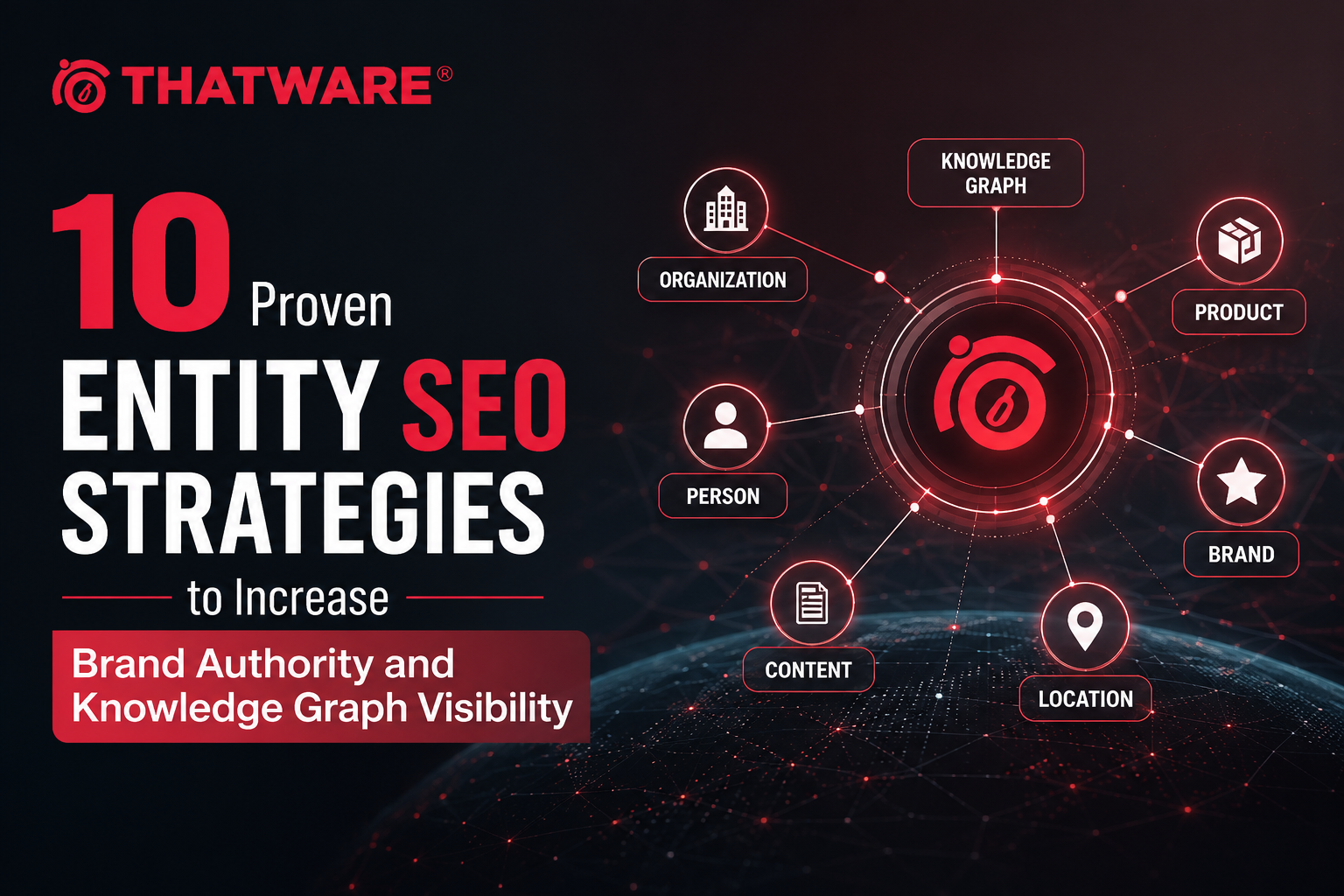
10 Proven Entity SEO Strategies to Increase Brand Authority and Knowledge Graph Visibility
Introduction
Search engines no longer just match keywords — they understand entities: real people, places, brands, and concepts, and how they relate to one another. This shift is why Entity SEO has become one of the most important strategies for brands wanting to appear prominently in Google's Knowledge Graph, featured snippets, and even AI-powered answer engines. If your brand isn't clearly defined as an entity, search engines and large language models may struggle to recognize your authority — no matter how much content you publish. This blog breaks down 10 proven Entity SEO strategies that strengthen semantic relevance, build topical authority, and improve Knowledge Graph visibility. Whether you're a growing business or an established brand, these techniques, used by experts like ThatWare LLP, can help you become a recognized, trusted entity across search and AI platforms.
What Is Entity SEO and Why It Matters Today
Entity SEO is the practice of optimizing your website and online presence so that search engines can accurately identify, verify, and connect your brand, products, and key concepts as distinct "entities" within their knowledge systems. Unlike traditional keyword SEO, Entity Optimization focuses on context, relationships, and meaning rather than exact-match phrases.
With the rise of AI Overviews, voice search, and generative answer engines, Knowledge Graph SEO and Semantic SEO have become essential ranking factors. Google's systems now prioritize brands that are:
- Clearly defined with consistent entity data across the web
- Connected to authoritative sources (Wikipedia, Wikidata, LinkedIn, industry directories)
- Structured with machine-readable markup (schema.org)
- Mentioned in context alongside related, trusted entities
Without entity clarity, even well-written content can be overlooked by both traditional search engines and AI-driven platforms.
10 Proven Entity SEO Strategies for Brand Authority
1. Build and Optimize a Wikidata Profile
Wikidata is one of the primary sources search engines pull entity data from. Creating an accurate, well-sourced Wikidata entry helps validate your brand as a recognized entity.
2. Implement Schema Markup Extensively
Structured data — especially Organization, Person, Product, and FAQ schema — tells search engines exactly who you are and how your content relates to real-world entities.
3. Establish Topical Authority Through Content Clusters
Publishing interlinked content around a core topic (pillar pages + supporting articles) signals depth of expertise, a key factor in Semantic SEO.
4. Maintain NAP and Brand Consistency Across Platforms
Your Name, Address, and Phone details — along with brand descriptions — should be identical across your website, Google Business Profile, social media, and directories.
5. Get Mentioned Alongside Authoritative Entities
Earning mentions (with or without backlinks) on high-authority sites, industry publications, or news outlets strengthens co-citation signals.
6. Optimize Google Business Profile and Knowledge Panel
A fully verified, detailed Google Business Profile increases eligibility for a Knowledge Panel — a strong visual indicator of entity recognition.
7. Use Internal Linking to Reinforce Entity Relationships
Strategically linking related pages (services, case studies, authors) helps search engines map the relationships between entities on your site.
8. Leverage Author and Team Entity Profiles
Detailed author bios with credentials, linked social profiles, and consistent naming help establish E-E-A-T (Experience, Expertise, Authority, Trust).
9. Earn Digital PR and Brand Mentions
Digital PR campaigns that generate organic brand mentions across news sites and blogs help reinforce your entity's credibility at scale.
10. Monitor and Refine Entity Data Regularly
Entity SEO isn't a one-time task. Regularly auditing structured data, citations, and Knowledge Graph accuracy ensures your brand entity stays current and correctly represented.
Benefits of Entity SEO for Your Business
Investing in Entity Optimization delivers measurable, long-term value:
- Improved Search Visibility: Higher chances of appearing in Knowledge Panels, featured snippets, and AI Overviews
- Stronger Brand Trust: Verified entity data builds credibility with both users and search algorithms
- Better AI Platform Recognition: Clear entity signals help LLM-based platforms (ChatGPT, Gemini, Perplexity) reference your brand accurately — key for Generative Engine Optimization (GEO) and Answer Engine Optimization (AEO)
- Higher Click-Through Rates: Rich entity data often results in more prominent, visually distinct search listings
- Long-Term SEO Resilience: Entity-based signals are less vulnerable to algorithm updates than keyword-only strategies
Why Choose ThatWare LLP for Entity SEO Optimization
ThatWare LLP specializes in advanced, data-driven Entity SEO strategies designed to strengthen brand authority and Knowledge Graph SEO visibility. Their approach combines semantic content architecture, structured data implementation, and entity-based link building to help brands become recognized, trusted, and accurately represented across search engines and emerging AI platforms.
With a strong focus on Semantic SEO and future-ready optimization techniques, ThatWare LLP helps businesses move beyond outdated keyword tactics and build a genuinely authoritative digital presence — one entity connection at a time.
Conclusion and Next Steps
Entity SEO is no longer optional — it's foundational to how modern search engines and AI platforms understand and rank your brand. From Wikidata profiles to schema markup and topical content clusters, each strategy discussed above contributes to a stronger, more recognizable brand entity.
Ready to strengthen your brand's Knowledge Graph visibility and search authority? Explore ThatWare LLP's dedicated Entity SEO Optimization services to get a customized strategy built around your business goals.
FAQs
Q1. What is Entity SEO? Entity SEO is the process of optimizing your online presence so search engines can clearly identify, verify, and connect your brand as a distinct entity, rather than relying solely on keywords.
Q2. How is Entity SEO different from traditional keyword SEO? Traditional SEO focuses on matching search terms, while Entity SEO focuses on context, relationships, and meaning — helping search engines understand who and what your brand represents.
Q3. Why is Knowledge Graph visibility important? Appearing in Google's Knowledge Graph increases brand trust, visibility, and click-through rates, and improves how your brand is represented in AI-generated answers.
Q4. Does Entity SEO help with AI platforms like ChatGPT or Gemini? Yes. Strong entity signals improve how accurately AI and LLM-based platforms reference and describe your brand, which is central to AEO and GEO optimization.
Q5. How long does it take to see results from Entity SEO? Results vary, but most brands begin seeing improved recognition and visibility within 3-6 months of consistent entity optimization efforts.
Q6. Can ThatWare LLP help with Entity SEO for any industry? Yes, ThatWare LLP's Entity SEO strategies are customized to fit various industries and business sizes, focusing on measurable authority and visibility growth.

 English
 French
 Spanish
 Portuguese
 Deutsch
 Turkish
 Dutch
Dutch
 Italiano
 Russian
 Romaian
 Portuguese (Brazil)
 Greek
Greek
