
From Measurements to Budgets: The Power of Accurate Roofing Estimates
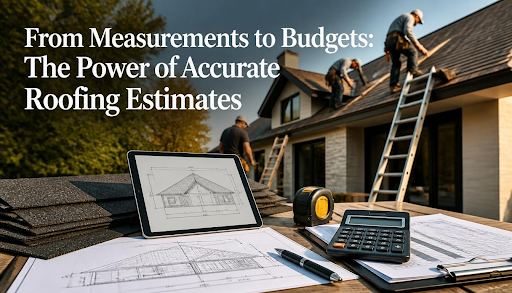
The power of accurate roofing estimates is that they help you plan your budget with confidence from the very beginning. A precise estimate relies on exact roof dimensions, accurate material quantities and accurate labor pricing for an estimate you can actually trust. Missing this step leads to unanticipated fees midway through the project. According to NerdWallet, homeowners nationally pay anywhere from $4 to $11 per square foot for a roof, depending on material and size.
What Is the Actual Cost Difference Between An Accurate and A Rough Estimate?
An average roof, for instance, could cost you between $900 and $1500 for a 10% miscount of shingles. That difference is never included in the original quote and is always presented as a change order. This can reduce profits or lead to an unexpected price increase.
Accurate Roof Cost Estimate vs. Poor Estimate: What It Does to Your Project
The difference isn't just a number on paper. It changes how the whole job runs, from the first material order to the final invoice.
|
Project Area |
Accurate Estimate |
Poor Estimate |
|
Material order |
Ordered once, matches the roof |
Falls short, needs a second delivery mid-job |
|
Budget |
Client sees a number that holds |
The price creeps up with change orders |
|
Schedule |
Crew keeps moving; there are no interruptions |
Job stalls waiting on backordered shingles |
|
Client trust |
The final invoice matches the quote |
The final invoice surprises the client and damages trust |
|
Inspection/warranty |
The correct underlayment and waste factor pass review |
A wrong material count can affect the manufacturer's warranty terms |
How Do Contractors Calculate a Roofing Estimate?
Contractors divide roofs into squares, which are assumed to be 100 square feet each. Then, they multiply by material and labor cost per square foot. Most contractors today pair a measurement tool with a physical walk-through to confirm pitch, layers, and any hidden damage.
Here's the typical process that contractors follow to calculate a detailed roof estimate:
-
Measure the roof. This can be done by using aerial imagery, a smartphone-based 3D scan, or a physical tape-and-ladder walk.
-
Calculate total squares, including a waste factor, usually 10-15% extra for cuts and hips. A number of contractors outsource expert quantity takeoff services to determine the precise amount of shingles, underlayment, flashing and other roofing materials that they will need before ordering.
-
Account for valley, chimney, skylight and vent as these are common roof features that increase labor hours.
-
Check pitch and layers. Steep roofs and removing old layers both cost more per square.
-
Apply current material and labor rates from up-to-date supplier pricing, not numbers from last year.
-
Add permit and disposal fees. These get missed out in a lot of rough, verbal estimates.
Skipping the waste factor is one of the most common mistakes newer contractors make. It's also the one that quietly adds hundreds of dollars to a final bill.
Can I Measure My Own Roof for an Estimate?
You can get a rough estimate from your home's floor plan, but roof pitch adds real surface area that a floor plan won't show. So always pair any measurement you do yourself with a professional on-site inspection before you plan your budget around it. You can also outsource expert roofing estimating services if you want a more accurate estimate without doing all the measurements yourself. This can help you plan your budget with more confidence.
Do Digital Measurement Tools Really Improve Accuracy?
Yes, digital measurement tools like EagleView and Hover obtain roof dimensions from aerial imagery by reducing human error in the calculation. The real lesson is that no single tool covers everything on its own. A solid estimate combines remote measurement with an actual walk-through, especially on older homes or anything with a busy roofline.
-
EagleView is used heavily by insurance adjusters and larger roofing companies for its detailed reports and pitch detection.
-
Hover lets homeowners take a few smartphone photos and generates a 3D model with square footage.
-
GAF QuickMeasure is free for contractors enrolled in GAF's certified network and is tied directly into their material calculators.
According to EagleView, one of the most widely used aerial measurement providers, an independent 2025 study by the surveying firm CompassData compared EagleView's reports against independent benchmark scans. The result is that roofline measurements came in 98.77% accurate, roof area 98.43% accurate, and roof slope 98.49% accurate.
But none of these tools can replace a physical inspection. Software can't see if the decking underneath is rotted, and that's a cost no algorithm will catch until an expert is up on the roof with a screwdriver testing for soft spots.
How Do Different Estimate Methods Compare in Accuracy?
Not every measurement method gives you the same accuracy. Some are much more accurate than others.
|
Estimate Method |
What It Measures |
Known Limitation |
|
Ground-level visual guess |
Rough square footage only |
Misses slope, pitch, and waste factor entirely; no real accuracy to speak of |
|
Aerial imagery |
Full roof geometry, from above |
Can't see under eaves; needs existing flyover images to work |
|
Smartphone 3D scan |
Roof, walls, soffits, and fascia |
Still needs someone on-site to do the scan |
|
Physical walk-through inspection |
Hidden damage and decking condition |
Slower, but it's the only method that catches what a camera can't |
|
Drone + physical inspection |
Combines remote data with a hands-on check |
Fewest surprises, tightest budget, but takes the most time upfront |
Honestly, the safest approach pairs a measurement tool like a drone with a physical inspection. Better roof measurements improve construction cost estimation. If the measurements are precise, it becomes easier to determine the costs of the project, including material, labour and other costs.
The Bottom Line
Getting an accurate roofing estimate does not just help you save a few hundred bucks. It's about your project actually finishing on time, your budget staying on track, and reducing the risks of roofing problems in the future. The power of accurate estimates is that they help you avoid costly surprises and keep your roofing project under control from beginning to end. So before you agree to any quote, make sure it is based on real measurements, ones that come from actual tools, not from a glance at the drawings. Also, make sure someone inspects your roof in person too.
FAQ
Do roofing estimates cost anything?
Most contractors offer free estimates for standard residential roofing. Independent aerial measurement reports can often cost around $15-$87, depending on report type, although many contractors fold this cost into the free quote.
How long does an accurate roof measurement take?
Aerial or smartphone scans usually take a few hours up to a couple of days. A complete on-site inspection usually takes one or two hours on-site.

 English
 French
 Spanish
 Portuguese
 Deutsch
 Turkish
 Dutch
Dutch
 Italiano
 Russian
 Romaian
 Portuguese (Brazil)
 Greek
Greek
