
US Aviation IoT Market Size, Share, Trends 2035
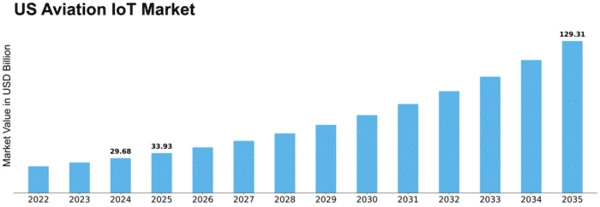
As per Market Research Future analysis, the US Aviation IoT Market Size was estimated at 29.68 USD Billion in 2024. The US aviation IoT market is projected to grow from 33.93 USD Billion in 2025 to 129.31 USD Billion by 2035, exhibiting a compound annual growth rate (CAGR) of 14.3% during the forecast period 2025–2035.
Introduction
IoT adoption in the US aviation sector is transforming how airlines, airports, and aviation authorities manage complex operations. By enabling continuous connectivity between aircraft, ground systems, and operational control centers, aviation IoT creates a data-driven ecosystem that enhances situational awareness and decision-making. The growing reliance on real-time data is redefining traditional aviation workflows and establishing a new standard for operational excellence.
Market Growth and Trends
The US Aviation IoT market is experiencing rapid growth as airlines increasingly prioritize digital transformation initiatives. Predictive maintenance powered by IoT analytics is emerging as a key trend, allowing airlines to anticipate component failures before they occur. This approach not only reduces maintenance costs but also improves aircraft availability and flight reliability.
Another important trend is the adoption of IoT in air traffic management and airport operations. Smart surveillance systems, connected weather monitoring solutions, and automated runway management tools are being deployed to enhance safety and reduce congestion. The rise of cloud-based IoT platforms is also enabling scalable and flexible deployment of connected aviation solutions across the US.
Key Drivers, Challenges, Trends, and Opportunities
Key drivers include the need for cost optimization, improved safety performance, and enhanced passenger experience. Airlines are using IoT-generated insights to optimize fuel usage, reduce turnaround time, and improve on-time performance. Regulatory compliance requirements related to safety monitoring and reporting are further accelerating IoT adoption.
Challenges include data integration complexity and the need for skilled personnel capable of managing advanced IoT systems. Interoperability between different IoT platforms and aviation systems remains a technical hurdle. Additionally, ensuring cybersecurity resilience across interconnected aviation networks is a critical priority.
Opportunities lie in the expansion of smart airport initiatives and the integration of IoT with emerging technologies such as artificial intelligence and machine learning. Advanced analytics can unlock deeper insights from IoT data, enabling proactive risk management and strategic planning. The increasing use of unmanned aerial systems and advanced air mobility platforms also presents new growth opportunities for aviation IoT solutions.
Future Scope
Looking ahead, the US Aviation IoT market is expected to evolve toward fully connected and autonomous aviation ecosystems. Real-time aircraft-to-ground communication, intelligent airspace management, and self-optimizing airport systems will become more prevalent. As technology maturity increases, IoT will play a central role in shaping the future of safe, efficient, and sustainable aviation in the United States.
Discover More Research Reports on Aerospace & Defense By Market Research Future
US Organic Feed Additives market

 English
 Arabic
 French
 Spanish
 Portuguese
 Deutsch
 Dutch
Dutch
 Italiano
 Russian
 Romaian
 Portuguese (Brazil)
 Greek
Greek