
Latin America Temperature Sensor Market Driven by Industrial Automation Growth
The Latin America Temperature Sensor Market: Engineering Precision in an Era of Digital Transformation (2026–2032)
In the rapidly evolving landscape of industrial automation, temperature monitoring has emerged as a cornerstone of operational efficiency. As Latin American Temprature Sensor Market industries—ranging from oil and gas to advanced manufacturing and pharmaceuticalsaccelerate their transition toward Industry 4.0, the regional market for temperature sensors is poised for a significant transformation. A global leader in market intelligence, provides an in-depth analysis of this vital sector, highlighting the strategic shifts, technological integration, and investment opportunities defining the Latin American landscape through 2032.
𝐃𝐨𝐰𝐧𝐥𝐨𝐚𝐝 𝐅𝐫𝐞𝐞 𝐏𝐃𝐅 𝐁𝐫𝐨𝐜𝐡𝐮𝐫𝐞 @https://www.maximizemarketresearch.com/request-sample/4680/
The Strategic Role of Temperature Sensing in Latin American Industry
Temperature sensors serve as the "nervous system" of modern industrial infrastructure. Whether it is ensuring the integrity of a pharmaceutical cold chain, optimizing thermal output in lithium extraction, or maintaining safety standards in petrochemical refineries, these devices are indispensable.
In Latin America, the market is undergoing a fundamental shift. Traditionally driven by the necessity of basic process control, the market is now being reshaped by the demand for "intelligent" sensing—devices that do not merely measure heat but feed critical, real-time data into predictive maintenance and analytics platforms. As regional economies focus on factory digitization and infrastructure modernization, the adoption of high-precision temperature monitoring is no longer viewed as an operational cost, but as a strategic investment.
Market Dynamics: Forces Shaping the Future
Navigating the Latin American market requires a clear understanding of the drivers and headwinds currently influencing stakeholder decisions.
1. Industrial Digitization and Industry 4.0
The primary driver for the regional market is the systematic upgrade of legacy industrial infrastructure. Across Brazil, Mexico, and Argentina, there is a marked focus on integrating IoT (Internet of Things) and edge computing. Sensors are now expected to be "connected," enabling remote monitoring and data-driven decision-making that reduces downtime and optimizes energy consumption.
2. The Rise of Lithium and Energy Storage
Latin America’s "Lithium Triangle" (Argentina, Chile, and Bolivia) and Brazil’s expanding battery gigafactory initiatives are creating localized demand for high-accuracy thermal management solutions. Cell pack manufacturing requires multi-point sensors to detect potential thermal runaways before they occur, triggering significant procurement cycles for high-accuracy digital integrated circuits (ICs).
3. Precision Agriculture and Food Security
As a global powerhouse in agricultural exports, Latin America is increasingly deploying smart farming technologies. Temperature sensors are critical for monitoring soil conditions, greenhouse climates, and, crucially, the "cold chain" logistics required to export perishable goods to international markets without loss of quality.
4. Regulatory and Logistical Challenges
While growth prospects are robust, the market is not without complexity. High import tariffs on advanced sensor modules often create a friction point for local distributors. Furthermore, cross-qualification costs for industrial-grade sensors can slow adoption cycles. Manufacturers and distributors that can provide localized support, calibration services, and supply-chain resilience are currently outperforming those who rely solely on imports.
Segmental Growth: Where the Capital is Flowing
A granular analysis of the market reveals specific segments that are capturing the most interest from investors and industry leaders:
-
Connectivity (Wired vs. Wireless): While wired sensors remain the backbone of heavy industrial facilities due to their reliability in high-interference environments, the wireless node segment is experiencing a faster growth rate. Wireless technology is the key enabler for remote monitoring in logistics and scattered agricultural sites.
-
Technology Segmentation: Thermocouples continue to lead in terms of market share due to their ruggedness in high-heat industrial applications. However, fiber-optic sensors are gaining traction in specialized sectors like oil and gas, where immunity to electromagnetic interference is a vital requirement.
-
Output Interface: The transition from analog to digital output interfaces is accelerating. Digital sensors offer superior noise immunity, simplified integration with modern bus architectures, and the ability to output "smart" diagnostic data.
Regional Spotlight: Brazil as the Growth Engine
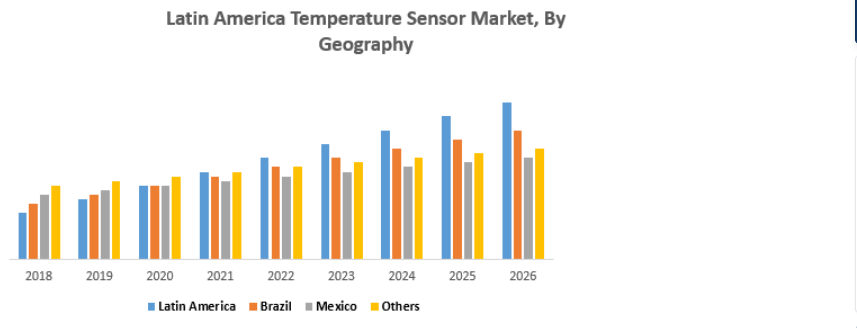
Brazil currently commands the largest share of the Latin American temperature sensor market, supported by a strong domestic automotive manufacturing sector and aggressive government incentives for industrial digitalization. Chile is emerging as a high-growth market, driven by its sophisticated mining sector and rapid adoption of automated instrumentation to meet global sustainability standards.
For international firms, the "country-specific" strategy is vital. Navigating the unique economic and regulatory frameworks of Mexico—which is deeply integrated into North American supply chains—requires a different tactical approach than catering to the resource-heavy industrial needs of the Andean nations.
Strategic Decision-Making: A Guide for Stakeholders
For businesses, investors, and procurement officers, the decision to invest in specific temperature-sensing technologies should be based on three core pillars:
-
Prioritize Interoperability: Ensure that hardware choices are compatible with standard industrial communication protocols (such as IO-Link or Modbus). The goal is to avoid "siloed" data and ensure that temperature insights can be aggregated at the enterprise level.
-
Invest in "Lifecycle" Partnerships: The value of a sensor is measured over its lifetime, not its purchase price. Align with vendors who offer robust local calibration services and technical support. In regions where supply chains can be volatile, local availability is a competitive advantage.
-
Adopt Predictive-Ready Hardware: As predictive maintenance becomes the industry standard, prioritize sensors that offer internal diagnostics and self-calibration features. These "smarter" components reduce the frequency of manual inspection, thereby lowering total operational expenditure.
The Competitive Landscape
The market is characterized by a mix of global technology leaders and specialized local distributors. Competitive pressure is pushing manufacturers to differentiate through software integration—providing dashboards and analytics that turn raw temperature data into actionable business intelligence.
Leading companies are focusing on three main areas:
-
Ruggedization: Developing sensors that survive the harsh conditions of Latin American mining and offshore oil extraction.
-
Calibration Services: Bridging the technical gap for local manufacturers by providing easy-to-use validation tools.
-
Ecosystem Building: Collaborating with software platforms to ensure that sensor data is immediately useful for AI-driven maintenance systems.
-
Some of the key players of the Latin America Temperature Sensor market include:
• Sensor Technology
• Omega Engineering
• Esterline
• QTI Sensing Solutions
• Nippon Instruments
• Pyromation
• United Electric Controls
• Micro-epsilon
• Sensirion
• Yokogawa
• Texas Instruments
• STMicroelectronics
• Honeywell International
• Infineon Technologies AG
• Freescale semiconductor Inc.
• Maxim Integrated Products Inc.
For full access to the comprehensive strategic report, visit:https://www.maximizemarketresearch.com/market-report/latin-america-temperature-sensor-market/4680/
Conclusion: Engineering a Smarter Future
The Latin American temperature sensor market is evolving from a commodity-based sector into a high-tech ecosystem. As the region solidifies its role in the global supply chain—from high-tech electronics to essential agricultural exports—the demand for reliable, precise, and "connected" thermal data will continue to rise.
Stakeholders who recognize the shift toward digitalization and invest in locally supported, high-accuracy sensing solutions will find themselves at the center of the region's industrial advancement. Maximize Market Research remains dedicated to tracking these transformations, providing the clarity and insight necessary to make informed investment decisions in an increasingly interconnected global market.
About Maximize Market Research
Maximize Market Research is a multifaceted market research and consulting company with professionals from several industries. Some of the industries we cover include medical devices, pharmaceutical manufacturers, science and engineering, electronic components, industrial equipment, technology and communication, cars and automobiles, chemical products and substances, general merchandise, beverages, personal care, and automated systems. To mention a few, we provide market-verified industry estimations, technical trend analysis, crucial market research, strategic advice, competition analysis, production and demand analysis, and client impact studies.
Contact Maximize Market Research
3rd Floor, Navale IT Park, Phase 2
Pune Bangalore Highway, Narhe,
Pune, Maharashtra 411041, India
sales@maximizemarketresearch.com
+91 96071 95908, +91 9607365656

 English
 Arabic
 French
 Spanish
 Portuguese
 Deutsch
 Turkish
 Dutch
Dutch
 Russian
 Romaian
 Portuguese (Brazil)
 Greek
Greek
