
Digital Camera Market Share, Demand and Competitive Landscape Analysis
The Future of Imaging: Navigating the Global Digital Camera Market (2026–2032)
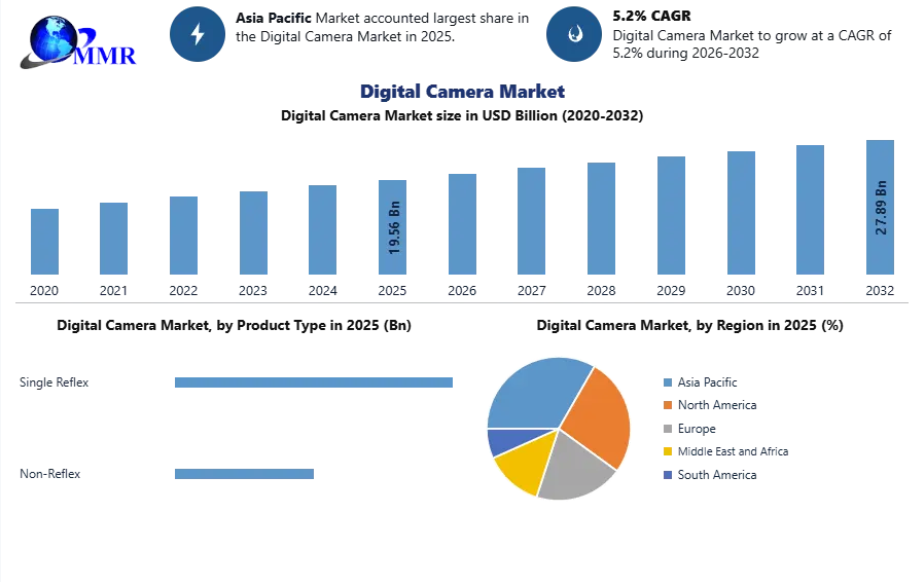
The global landscape of visual documentation is undergoing a seismic shift. Once a market dominated by point-and-shoot simplicity, the digital camera industry has matured into a sophisticated ecosystem driven by high-end performance, professional content creation, and cutting-edge optical engineering. As of 2025, the Digital Camera Market was valued at approximately USD 19.56 Billion, and industry analysts project a steady growth trajectory, reaching USD 27.89 Billion by 2032 with a CAGR of 5.2%.
However, this growth is not occurring in a vacuum. Navigating the modern market requires an understanding of how manufacturers are pivoting amidst supply chain volatility, the relentless rise of computational photography, and the evolving demands of a new generation of creators.
𝐃𝐨𝐰𝐧𝐥𝐨𝐚𝐝 𝐅𝐫𝐞𝐞 𝐏𝐃𝐅 𝐁𝐫𝐨𝐜𝐡𝐮𝐫𝐞 @https://www.maximizemarketresearch.com/request-sample/54990/
The Evolution of Imaging: Beyond the Sensor
The contemporary digital camera market is defined by a strategic inflection point. While the proliferation of high-end smartphone cameras initially threatened the "point-and-shoot" segment, it paradoxically created a massive pipeline of aspiring creators. Today’s consumers are no longer satisfied with mobile optics; they are graduating to dedicated mirrorless systems that offer superior dynamic range, interchangeable lenses, and professional-grade video capabilities.
The industry is currently transitioning toward "Premiumization." Manufacturers are focusing on high-margin mirrorless models that cater to the professional, vlogger, and enthusiast markets. This shift is essential, as the industry faces logistical challenges—including energy-intensive sensor fabrication and global freight fluctuations—that necessitate a move toward higher-value, more resilient production models.
Key Drivers Shaping the Industry
Several critical factors are fueling the current demand for advanced imaging technology:
1. The Content Creation Boom
From platforms like YouTube, Instagram, and TikTok to the rise of independent cinema, the demand for high-quality video content has never been higher. Cameras are now being designed with specialized features such as 4K/6K recording, high-frame-rate options, and advanced autofocus tracking. This "creator-centric" design philosophy is a primary driver for sustained market growth.
2. The Dominance of Mirrorless Technology
Mirrorless cameras have effectively cannibalized the DSLR market. By removing the bulky mirror mechanism, manufacturers can produce smaller, lighter, and faster bodies. Features like electronic viewfinders (EVFs) provide real-time exposure feedback, an advantage that has proven irresistible to both professional photographers and casual enthusiasts.
3. AI and Computational Photography
Artificial Intelligence (AI) is no longer a futuristic concept; it is integrated into the core of modern camera systems. AI-driven scene recognition, real-time subject tracking (eye, animal, and vehicle detection), and automated settings adjustments have significantly lowered the barrier to entry for professional-grade photography.
Segment Analysis: The Engine of Revenue
The market is divided into distinct segments that reveal where the future of profitability lies:
-
Technology Segmentation (CCD vs. CMOS): The industry has decisively moved toward CMOS (Complementary Metal-Oxide-Semiconductor) technology. CMOS sensors offer superior processing speeds, higher sensitivity, and lower power consumption, making them the standard for modern high-speed and high-resolution imaging.
-
Application Segmentation (Personal vs. Professional): While the personal segment remains broad, the professional category remains the primary driver of high-end revenue. The demand from film producers, advertising agencies, and professional photographers for specialized optics and rugged, reliable hardware ensures that the professional segment remains the bedrock of the market's value.
Regional Growth Perspectives: A Global Snapshot
-
Asia-Pacific: This region is witnessing the fastest growth, fueled by an expanding middle class and a burgeoning culture of professional content creation. High disposable incomes in nations like China and India are transforming these markets into hotbeds for mid-to-high-end camera adoption.
-
North America & Europe: These markets remain the strongholds of legacy camera manufacturers. Here, the focus is on innovation, connectivity (Wi-Fi/Bluetooth integration), and ecosystem building. Users in these regions are early adopters of the latest lens technology and mirrorless advancements.
-
Emerging Markets: In South America, the Middle East, and Africa, the focus remains on balancing affordability with essential professional features. Manufacturers are successfully tailoring entry-level mirrorless products to meet the unique economic constraints of these regions.
Strategic Decision-Making: A Guide for Stakeholders
For investors, retailers, and industry participants, success depends on recognizing that the digital camera is no longer a standalone device; it is part of a digital workflow.
-
Embrace the Hybrid Workflow: The most successful players in the market are those who integrate their cameras seamlessly with smartphone ecosystems. Features that allow for instant transfer and cloud-based editing are no longer "optional"—they are expectations.
-
Focus on Niche Specialization: As seen with brands like Leica (luxury) or Pentax (rugged/adventure), the most successful companies are those that own a specific, dedicated user base. Avoid the "race to the bottom" in the budget segment and focus on quality and brand identity.
-
Sustainability as a Competitive Advantage: With global pressures mounting, brands that invest in sustainable manufacturing, recyclable materials, and energy-efficient electronics are better positioned to appeal to the environmentally conscious Gen Z and Millennial consumer base.
The Competitive Landscape
The market remains a battleground for titans such as Canon, Nikon, Sony, Fujifilm, and Panasonic. However, the competition has shifted from simple megapixel wars to innovation in image stabilization, autofocus speed, and software integration. The integration of high-end imaging tech into smartphones by companies like Apple and Samsung continues to exert pressure, forcing traditional camera makers to differentiate through unique optical characteristics and deep, ergonomic creative control.
Key Players / Competitors Profiles Covered in Brief in Global Digital Camera Market Report in Strategic Perspective:
- Leica
- Hasselblad
- Phase One
- ALPA
- RED Digital Cinema
- Polaroid
- Lomography
- Blackmagic Design
- Canon
- Nikon
- Fujifilm
- Sony
- Olympus
- Panasonic
- Xiaomi
- DJI
- GoPro, Inc.
- Ricoh Imaging Company, Ltd.
- Sigma Corporation
- OM Digital Solutions
- Samsung Electronics Co. Ltd.
- Insta360
- Eastman Kodak Company
- Carl Zeiss AG
- Casio Computer Co. Ltd.
For full access to the comprehensive strategic report, visit:https://www.maximizemarketresearch.com/market-report/global-digital-camera-market/54990/
Conclusion
The global digital camera market is far from stagnant. While it has been transformed by the rise of mobile photography, it has emerged as a leaner, more specialized, and highly innovative industry. By prioritizing high-end mirrorless systems, AI-driven performance, and the needs of the professional creator, the industry is well-positioned for sustainable growth through 2032. Success in this era belongs to those who view their cameras not just as tools of capture, but as essential components of the global digital communication network.
About Maximize Market Research
Maximize Market Research is a multifaceted market research and consulting company with professionals from several industries. Some of the industries we cover include medical devices, pharmaceutical manufacturers, science and engineering, electronic components, industrial equipment, technology and communication, cars and automobiles, chemical products and substances, general merchandise, beverages, personal care, and automated systems. To mention a few, we provide market-verified industry estimations, technical trend analysis, crucial market research, strategic advice, competition analysis, production and demand analysis, and client impact studies.
Contact Maximize Market Research
3rd Floor, Navale IT Park, Phase 2
Pune Bangalore Highway, Narhe,
Pune, Maharashtra 411041, India
sales@maximizemarketresearch.com
+91 96071 95908, +91 9607365656

 English
 Arabic
 French
 Spanish
 Portuguese
 Turkish
 Dutch
Dutch
 Italiano
 Russian
 Romaian
 Portuguese (Brazil)
 Greek
Greek
