
Industrial Salt Supply Chain: From Himalayan Rock Salt to Factory-Ready Materials
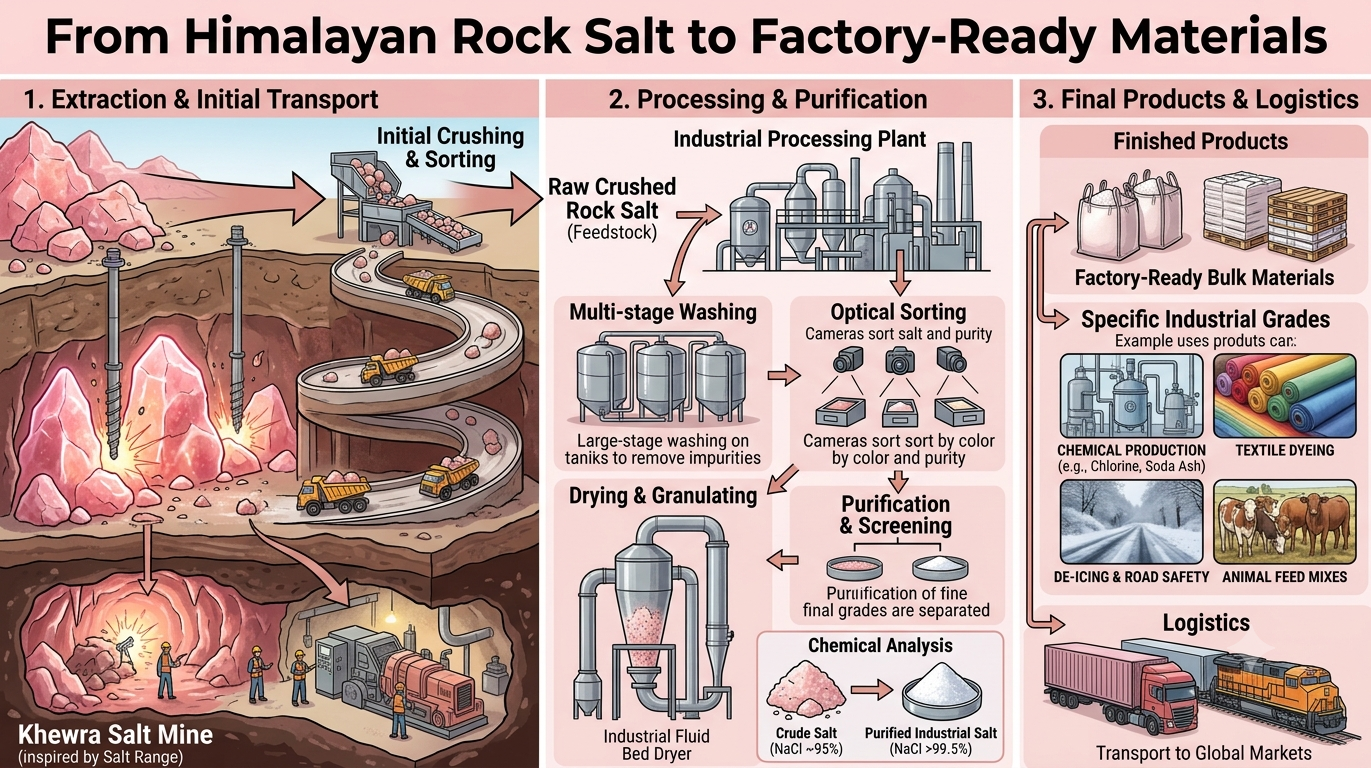
Most people notice salt only when it reaches a kitchen table. In business, salt has a much larger journey. Industrial salt begins as natural rock inside the earth, then moves through mining, sorting, processing, packaging, transport, and final use.
For a factory, salt is not simply a white crystal. It is a material that must arrive in the correct size, dryness, and packaging. A textile plant may need fast-dissolving salt. A water-treatment company may need uniform crystals. A distributor may need strong bags for resale.
This is why the industrial salt supply chain matters. It connects natural resources with the daily work of factories, utilities, manufacturers, and commercial buyers.
Industrial Salt Starts With Rock Salt
Natural rock salt is found in underground deposits created over millions of years. In Pakistan, Himalayan rock salt is mined from the Salt Range and prepared for different commercial markets.
After mining, raw salt can appear as large uneven rocks. It may include different crystal sizes, natural color variations, and small amounts of dust from handling.
The raw material is moved from the mine to a processing facility. Here, it is checked and prepared for specific customer requirements.
When buyers ask, where can you get rock salt, the answer depends on the product grade they need. Rock salt can be purchased from mining companies, salt processors, exporters, wholesalers, and private-label suppliers.
The First Decision: What Will the Salt Do?
Before processing begins, the supplier needs to understand the final purpose of the salt.
This matters because different industrial salt applications require different product forms. Large crystals may suit leather preservation or winter road work. Fine salt may work better in textile dyeing. Medium grains can be useful in water-treatment systems.
A buyer should provide clear details before ordering. The supplier may need to know the application, grain size, monthly quantity, packing type, and delivery location.
This information helps create a product that works properly from the first shipment.
Industrial Salt Processing Systems Create Consistency
Raw salt must be processed before it can meet many commercial requirements. Industrial salt processing systems help turn irregular rock salt into uniform products.
The process often begins with crushing. Large rock pieces are reduced into smaller crystals. Next, vibrating screens separate the salt by grain size.
Some salt is washed to remove dust. Some is dried to reduce moisture. Drying is important because damp salt can clump in storage bags or block equipment.
After sorting, the salt moves into storage bins and packing machines. The finished product may be packed in small bags, 25 kg bags, 50 kg bags, or jumbo bags.
Each step supports consistency. Consistent salt is easier for factories to measure, store, and use.
Salt Granulated: A Practical Middle Size
Salt granulated is a medium-sized salt product made from crushed and screened rock salt. It is larger than fine salt but smaller than many coarse rock salt pieces.
This size is useful because it can move through many storage and feeding systems without creating too much dust. It may also dissolve more evenly than very large crystals.
Many companies choose salt granulated for water treatment, chemical operations, textile processing, and general manufacturing work.
The exact grain range should always be confirmed before ordering. One buyer may need a smaller granulated grade, while another may need larger crystals for a specific machine.
Manufacturing Salt for Reliable Production
Manufacturing salt is selected according to the needs of a production process. It may be supplied as fine salt, granulated salt, coarse salt, chunks, or powder.
Factories often require regular supply because a shortage can interrupt production. For this reason, packaging and delivery schedules are just as important as grain size.
A reliable supplier should provide clear product details and help customers plan their orders. Businesses may need monthly deliveries, container shipments, or bulk stock for seasonal demand.
The goal is not simply to buy salt. The goal is to keep the production line moving without unexpected delays.
Industrial Salt Applications Across Major Sectors
The range of industrial salt applications is broad. Different industries use salt in different ways.
Water Treatment and Softening
Water softening systems use salt during regeneration. This process helps remove hardness minerals from water used in hotels, homes, factories, and commercial buildings.
Many systems use coarse or granulated salt because the crystals dissolve at a steady pace.
Textile Dyeing and Fabric Processing
Textile companies may use salt during dyeing processes. Salt can help support the interaction between dye and fabric.
The required salt size depends on the process, machinery, and type of fabric. Fine or medium crystals are often selected for easier mixing.
Leather Preservation
Salt is used to preserve animal hides before further leather treatment. Coarse salt can help cover hides and reduce spoilage during transport and storage.
Chemical and Industrial Manufacturing
Salt can be used as a raw material in several chemical processes. It may support the production of chemicals used in cleaning, water treatment, paper, plastics, and other products.
Chemical buyers often need controlled specifications, reliable supply, and consistent packaging.
Winter Road and Surface Management
In cold regions, rock salt can help manage ice on roads, parking areas, loading zones, and walkways.
The product choice depends on local weather, temperature, environmental rules, and surface conditions.
Salt Industry Quality Checks
The salt industry depends on quality control because customers need dependable material.
A supplier may check grain size, moisture, packaging strength, cleanliness, and weight before shipment. These checks help reduce problems during transport and factory use.
For example, salt with too much moisture may form hard lumps. Salt with uneven grain size may not flow properly through equipment. Weak packaging can lead to product loss during shipping.
Quality checks are especially important for bulk buyers who depend on regular deliveries.
Packaging and Storage for Industrial Salt
The right packaging protects industrial salt from moisture, dirt, and damage.
Small bags may suit retailers and workshops. Larger bags are useful for distributors, warehouses, and factories. Jumbo bags can support high-volume operations.
Common packaging options include:
- 25 kg bags
- 50 kg bags
- Jumbo bags
- Bulk bags
- Loose bulk supply
- Custom branded packaging
Industrial salt should be stored in a dry place. Warehouses should keep bags off wet floors and away from rain, leaks, and humidity.
Proper storage helps prevent clumping and keeps the salt easy to handle.
Private Labelling for Salt Businesses
Private Labelling allows businesses to sell Himalayan salt products under their own brand.
A retailer, distributor, importer, or online seller can choose the product type, grain size, packaging format, and label design. This can help create a professional product range for local or international markets.
Private Labelling can be useful for industrial salt distributors, food brands, spa companies, livestock suppliers, and gift-product businesses.
For custom packaging, bulk supply, and Private Labelling options, visit our Contact Us page.
Our Himalayan Pink Salt Product Categories
We offer Himalayan pink salt products for several industries and customer needs. Each product should be used only for its intended purpose.
Our Edible Salts are food-grade products for cooking, baking, seasoning, grilling, and food service.
Our Lick Salts are made for livestock, including cattle, horses, goats, sheep, and other farm animals.
Our Bath Salts are designed for bath routines, spa products, foot soaks, and gift packaging.
Our Salt Lamps are decorative products for homes, offices, hotels, and retail stores.
Our Industrial Salts are supplied for water treatment, manufacturing, textile dyeing, leather processing, road maintenance, and other commercial uses.
We also provide Private Labelling services for businesses that need branded Himalayan pink salt products.
Final Thoughts
Industrial salt is an important material for modern business. It moves from natural rock salt deposits through processing systems and into factories, water-treatment plants, warehouses, and commercial sites.
The right product depends on grain size, moisture, packaging, and the intended use. Whether a buyer needs rock salt, fine salt, or salt granulated, clear specifications help ensure the salt performs properly.
A strong supplier relationship can make ordering easier, reduce product waste, and support reliable manufacturing operations. For bulk industrial salt, custom grain sizes, and private-label packaging, visit our Contact Us page.
Frequently Asked Questions
What is industrial salt?
Industrial salt is salt supplied for manufacturing, water treatment, textile processing, leather work, road maintenance, and other technical uses.
What is salt granulated?
Salt granulated is medium-sized salt made by crushing and screening rock salt into more uniform crystals.
Where can you get rock salt?
You can get rock salt from salt mines, processors, exporters, wholesalers, and industrial suppliers.
What are industrial salt processing systems?
Industrial salt processing systems crush, screen, wash, dry, sort, and package rock salt for commercial use.
Can industrial salt be used for food?
No. Only products clearly labeled as food-grade or edible salt should be used for cooking.

 English
 Arabic
 French
 Spanish
 Portuguese
 Deutsch
 Turkish
 Dutch
Dutch
 Italiano
 Russian
 Portuguese (Brazil)
 Greek
Greek
