
Enterprise Video Market Growth Fueled by Hybrid Work and Digital Collaboration
Global Enterprise Video Market Projected to Surge Past USD 75 Billion by 2035, Driven by AI-Native Video Orchestration and Hybrid Workplace Evolution
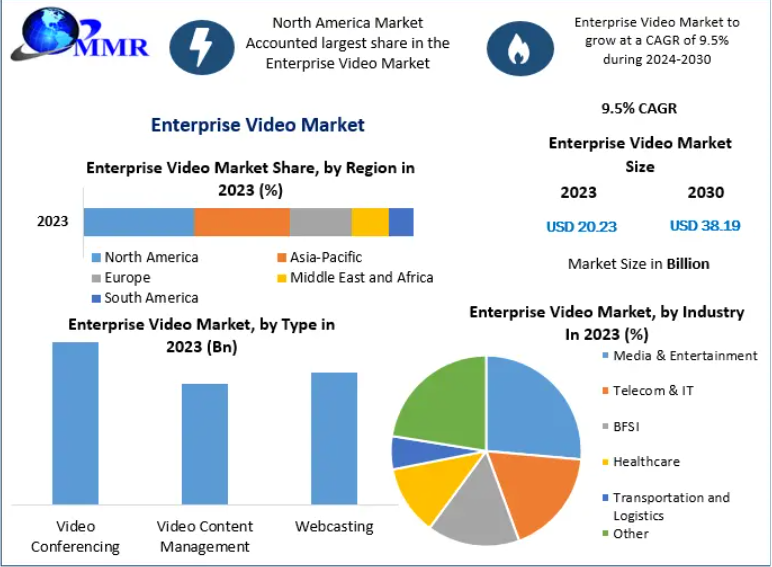
The global Enterprise Video Market is undergoing a seismic technological shift, evolving from a standard tool for operational business continuity into an essential, intelligence-driven framework for corporate growth. According to an in-depth market analysis by Maximize Market Research, the global enterprise video market size reached USD 28.15 billion in 2025 and is on a definitive trajectory to surpass USD 72.48 billion by 2035. This remarkable expansion represents a compound annual growth rate (CAGR) of 10.92% over the forecast period.
The acceleration of the market is anchored by deep structural changes across the corporate landscape. Modern organizations no longer view video simply as a medium for virtual meetings. Instead, enterprise video architectures have transformed into rich, interactive knowledge repositories. Powered by advanced artificial intelligence (AI), machine learning (ML), and cloud infrastructure, enterprise video technologies are now central to large-scale knowledge management, secure internal communications, targeted talent upskilling, and multi-channel customer engagement.
𝐃𝐨𝐰𝐧𝐥𝐨𝐚𝐝 𝐅𝐫𝐞𝐞 𝐏𝐃𝐅 𝐁𝐫𝐨𝐜𝐡𝐮𝐫𝐞 @https://www.maximizemarketresearch.com/request-sample/6970/
Strategic Market Drivers: Decoding the Velocity of Enterprise Video Ecosystems
The modern enterprise is fundamentally decentralized, heavily reliant on highly distributed operational teams and cross-border collaborations. This structural dispersion has fueled an unprecedented demand for resilient, enterprise-grade video solutions capable of maintaining high-quality performance over various networking constraints.
1. The Proliferation of Regulated Hybrid Work Models
While initial remote-work initiatives were established as temporary fixes, the contemporary corporate framework relies on an intentional, structured hybrid architecture. Global enterprises and public sector institutions are heavily funding specialized workspace tools to bridge the physical-digital divide. Initiatives like the U.S. Federal Workplace Modernization Act and the European Commission’s Digital Decade targets have established explicit blueprints for digital workplace transformation, driving deep institutional procurement of secure corporate communications infrastructure.
2. The Influx of On-Demand Content for Training and Development
Continuous professional development has emerged as a key strategic differentiator for companies seeking to retain top talent. Corporate learning management systems (LMS) are increasingly incorporating cloud-hosted video portals. These tools allow organizations to record, catalogue, and distribute detailed training documentation, standard operating procedures, and leadership insights globally. By relying on indexed, searchable video streaming APIs, businesses can significantly minimize the massive overhead and operational costs linked to traditional, in-person training programs.
3. Regulatory Compliance and Secure Video Archiving
Global financial regulations, including MiFID II in Europe and SEC Rule 17a-4 in the United States, have implemented stringent communication capture requirements. Financial, legal, and public sector organizations must now capture, index, and securely archive all internal and external electronic communications, including video calls and webinars. This compliance mandate has created a distinct, rapidly expanding sub-segment within the enterprise video market dedicated strictly to secure video content lifecycle management and immutable digital archiving.
Segmentation Analysis: Mapping Infrastructure and Software Domination
To understand how the enterprise video landscape is expanding, the market can be thoroughly analyzed across three core axes: component types, deployment methodologies, and targeted end-user verticals.
Component Breakdown: Software and Platform Licensing Take the Lead
Software applications captured a commanding 54.3% share of the overall market value. This clear dominance highlights a broader industry shift where organizations prioritize cloud platform licenses, interactive applications, and intelligent dashboards over expensive hardware retrofits. Software innovation is heavily centered around low-latency streaming APIs, multi-tenant architectures, and complex encoding software that optimizes bandwidth consumption across low-connectivity regions.
Concurrently, the services segment is advancing at the fastest rate, recording a projected 15.1% CAGR. As enterprise video setups become more intricate—integrating multiple APIs, unified communications systems, and custom internal networks—organizations are turning away from managing these complex ecosystems entirely in-house. CIOs are increasingly outsourcing system integration, security compliance audits, and custom development to specialized third-party providers.
Deployment Methodologies: The Coexistence of On-Premises and Cloud Models
On-premises deployments accounted for 59.8% of the global market share. This high percentage highlights the strict security requirements of heavily regulated sectors like defense, aerospace, and banking (BFSI). These institutions favor full control over local network firewalls and physical storage arrays to guarantee comprehensive data protection and mitigate the risks of data breaches.
In contrast, cloud-based enterprise video architectures are growing rapidly, climbing at a 13.8% CAGR. The cloud paradigm offers unmatched elastic scaling, pay-as-you-go pricing models, and rapid global deployment capabilities. These characteristics make cloud solutions highly attractive to small and medium enterprises (SMEs) looking to bypass massive upfront capital expenses while gaining access to advanced, enterprise-grade video infrastructures.
Sector-Specific Demand: Vertical Innovations Across Key Industries
The adoption of enterprise video solutions is not uniform; different verticals leverage these visual tools to address unique operational and commercial challenges.
1. IT, Telecommunications, and the Edge Ecosystem
Capturing 27.6% of total market revenue, the IT and telecommunications sector serves as both a primary consumer and an infrastructure foundation for enterprise video. Software-defined networking, private 5G campus networks, and edge computing nodes are deployed specifically to support ultra-low-latency video communication. Tech companies use video extensively for agile product development cycles, cross-border engineering huddles, and large-scale virtual developer conferences.
2. Healthcare and Lifesciences: Telehealth and Archiving
The healthcare vertical is projected to be one of the fastest-growing segments, expanding at a 17.1% CAGR. This rapid growth is driven by the formalization of telehealth regulations and the need for high-fidelity surgical video archiving. Medical centers use advanced enterprise video systems for remote specialist consultations, continuous medical education, and real-time streams of complex procedures for educational purposes, all while adhering to strict privacy rules like HIPAA.
3. Banking, Financial Services, and Insurance (BFSI)
The financial industry uses enterprise video platforms as secure tools for high-value client advisory sessions, global investment briefings, and institutional compliance tracking. Given the critical importance of absolute data security, BFSI firms are investing heavily in enterprise video systems that feature end-to-end encryption, multi-factor biometric authentication, and automated audit trails to ensure complete compliance with global financial oversight bodies.
𝐃𝐨𝐰𝐧𝐥𝐨𝐚𝐝 𝐅𝐫𝐞𝐞 𝐏𝐃𝐅 𝐁𝐫𝐨𝐜𝐡𝐮𝐫𝐞 @https://www.maximizemarketresearch.com/request-sample/6970/
Regional Dominance and Global Expansion Trajectories
North America: The Hub of Enterprise SaaS Innovation
North America maintains its position as the largest regional market, controlling approximately 36.4% of global revenues. This dominant position is supported by the dense concentration of Fortune 500 headquarters, major hyperscale cloud providers, and advanced SaaS innovators across the United States and Canada. The regional market benefits from robust digital infrastructure, high corporate technology budgets, and the widespread adoption of "Bring Your Own Device" (BYOD) workforce policies.
Europe: Navigating Data Sovereignty and Legislative Archiving
Europe holds the second-largest market share at roughly 27.1%. The core operational challenge across the European continent centers around data sovereignty and strict compliance with the General Data Protection Regulation (GDPR). Consequently, European enterprises strongly favor specialized video content management vendors that offer local EU-based cloud hosting, localized data processing, and advanced compliance-driven video archiving tools.
Asia-Pacific: The World's Fastest-Growing Enterprise Landscape
The Asia-Pacific region is experiencing the highest growth velocity, tracking a 13.5% CAGR. This rapid expansion is powered by large-scale digital transformation initiatives, such as the "Digital India" program and extensive enterprise digitization efforts across East Asia. The massive expansion of high-speed 5G networks, combined with a rising number of mid-sized corporate entities across India, China, and Southeast Asia, has created an expansive market for scalable, cost-effective mobile-first enterprise video solutions.
The Competitive Landscape: Vendor Consolidation and AI Integration
The global enterprise video market features a mix of massive, well-established technology companies and nimble, highly specialized software providers. This competitive environment is currently undergoing a wave of product updates and consolidation as vendors race to integrate advanced AI capabilities directly into their software suites.
Global Enterprise Video Market, Key Players are
1. Huawei, Kaltura
2. Kontiki
3. Level 3 Communications
4. Librestream
5. NTT Communications
6. Polycom
7. Sonic Foundry
8. Tegrity
9. Telestream
10. Tremor Video
11. Vidtel
12. Vidyo
13. Altus365
14. AT&T
15. Avaya
16. Aver Information
17. AVI-SPL Inc.
18. Broadpeak
19. BT Conferencing
20. Cisco Systems
21. Epiphan, Hikvision
Market Leaders and Innovation Priorities
Major technology providers—including Microsoft Corporation, Zoom Video Communications, Cisco Systems, Google LLC, IBM Corporation, and Avaya Inc.—are focused on building full-stack, AI-driven communications platforms. Instead of treating video conferencing as an isolated software tool, these industry leaders are deeply embedding advanced AI models directly into their applications.
Key product innovations include:
-
AI-Driven Live Summarization: Generating automated, highly accurate meeting summaries, action items, and structural transcripts in real time.
-
Intelligent Semantic Search: Allowing corporate users to search through massive video archives using simple text queries to find specific moments where a particular topic or phrase was discussed.
-
Automated Production and Formatting: Leveraging smart camera tracking, real-time noise cancellation, and automated video editing to optimize recordings for internal knowledge bases.
Niche Specialists and Enterprise Video Management Systems
Simultaneously, specialized providers like Panopto, Brightcove, Kaltura, and ON24 are capturing significant market share by addressing distinct corporate use cases. These specialized vendors focus on high-scale enterprise video content management systems (EVCMS), virtual event software, and advanced viewer analytics. Their solutions allow companies to securely host large-scale corporate webcasts, track exact employee engagement metrics across training modules, and maintain detailed, catalogued video libraries that integrate seamlessly with existing corporate intranets.
For full access to the comprehensive strategic report, visit:https://www.maximizemarketresearch.com/market-report/global-enterprise-video-market/6970/
Strategic Recommendations for Corporate Decision Makers
As enterprise video environments become more deeply integrated into standard business operations, executive leadership and IT directors must make deliberate, long-term structural decisions.
1. Shift from Single-Feature Applications to Consolidated Platforms
Organizations should look to consolidate their communication tools by moving away from managing separate software for video meetings, corporate webcasting, and training content storage. Transitioning toward unified enterprise video content management systems simplifies internal IT workflows, minimizes total licensing costs, and provides a consistent user experience for employees.
2. Implement "Privacy-by-Design" and Rigorous Security Policies
Given the sensitive nature of internal strategy meetings, financial reviews, and intellectual property discussions, security cannot be an afterthought. CIOs must verify that their chosen video platforms feature advanced end-to-end encryption, flexible single sign-on (SSO) integrations, and granular access controls. For companies operating within heavily regulated industries, prioritizing hybrid or on-premises storage models is essential to ensure complete data compliance.
3. Capitalize on AI-Powered Knowledge Retrieval
The true long-term value of enterprise video lies within the unstructured data contained inside recorded files. By deploying video architectures equipped with intelligent AI transcription, automated tagging, and semantic search capabilities, corporations can turn hundreds of hours of recorded meetings and training sessions into an organized, easily accessible knowledge asset for their global workforce.
Strategic Market Horizon: Anticipating the Next Era of Enterprise Video
Looking toward the next decade, the enterprise video market will continue to evolve through distinct technological phases:
The 2026–2029 Window: AI-Native Video Orchestration
The primary focus during this phase will center on expanding automated intelligence. Platforms will move far beyond simple transcription to offer deep sentiment analysis, automated real-time translation across multiple languages, and predictive bandwidth management powered by edge AI tools.
The 2027–2031 Window: Full-Stack Economics
The industry will witness significant consolidation as smaller, single-feature software tools are absorbed by major communications suites. Enterprise clients will heavily favor comprehensive platform agreements that combine video conferencing, large-scale webinars, internal knowledge hosting, and operational analytics under unified, cost-effective license structures.
The 2029–2033 Window: Sustainability and Green Transcoding
As global data centers process increasingly massive volumes of high-definition video content, the environmental impact of video storage and encoding will face closer scrutiny. Leading software vendors will invest significantly in energy-efficient compression algorithms and carbon-neutral data hosting infrastructure to align with corporate sustainability and ESG targets.
The 2031–2035 Window: Spatial Video and Immersive Ecosystems
The final phase of the forecast period will mark the growing integration of spatial video, augmented reality (AR), and digital twin visualization. Traditional flat-screen video calls will evolve into highly interactive, immersive 3D communication spaces, allowing engineering, manufacturing, and medical teams to collaborate on complex physical models in real time from anywhere in the world.
About Maximize Market Research
Maximize Market Research is a multifaceted market research and consulting company with professionals from several industries. Some of the industries we cover include medical devices, pharmaceutical manufacturers, science and engineering, electronic components, industrial equipment, technology and communication, cars and automobiles, chemical products and substances, general merchandise, beverages, personal care, and automated systems. To mention a few, we provide market-verified industry estimations, technical trend analysis, crucial market research, strategic advice, competition analysis, production and demand analysis, and client impact studies.
Contact Maximize Market Research
3rd Floor, Navale IT Park, Phase 2
Pune Bangalore Highway, Narhe,
Pune, Maharashtra 411041, India
sales@maximizemarketresearch.com
+91 96071 95908, +91 9607365656

 English
 Arabic
 French
 Spanish
 Portuguese
 Turkish
 Dutch
Dutch
 Italiano
 Russian
 Romaian
 Portuguese (Brazil)
 Greek
Greek
