
AIOps Platform Market Size to Expand with Increasing Cloud Adoption
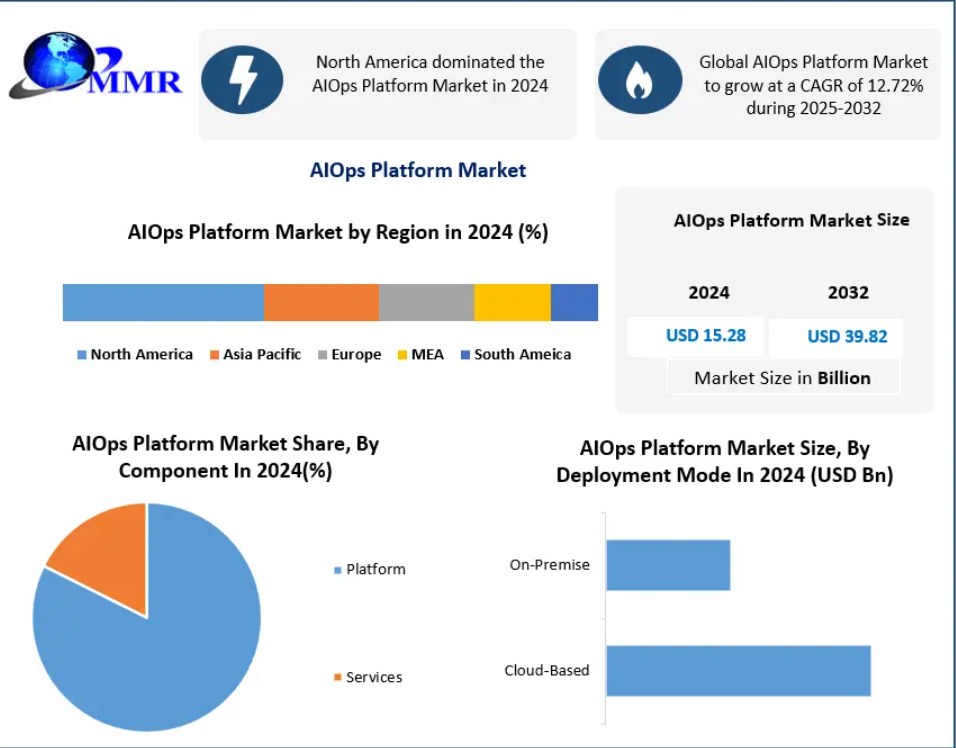
Global AIOps Platform Market Size Projected to Surpass USD 41 Billion by 2030, Accelerating at a Staggering 30.3% CAGR Amid Enterprise Infrastructure Expansion
The global landscape of enterprise IT infrastructure is currently navigating an unprecedented scaling crisis. As businesses aggressively transition to microservices, multi-cloud deployments, and highly complex hybrid ecosystems, the sheer volume, velocity, and variety of telemetry data generated across infrastructure stacks have completely overwhelmed human capacity. Traditional, siloed monitoring tools are no longer capable of filtering out noise to identify systemic vulnerabilities before they cause catastrophic downtime.
Recognizing this fundamental operational turning point,a premier global business intelligence and market advisory firm, has published its definitive, peer-reviewed evaluation of the Global AIOps (Artificial Intelligence for IT Operations) Platform Market.
The comprehensive research suite highlights that the global AIOps Platform market size was valued at USD 10.2 Billion in 2024 and is strategically projected to reach a commanding valuation of USD 41.6 Billion by 2030. This vertical trajectory represents an exceptional, highly sustained Compound Annual Growth Rate (CAGR) of 30.3% over the forecast period.
The study provides an analytical deep dive into the macroeconomic and microeconomic variables driving automated digital operations. With enterprise system outages carrying crippling financial and reputational liabilities, AIOps platforms have advanced from a specialized luxury for early technology adopters into an indispensable cornerstone of modern digital business engineering.
𝐃𝐨𝐰𝐧𝐥𝐨𝐚𝐝 𝐅𝐫𝐞𝐞 𝐏𝐃𝐅 𝐁𝐫𝐨𝐜𝐡𝐮𝐫𝐞 @https://www.maximizemarketresearch.com/request-sample/13765/
Executive Summary: Understanding the Shift to Autonomous IT Operations
Artificial Intelligence for IT Operations represents the strategic convergence of big data, machine learning, and advanced orchestration. By ingesting massive, disparate datasets—including system logs, metrics, alerts, network packets, and incident ticketing histories—AIOps platforms utilize advanced algorithmic models to automatically isolate performance anomalies, determine root causes with absolute precision, and orchestrate real-time remediation scripts.
According to the analysis by Maximize Market Research, the contemporary demand curve for AIOps deployment is undergoing a radical structural change. Historically, IT operations were reactive, relying on manual triage protocols where human operators laboriously cross-referenced dashboards during an ongoing system outage. Today, the market is experiencing a profound transformation. The rapid integration of generative AI models, the proliferation of edge compute environments, and the strict requirements for continuous application delivery are completely rewriting the operational playbook.
Security and infrastructure leaders across the globe are waking up to a fundamental reality: traditional, reactive IT management is completely inadequate when application dependencies are highly ephemeral and distributed globally. AIOps provides the foundational capabilities needed to transition from simple monitoring to full, autonomous observability and automated self-healing.
Market Dynamics: The Core Catalysts of Automated Operations
The strategic expansion of the global AIOps Platform market is propelled by a matrix of interconnected industry dynamics. To assist corporate decision-makers in navigating this high-stakes landscape, the research breaks down the market into its primary growth drivers and architectural challenges.
1. The Proliferation of Hyper-Complex Multi-Cloud Environments
Modern enterprises are increasingly scattering their operational workloads across a mix of public clouds, private on-premises infrastructure, and localized edge servers. This fragmented reality creates massive operational blind spots. AIOps platforms break down these structural data silos by serving as a centralized, unified telemetry repository. By applying advanced algorithmic analysis across all infrastructure layers simultaneously, these solutions offer continuous visibility into cross-platform application behaviors.
2. Exponential Expansion of Telemetry Data Volume and Noise Inflation
The shift toward containerized application structures like Kubernetes has triggered an explosion in alert volumes. A major structural pain point for contemporary IT engineering departments is alert fatigue, where human operators are continuously bombarded by thousands of minor, cascading notifications during a localized server glitch. AIOps platforms address this vulnerability through intelligent alert deduplication and correlation, condensing thousands of chaotic data points into a single, actionable root-cause incident window.
3. The Urgent Mandate to Lower Mean Time to Resolution (MTTR)
In a digital-first economy, application performance degradation equates to immediate revenue loss. Whether it is an e-commerce checkout stall or a banking API lag, businesses require systems that minimize system downtime. AIOps platforms systematically reduce MTTR from hours to mere fractions of a second by bypassing traditional manual diagnostic loops. The platform automatically points engineers directly to the specific code error, database lock, or network bottleneck causing the performance drop.
4. Integration of Generative AI and Natural Language Interfaces
A powerful recent catalyst driving massive user adoption is the blending of Large Language Models (LLMs) with standard AIOps workflows. Modern platforms are incorporating intuitive, natural-language interfaces. This enables non-technical business leaders or junior IT technicians to query complex infrastructure states using simple phrases like, "Why is the payment gateway slow right now?", immediately receiving clear, conversational root-cause breakdowns paired with recommended remediation scripts.
Architectural Challenges and Market Restraints
While the market opportunities remain vast, the implementation of a comprehensive, enterprise-wide AIOps platform is not without its structural hurdles. Corporate decision-makers must carefully plan around these technical complexities to ensure successful, cost-effective deployments.
-
Data Fragmentation and Ingestion Quality Concerns: The accuracy of any machine learning model is directly dependent on the purity and comprehensiveness of the incoming data stream. Many legacy enterprises possess heavily fragmented IT environments where historical data remains trapped in proprietary, outdated silos. Poorly formatted data or incomplete log records can dilute the effectiveness of AIOps analytical engines, leading to inaccurate anomaly alerts or missed system defects.
-
Cultural Resistance and Change Management Friction: Transitioning an enterprise from established manual processes to automated, algorithmic orchestration often encounters significant cultural resistance within traditional IT operations teams. Engineers are frequently hesitant to trust automated scripts to make live changes to critical, revenue-generating production environments. Overcoming this trust deficit requires a gradual, tiered approach to automation.
Detailed Segment Analysis: Tracking the Value Chains
This report provides a granular breakdown of the global AIOps Platform market across several critical dimensions, allowing vendors and enterprise buyers to allocate capital with precision.
By Component: Software Platforms Capture the Core Capital
The market is divided into Software Platforms and Professional/Managed Services.
The Software Platform segment captured the largest share of the global market in 2024. This dominance is driven by the urgent enterprise transition toward end-to-end observability suites. Modern corporations are actively consolidating their monitoring software vendors, moving away from niche, point-based analytical utilities toward comprehensive, unified control planes.
Concurrently, the Services segment is expanding at a rapid pace. This growth is propelled by the intense global shortage of specialized data scientists and DevOps architects capable of configuring custom machine learning models within enterprise IT frameworks. As a result, professional deployment, custom integration, and ongoing managed service contracts remain high-value revenue drivers.
By Deployment Mode: The Irresistible Force of Cloud-Native Platforms
While historically conservative sectors like defense and central banking have traditionally favored highly secured, On-Premises deployments due to extreme data sovereignty regulations, the Cloud-Based AIOps segment is projected to achieve the highest CAGR through 2030.
Cloud-native AIOps platforms eliminate the heavy infrastructure costs, operational overhead, and specialized engineering requirements of traditional on-prem setups. Because analyzing massive datasets requires immense computing elasticity, cloud-native deployments allow the underlying machine learning models to dynamically scale their processing power during intense data spikes without degrading corporate application speeds.
By End-User Industry: Vertical Adoption Accelerates
-
Banking, Financial Services, and Insurance (BFSI): The BFSI vertical commands the largest single market share. Driven by the explosive growth of open banking APIs, digital wallets, automated mobile trading platforms, and high-frequency transactions, financial institutions rely heavily on AIOps to ensure continuous system availability and proactively identify fraudulent transactional patterns.
-
IT and Telecommunications: As telecommunication networks rapidly advance into containerized 5G and early 6G cloud-native architectures, securing network routing protocols, edge compute nodes, and over-the-air firmware updates has driven massive demand for high-throughput AIOps platforms.
-
Retail and E-Commerce: With online retail experiences tied directly to customer retention, any slight delay in page load speeds or checkout failures can lead to immediate cart abandonment. This sector utilizes AIOps to monitor real-time user journeys and optimize cloud resource allocations during massive seasonal shopping traffic surges.
𝐃𝐨𝐰𝐧𝐥𝐨𝐚𝐝 𝐅𝐫𝐞𝐞 𝐏𝐃𝐅 𝐁𝐫𝐨𝐜𝐡𝐮𝐫𝐞 @https://www.maximizemarketresearch.com/request-sample/13765/
Regional Insights: Analyzing Global Development Hotspots
North America: The Enterprise Innovation Leader
North America maintains the largest revenue share in the global AIOps Platform market. This dominance is directly tied to the region’s advanced technological landscape, widespread cloud adoption, and concentration of tech giants. Major financial hubs and enterprise software corporations headquartered across the United States are heavily investing in algorithmic automation to maintain their competitive advantages and optimize massive infrastructure expenditures.
Asia-Pacific: The Hyper-Growth Frontier
The Asia-Pacific region is mathematically projected to expand at the fastest pace through the 2030 forecast window. This explosive growth is driven by massive digital transformation initiatives, expanding e-commerce ecosystems, and heavy state-sponsored investments in national digital identity networks across nations like India, China, Japan, and Australia. The rapid industrial shift toward automation and smart manufacturing infrastructures across the region is creating a massive market opportunity for real-time operational analytics tools.
For full access to the comprehensive strategic report, visit:https://www.maximizemarketresearch.com/market-report/aiops-platform-market/13765/
Competitive Landscape: Market Leaders Driving Algorithmic Innovation
The global AIOps Platform market is characterized by a high degree of strategic consolidation alongside intense technological innovation. Established tier-one cloud infrastructure and monitoring giants are continually expanding their product portfolios, often acquiring agile, AI-native startups to capture market share in automated infrastructure diagnostics.
AIOps Platform Key players
North America
1. IBM (United States)
2. Microsoft (United States)
3. BMC Software (United States)
4. Cisco (United States)
5. Splunk (United States)
6. Dynatrace (United States)
7. AppDynamics (United States)
8. Datadog (United States)
9. New Relic (United States)
10. Sumo Logic (United States)
11. Turbonomic (United States)
12. OpsRamp (United States)
13. VictorOps (United States)
14. PagerDuty (United States)
15. Alert Logic (United States)
16. LogicMonitor (United States)
17. Instana (United States)
18. Lightstep (United States)
19. Honeycomb (United States)
20. UiPath (United States)
21. Automation Anywhere (United States)
22. C3.ai (United States)
23. Pegasystems (United States)
Europe:
1. Blue Prism (United Kingdom)
2. Grafana (Sweden)
3. Elastic (Netherlands)
4. Prometheus (Germany)
Rest of the World:
1. ManageEngine (India)
2. Logz.io (Israel)
3. Humio (Denmark)
Strategic Recommendations for Corporate Action
Based on the explicit market intelligence compiled by Maximize Market Research, enterprise executives and IT leaders should focus on several vital steps to ensure long-term operational resilience:
-
Transition from Reactive Monitoring to Active Observability: Organizations must phase out siloed monitoring tools that only report when a component has already failed. Investing in a unified AIOps platform that maps full system dependencies allows teams to detect leading indicators of failure, catching system anomalies before they impact the end-user experience.
-
Implement a Phased Automation Trust Protocol: To overcome organizational resistance, engineering leaders should deploy AIOps platforms in a tiered fashion. Begin by leveraging the platform purely for data correlation and root-cause analysis, then transition to human-in-the-loop automated recommendations, and finally enable full closed-loop autonomous remediation once the algorithmic accuracy is thoroughly proven.
-
Prioritize Vendor Consolidation and Tool Streamlining: Managing dozens of separate monitoring tools introduces massive operational friction, high licensing overhead, and fragmented data tracking. Corporate decision-makers should leverage modern AIOps platforms to consolidate their operations into a single control plane, drastically reducing corporate software expenditures while boosting developer productivity.
About Maximize Market Research
Maximize Market Research is a multifaceted market research and consulting company with professionals from several industries. Some of the industries we cover include medical devices, pharmaceutical manufacturers, science and engineering, electronic components, industrial equipment, technology and communication, cars and automobiles, chemical products and substances, general merchandise, beverages, personal care, and automated systems. To mention a few, we provide market-verified industry estimations, technical trend analysis, crucial market research, strategic advice, competition analysis, production and demand analysis, and client impact studies.
Contact Maximize Market Research:
3rd Floor, Navale IT Park, Phase 2
Pune Bangalore Highway, Narhe,
Pune, Maharashtra 411041, India
sales@maximizemarketresearch.com
+91 96071 95908, +91 9607365656

 Arabic
 French
 Spanish
 Portuguese
 Deutsch
 Turkish
 Dutch
Dutch
 Italiano
 Russian
 Romaian
 Portuguese (Brazil)
 Greek
Greek
