
Bio-Based Acetic Acid Market Forecast at 10.5% CAGR Through 2036, USA Leads at 11.2%
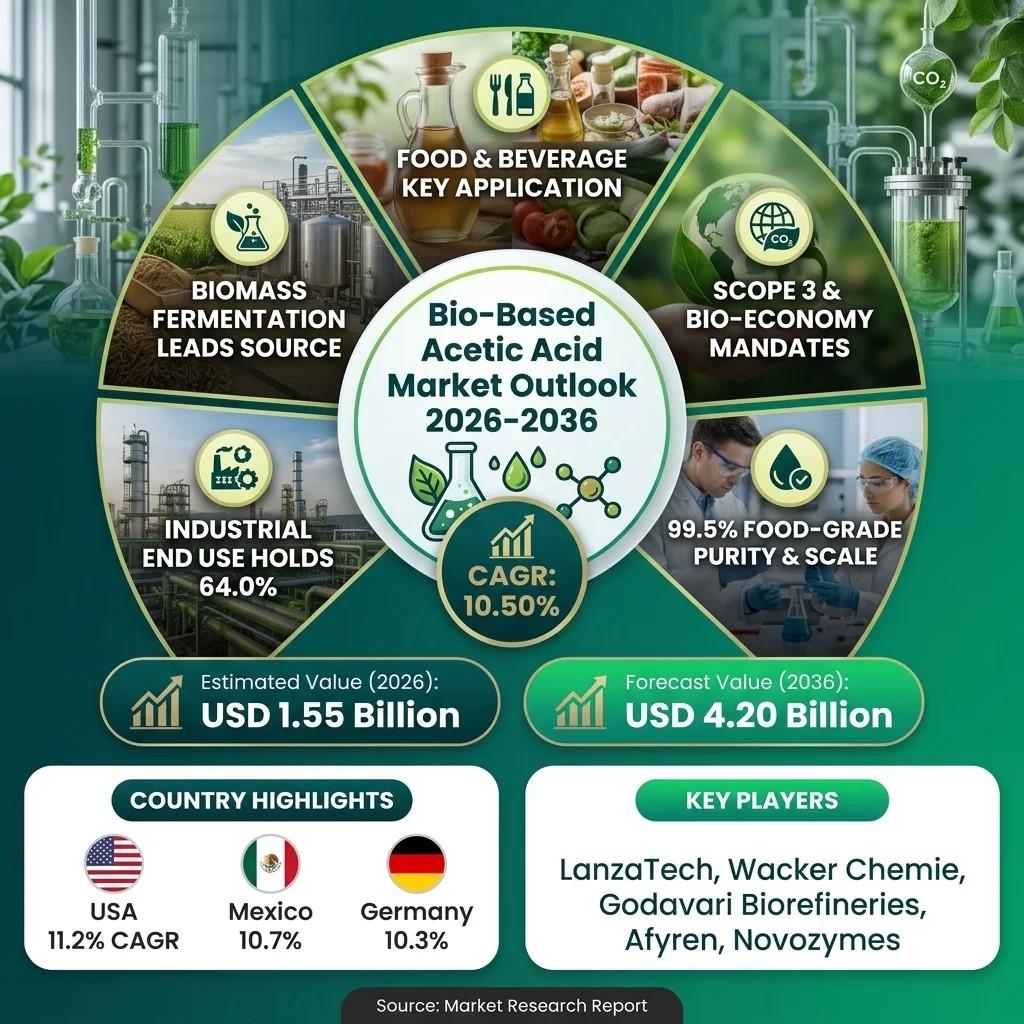
The global bio-based acetic acid market is forecast to expand from USD 1.55 billion in 2026 to USD 4.20 billion by 2036, registering a CAGR of 10.5% over the forecast period. Fact.MR attributes this expansion to increasing sustainability commitments among food manufacturers, regulatory support for renewable chemicals, and growing demand for alternatives to conventional petrochemical-derived acetic acid. Businesses are increasingly incorporating bio-based ingredients into production processes to reduce carbon emissions and strengthen sustainable sourcing practices.
The transition toward renewable chemical manufacturing is gaining momentum as companies work toward Scope 3 emissions reduction targets and adopt circular economy principles. Food and beverage manufacturers are increasingly considering bio-based acetic acid for vinegar production, food preservation, and pH adjustment. Improvements in biomass fermentation, gas fermentation, and synthetic biology are also helping manufacturers improve production efficiency and expand the commercial availability of renewable chemical alternatives.
Get detailed market forecasts, competitive benchmarking, and pricing trends:
https://www.factmr.com/connectus/sample?flag=S&rep_id=1189
Biomass Fermentation Supports Production Growth
By source, biomass fermentation represents a major production pathway in the bio-based acetic acid market. This technology uses renewable feedstocks, including agricultural residues and lignocellulosic materials, to produce acetic acid through biological conversion. Its established production capabilities and feedstock flexibility are supporting its adoption among chemical manufacturers seeking alternatives to fossil-based production processes.
Synthetic biology is another important area of development. Manufacturers are exploring engineered microorganisms and advanced biological processes to improve feedstock conversion, increase production efficiency, and achieve consistent product quality. These technologies could help reduce manufacturing costs and support the commercial expansion of bio-based chemical production.
By application, food and beverage represents the leading demand category. Bio-based acetic acid is used in vinegar production, food preservation, and pH adjustment processes. Growing interest in certified renewable ingredients and lower-carbon supply chains is encouraging food manufacturers to consider bio-based alternatives while maintaining established product quality and food safety requirements.
Industrial applications also contribute significantly to market demand. Chemical manufacturing and pharmaceutical production require consistent product specifications and dependable supply. Increasing sustainability requirements across industrial procurement are creating opportunities for manufacturers capable of supplying bio-based acetic acid at commercial scale.
USA, Germany, and France Show Strong Growth Potential
The USA is projected to record an 11.2% CAGR in the bio-based acetic acid market through 2036, making it the fastest-growing country among those assessed by Fact.MR. Expanding biotechnology capabilities, pharmaceutical manufacturing, and corporate sustainability commitments are supporting demand. Food manufacturers are increasingly exploring renewable chemical ingredients to meet sustainability procurement requirements and strengthen their environmental performance.
Mexico follows with a projected CAGR of 10.7% through 2036. Agricultural waste availability, expanding chemical manufacturing, and growing interest in renewable feedstocks are supporting the country's market development. Its strategic position within North American manufacturing and trade networks also creates opportunities for bio-based chemical production and distribution.
Germany is expected to register a 10.3% CAGR during the forecast period. Its established chemical manufacturing industry, advanced biotechnology capabilities, and focus on industrial decarbonization are supporting adoption. European bioeconomy initiatives and investment in biorefinery infrastructure are further encouraging the development of renewable chemical production technologies.
France is projected to expand at a CAGR of 10.1% through 2036. Biorefinery development, agricultural resource availability, and sustainability-focused chemical manufacturing are supporting market opportunities. Investments in agricultural waste utilization and renewable feedstock processing are strengthening the country's position in the European bio-based chemicals industry.
The United Kingdom is expected to record a 10.0% CAGR, supported by green chemistry research, pharmaceutical manufacturing, and sustainable industrial development. South Korea and Japan are also contributing to regional market expansion, with projected CAGRs of 9.8% and 9.6%, respectively. Their biotechnology capabilities and growing interest in advanced fermentation technologies are supporting the development of specialized bio-based chemical applications.
Competitive Landscape
Competition in the bio-based acetic acid market includes biotechnology companies, specialized chemical manufacturers, and renewable chemical producers. Key companies profiled by Fact.MR include LanzaTech Inc., Wacker Chemie AG, Godavari Biorefineries Ltd., Afyren S.A., and Novozymes A/S. Other participants include Zea2, Carbon Recycling International, BP Bioacids, BioChemtex, and Sekab E-Technology AB.
Companies are focusing on production capacity expansion, advanced fermentation technologies, feedstock optimization, and product quality improvements to strengthen their competitive positions. Bio-based content certification and consistent food-grade purity are also becoming important procurement considerations. Manufacturers capable of maintaining reliable production volumes and meeting demanding quality specifications are better positioned to secure long-term supply agreements with food and chemical companies.
Technology and Sustainability Developments Shape the Market
The bio-based acetic acid industry is witnessing increasing investment in advanced fermentation and biotechnology processes. Manufacturers are developing engineered microorganisms, improving continuous fermentation systems, and exploring gas fermentation technologies to increase production efficiency. These developments are helping companies utilize renewable feedstocks and explore alternative production routes.
Waste-to-chemical technologies are another important area of development. Agricultural residues and industrial waste streams offer opportunities to produce renewable chemicals while supporting resource utilization and circular manufacturing practices. Investment in biorefinery infrastructure is expected to strengthen the availability of renewable feedstocks and support commercial production.
Despite these opportunities, high manufacturing costs, fermentation yield variability, and inconsistent feedstock availability remain important challenges. Production scale-up and the ability to maintain consistent product quality will influence the industry's competitiveness against conventional petrochemical-derived acetic acid.
As sustainability requirements become more prominent across food processing and chemical manufacturing, bio-based acetic acid is expected to gain wider commercial acceptance. Continued investment in fermentation technology, renewable feedstock utilization, and production capacity will shape market development through 2036.
To View Top Reports
Microemulsions Market: https://www.factmr.com/report/microemulsions-market
Isopropylamine Market: https://www.factmr.com/report/isopropylamine-market
Circular Polyester Intermediates Market: https://www.factmr.com/report/circular-polyester-intermediates-market
About Fact.MR
Fact.MR is a market research and consulting company providing market intelligence, competitive analysis, and forecasting across global industries. Its research supports businesses with data-driven insights into emerging markets, technology trends, competitive dynamics, regional opportunities, and changing demand patterns.

 English
 French
 Spanish
 Portuguese
 Deutsch
 Turkish
 Dutch
 Italiano
 Russian
 Romaian
 Portuguese (Brazil)
 Greek
