
Small Satellite Market Outlook, Key Drivers and Future Opportunities Report by Maximize Market Research
Small Satellite Market
Market Overview
The global Small Satellite Market is experiencing significant growth, driven by increasing demand for affordable satellite communication, advancements in space technology, and rising investments in commercial space programs. Small satellites, generally defined as satellites weighing less than 500 kg, are widely used for communication, Earth observation, remote sensing, scientific research, meteorology, and defense applications. Their compact design, lower manufacturing costs, and shorter development cycles make them an attractive alternative to traditional large satellites.
The growing adoption of CubeSats, nanosatellites, and microsatellites is transforming the global aerospace and satellite industry. Government agencies, private space companies, and research institutions are increasingly deploying small satellites to improve global connectivity, monitor environmental changes, and collect real-time data. Technological advancements in artificial intelligence (AI), machine learning (ML), miniaturized sensors, and propulsion systems are further improving satellite performance and operational efficiency.
Download Free PDF Brochure-https://www.maximizemarketresearch.com/request-sample/341/
Market Size and Growth
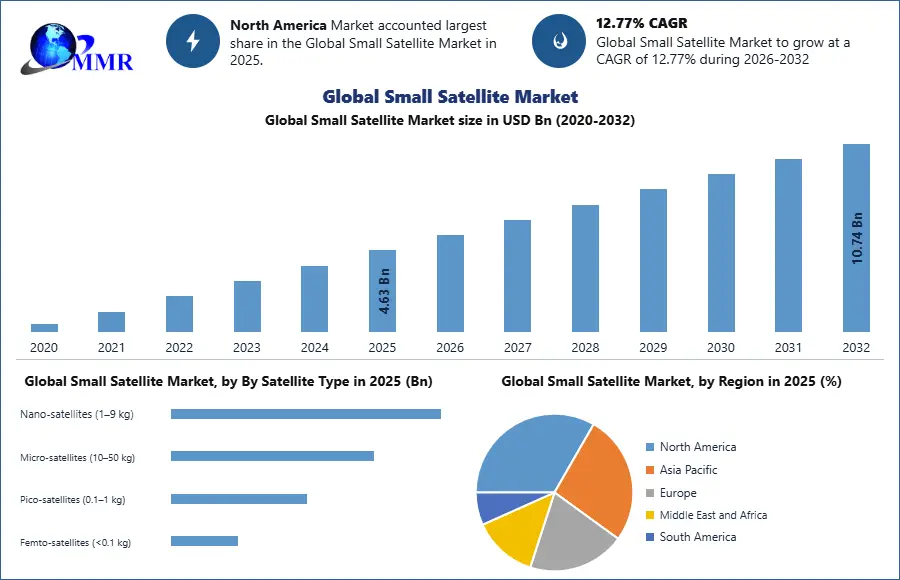
According to Maximize Market Research, the global Small Satellite Market was valued at USD 4.63 Billion in 2025. The market is expected to grow at a CAGR of 12.77% during the forecast period from 2026 to 2032, reaching approximately USD 10.74 Billion by 2032.
The increasing deployment of satellite constellations for broadband connectivity, Earth observation, and defense applications is supporting market expansion. Growing investments in commercial space infrastructure and the availability of cost-effective launch services are creating opportunities for manufacturers and satellite operators. Additionally, rising demand for high-resolution imaging, environmental monitoring, and IoT connectivity is encouraging companies to develop advanced small satellite technologies.
Key Market Segmentation
The Small Satellite Market is segmented by satellite type, orbit, propulsion technology, frequency band, application, and end user.
Based on satellite type, the market includes nanosatellites (1–9 kg), microsatellites (10–50 kg), picosatellites (0.1–1 kg), and femtosatellites (less than 0.1 kg). Nanosatellites dominated demand in 2025 because of their cost-effectiveness, rapid deployment capabilities, and increasing utilization in large satellite constellations. Microsatellites also represent an important segment due to their greater payload capacity and longer mission life.
By orbit, the market is categorized into Low Earth Orbit (LEO), Geostationary Earth Orbit (GEO), Medium Earth Orbit (MEO), and Beyond GEO. LEO dominated the market in 2025 because of its suitability for communication networks, Earth observation, and satellite internet services.
Based on propulsion technology, the market includes electric, gas-based, and chemical propulsion systems. Electric propulsion is experiencing increasing demand because of its fuel efficiency and precise maneuvering capabilities.
By frequency band, the market covers L-Band, S-Band, C-Band, X-Band, Ku-Band, Ka-Band, Q/V-Band, HF/VHF/UHF-Band, and Laser/Optical communication.
Based on application, the segments include Earth Observation and Remote Sensing, Communication and Connectivity, Scientific Research and Space Exploration, Technology Demonstration, Surveillance, Security and Defense, and Meteorology and Climate Monitoring. Communication and Connectivity represented the largest application segment in 2025.
By end user, the market is divided into commercial, government and military, academic and research institutions, and others.
Growth Drivers
The increasing demand for cost-effective satellite communication services is a major factor driving the Small Satellite Market. Small satellites provide connectivity solutions for remote locations, supporting broadband internet, mobile communication, and Internet of Things applications.
Another significant growth driver is the rising adoption of Earth observation and remote sensing technologies. Industries such as agriculture, urban planning, forestry, and disaster management increasingly depend on satellite-generated information for monitoring environmental conditions and improving operational decisions.
Government investments in space exploration, national security, and defense surveillance are also contributing to market growth. Furthermore, advancements in satellite miniaturization, propulsion systems, sensors, and communication technologies are improving satellite reliability and performance.
The availability of rideshare launch services and dedicated small satellite launch vehicles is reducing deployment costs and encouraging new companies to participate in the commercial space industry.
Emerging Trends
The growing adoption of CubeSats, nanosatellites, and microsatellites is one of the major trends shaping the market. These compact satellite platforms allow organizations to conduct space missions with lower investment requirements and shorter development timelines.
Artificial intelligence and machine learning integration is another important trend. These technologies improve onboard data processing, autonomous satellite operations, image analysis, and communication capabilities.
The expansion of satellite constellations is creating new opportunities for global broadband connectivity, remote sensing, and IoT applications. Additionally, electric propulsion systems and laser-based optical communication are gaining attention because of their potential to improve satellite efficiency and data transmission speeds.
Space sustainability is also becoming increasingly important. Satellite manufacturers and operators are focusing on collision avoidance, debris removal, and end-of-life disposal technologies to reduce the environmental impact of growing satellite deployments.
Regional Analysis
North America dominated the global Small Satellite Market in 2025, supported by strong private-sector innovation, advanced technological infrastructure, and substantial government investments in space programs. The United States leads regional development through commercial satellite launches and government-supported initiatives. Companies such as SpaceX, Lockheed Martin, and Northrop Grumman are contributing to satellite manufacturing, communication, and defense applications.
Europe represents another important regional market, driven by investments from the European Space Agency (ESA) and advancements in satellite manufacturing and launch capabilities. Germany, France, and the United Kingdom are major contributors to regional development. Initiatives such as Galileo and Copernicus strengthen Europe's position in satellite navigation and Earth observation.
Asia-Pacific is emerging as a significant growth region due to increasing investments in domestic space infrastructure and satellite manufacturing. China, India, and Japan are expanding their satellite deployment capabilities to support agricultural monitoring, disaster management, scientific research, and communication services. Collaborations between private companies and government agencies are further supporting regional market expansion.
Competitive Landscape
The global Small Satellite Market is highly competitive, with established aerospace companies and emerging satellite technology providers focusing on innovation, strategic partnerships, and product development.
Key market players include SpaceX, Airbus Defence and Space, Lockheed Martin, Northrop Grumman Corporation, Boeing Space, Maxar Technologies, L3Harris Technologies, Planet Labs, Ball Aerospace, Thales Alenia Space, GomSpace, Spire Global, Surrey Satellite Technology, Tyvak Nano-Satellite Systems, AAC Clyde Space, BlackSky, Capella Space, and ICEYE.
Companies are investing in advanced satellite platforms, communication systems, propulsion technologies, and high-resolution imaging solutions. Strategic collaborations, mergers and acquisitions, and research and development activities are helping market participants strengthen their competitive positions.
Download Free PDF Brochure-https://www.maximizemarketresearch.com/request-sample/341/
Recent Developments
The small satellite industry is witnessing continuous technological advancements and strategic developments.
GomSpace is focusing on nanosatellite manufacturing and constellation deployment to expand its presence in the commercial satellite industry.
SpaceX continues to expand its Starlink satellite constellation to improve broadband connectivity and provide satellite internet services across underserved regions.
Lockheed Martin is developing advanced small satellite solutions for defense applications, supporting improvements in national security and space-based surveillance capabilities.
Northrop Grumman is focusing on on-orbit servicing technologies to improve satellite lifespan and operational efficiency. Meanwhile, L3Harris Technologies is integrating advanced payloads and communication systems into small satellite platforms.
Future Outlook
The future of the Small Satellite Market is expected to remain promising, supported by increasing commercial space investments, growing demand for satellite communication, and advancements in Earth observation technologies. The expansion of broadband internet services, IoT connectivity, climate monitoring, and defense surveillance will create new opportunities for market participants.
Technological developments in AI-powered satellite operations, electric propulsion, optical communication, and autonomous spacecraft systems are expected to improve operational performance. Additionally, innovations in on-orbit servicing and space debris removal will support sustainable satellite operations.
Asia-Pacific is expected to offer significant growth opportunities as countries continue investing in satellite manufacturing, launch infrastructure, and space research capabilities.
For full access to the comprehensive strategic report, visit:https://www.maximizemarketresearch.com/market-report/global-small-satellite-market/341/
Conclusion
The global Small Satellite Market is expanding rapidly due to increasing demand for affordable satellite solutions, technological innovation, and rising investments in commercial and government space programs. The growing adoption of nanosatellites, CubeSats, and satellite constellations is creating opportunities across communication, Earth observation, scientific research, and defense applications. With the market projected to reach USD 10.74 Billion by 2032, the industry is positioned for substantial growth. Continuous technological advancements, strategic partnerships, and sustainable space solutions will remain essential for shaping the future competitive landscape.
About Maximize Market Research
Maximize Market Research is a multifaceted market research and consulting company with professionals from several industries. Some of the industries we cover include medical devices, pharmaceutical manufacturers, science and engineering, electronic components, industrial equipment, technology and communication, cars and automobiles, chemical products and substances, general merchandise, beverages, personal care, and automated systems. To mention a few, we provide market-verified industry estimations, technical trend analysis, crucial market research, strategic advice, competition analysis, production and demand analysis, and client impact studies.
Contact Maximize Market Research
3rd Floor, Navale IT Park, Phase 2
Pune Bangalore Highway, Narhe,
Pune, Maharashtra 411041, India
sales@maximizemarketresearch.com
+91 96071 95908, +91 9607365656

 English
 Arabic
 Spanish
 Portuguese
 Deutsch
 Turkish
 Dutch
 Italiano
 Russian
 Romaian
 Portuguese (Brazil)
 Greek
