
Global Nafion Market Forecast to Reach USD 1.62 Billion, Hydrogen Economy Supports Growth
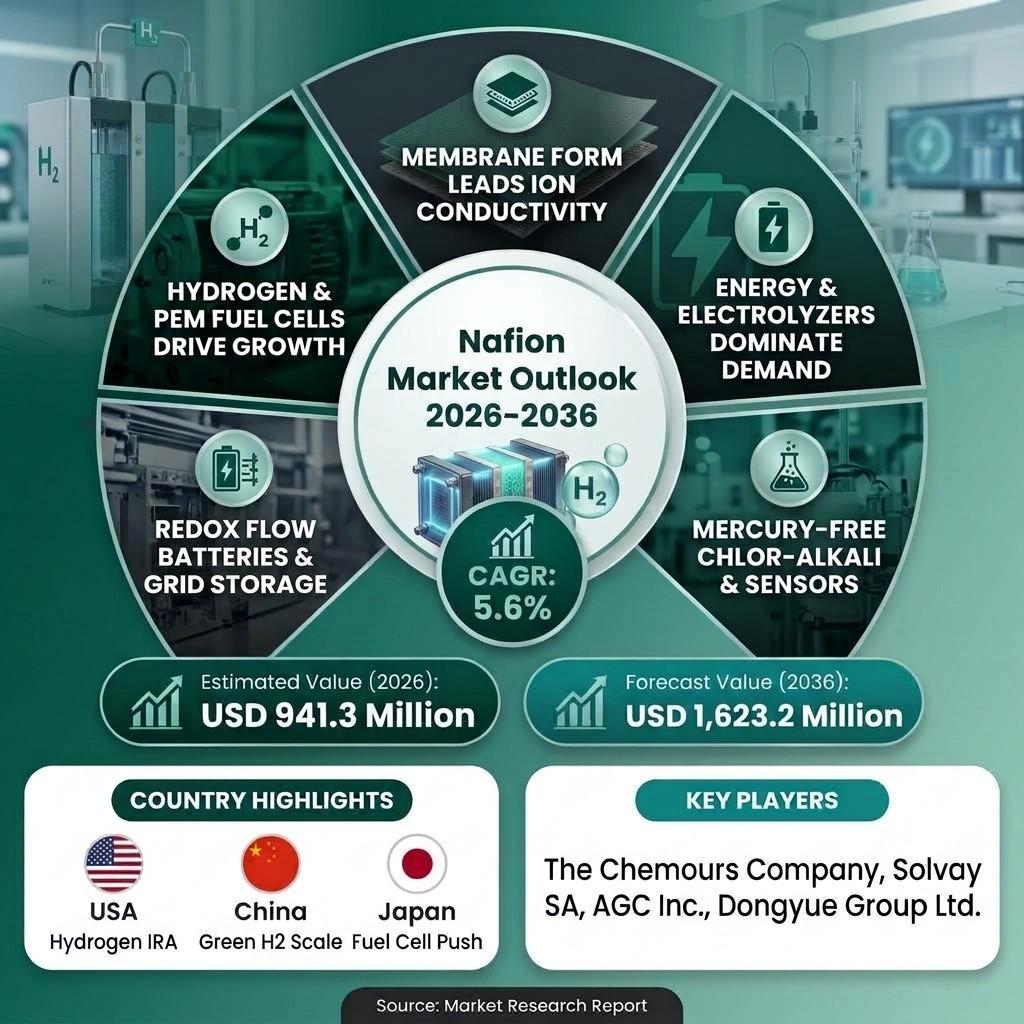
The global Nafion market is forecast to expand from USD 941.3 million in 2026 to USD 1,623.2 million by 2036, registering a 5.6% CAGR over the forecast period. Fact.MR attributes this growth to increasing demand for proton exchange membranes in fuel cells, hydrogen electrolyzers, energy storage systems, and industrial electrochemical processes. Growing investment in hydrogen infrastructure and clean energy technologies is strengthening Nafion's role across energy and chemical applications.
The transition toward hydrogen-based energy systems is creating new opportunities for Nafion suppliers. Its proton conductivity, chemical stability, and durability make the material suitable for proton exchange membrane (PEM) fuel cells and water electrolysis systems. Government decarbonization initiatives, renewable energy investments, and advancements in hydrogen production are encouraging manufacturers to expand their use of ion-exchange membrane technologies.
Get detailed market forecasts, competitive benchmarking, and pricing trends:
https://www.factmr.com/connectus/sample?flag=S&rep_id=4965
Membrane Retains Leading Position by Form
By form, membranes hold a leading position in the Nafion market. Their high proton conductivity, chemical resistance, and mechanical stability make them essential components in proton exchange membrane fuel cells and water electrolyzers. Growing deployment of hydrogen-based energy technologies is supporting demand for membranes capable of maintaining performance across demanding operating conditions.
Compared with resins and dispersions, Nafion membranes provide the structure and ionic transport properties required for electrochemical energy conversion. Their use in fuel cells, hydrogen production, and energy storage systems is gaining importance as governments and industrial companies increase investments in clean energy infrastructure. Research into improving membrane efficiency, durability, and operating performance is further strengthening their commercial relevance.
Energy Applications Drive Nafion Consumption
Energy is a leading application area for Nafion, supported by growing use in fuel cells, hydrogen production, and energy storage. PEM fuel cells use Nafion membranes to facilitate proton transport while separating reactants, making them relevant to transportation, stationary power generation, and backup energy systems.
Hydrogen production through PEM electrolyzers is another important demand avenue. As countries pursue lower-emission energy systems, investments in renewable hydrogen production are creating opportunities for membrane manufacturers. Nafion is also gaining relevance in redox flow batteries and other energy-storage technologies that support renewable power integration and grid stability.
Chemical processing remains an established application for Nafion. Its use in chlor-alkali production, ion exchange, catalysts, and specialized industrial processes is supported by chemical stability and electrochemical properties. Semiconductor manufacturing and advanced sensing applications are also contributing to demand for specialized ion-exchange materials.
USA, China, and Japan Strengthen Market Opportunities
The United States is an important market for Nafion, supported by hydrogen technology investments, fuel-cell development, and established industrial chemical operations. Federal clean-energy initiatives and investments in electrolyzer technologies are creating opportunities for membrane suppliers. Nafion demand also benefits from chlor-alkali applications and the development of energy-storage systems designed to support renewable power integration.
China is strengthening its position through large-scale hydrogen production projects, industrial modernization, and growing investment in electrochemical technologies. The country's expanding hydrogen ecosystem and established chemical-processing industry are creating opportunities for Nafion membranes. Semiconductor production, fuel-cell development, and renewable-energy infrastructure are also supporting demand for high-performance ion-exchange materials.
Japan continues to expand its hydrogen and fuel-cell ecosystem through investments in clean energy technologies, hydrogen-powered transportation, and electrochemical systems. Its established automotive, electronics, and chemical industries provide a strong base for Nafion applications. Research and development activities aimed at improving fuel-cell performance, membrane efficiency, and hydrogen technologies are further supporting its market prospects.
Europe also represents a significant market, driven by decarbonization targets, renewable energy integration, and hydrogen infrastructure investments. Germany, France, and the Netherlands are advancing electrolyzer projects and clean-energy initiatives that require high-performance membranes. Regulatory emphasis on sustainable industrial processes is supporting adoption across energy and chemical applications.
Competitive Landscape
Competition in the Nafion market includes established chemical manufacturers with expertise in fluoropolymer production, membrane technologies, and electrochemical materials. Key companies profiled by Fact.MR include The Chemours Company, Solvay SA, AGC Inc., and Dongyue Group Ltd.
Manufacturers are competing through product innovation, manufacturing capabilities, supply-chain expansion, and application-specific membrane development. Growing demand from fuel-cell and electrolyzer manufacturers is encouraging suppliers to improve membrane performance and support emerging hydrogen applications. Strategic investments and partnerships are also helping companies strengthen their position in regional markets and expand their customer base across energy and industrial sectors.
Hydrogen Technologies and R&D Shape Market Development
The Nafion market is expected to benefit from continued investment in hydrogen technologies, fuel cells, and electrochemical energy systems. Manufacturers are focusing on improving membrane durability, proton conductivity, and efficiency while addressing production costs and material-related challenges. Research into alternative hydrocarbon and composite membranes is also intensifying as companies seek more economical and sustainable options for emerging applications.
Environmental regulations surrounding fluorinated materials and PFAS-related substances could influence production strategies, material development, and supply chains. These regulatory developments are encouraging manufacturers to evaluate new technologies and improve the environmental profile of their products.
As clean-energy infrastructure expands and hydrogen technologies gain wider industrial adoption, Nafion is expected to remain relevant across fuel cells, electrolyzers, chemical processing, and advanced energy-storage applications. Continued innovation and investments in electrochemical technologies are likely to shape the market's development through 2036.
To View Top Reports
Hydrogen Vehicles Market: https://www.factmr.com/report/685/hydrogen-vehicle-market
Automotive Hydrogen Fuel Cell Market: https://www.factmr.com/report/4023/automotive-hydrogen-fuel-cell-market
Hydrogen Generation Market: https://www.factmr.com/report/4686/hydrogen-generation-market
About Fact.MR
Fact.MR is a market research and consulting company providing market intelligence, competitive analysis, and forecasting across global industries. Its research supports businesses with data-driven insights into emerging markets, technology trends, competitive dynamics, regional opportunities, and changing demand patterns.

 Arabic
 French
 Spanish
 Portuguese
 Deutsch
 Turkish
 Dutch
 Italiano
 Russian
 Romaian
 Portuguese (Brazil)
 Greek
