
Hydrocarbons Market Size, Share, Trends & Forecast 2033
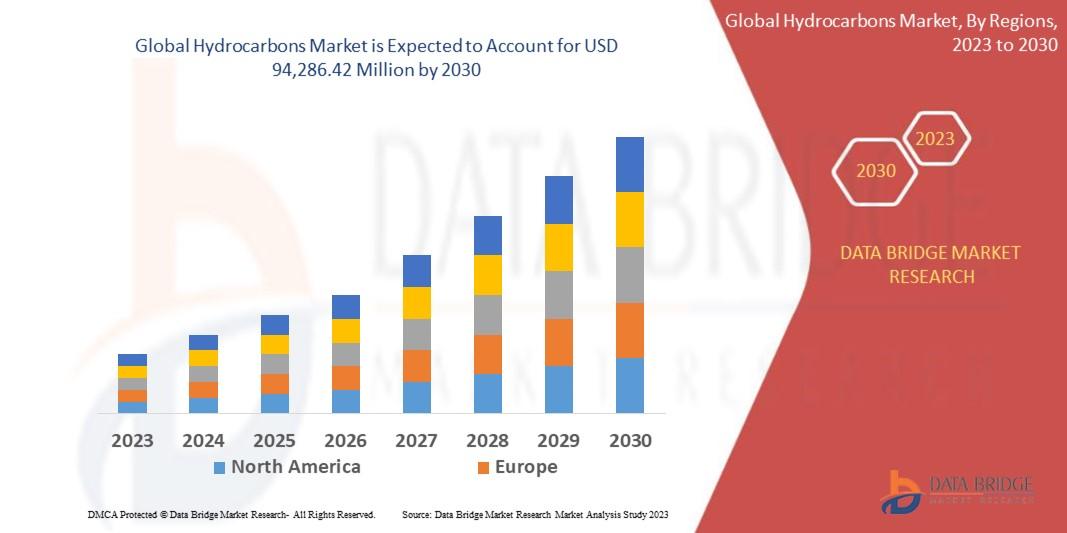
According to the latest report published by Data Bridge Market Research, the Hydrocarbons Market
CAGR Value
Data Bridge Market Research analyses that the hydrocarbons market is expected to reach USD 94,286.42 million by 2030, which is USD 71,602.20 million in 2022, registering a CAGR of 3.50% during the forecast period of 2023 to 2030. In addition to the insights on market scenarios such as market value, growth rate, segmentation, geographical coverage, and major players, the market reports curated by the Data Bridge Market Research also include in-depth expert analysis, geographically represented company-wise production and capacity, network layouts of distributors and partners, detailed and updated price trend analysis and deficit analysis of supply chain and demand.
This Hydrocarbons Market report is a verified and reliable source of information which gives telescopic view of the existing market trends, emerging products, situations and opportunities that drives business in the right direction of success. In this Hydrocarbons Market report, competitor strategies are analysed with respect to their recent developments, new product launches, joint ventures, mergers and acquisition which helps figure out the scope of improvement for the client business. This Hydrocarbons Market document is a great source of information for the major happenings and industry insights which is very valuable to thrive in this competitive age. Stay informed with our latest keyword market research covering strategies, innovations, and forecasts. Download full report: https://www.databridgemarketresearch.com/reports/global-hydrocarbons-market Hydrocarbons Market Segmentation and Market Companies Segments - Product Type: The global hydrocarbons market can be segmented based on product type into natural gas, crude oil, and refined petroleum products. Natural gas is expected to witness significant growth due to its increasing demand as a clean fuel alternative in various industries. Crude oil continues to be a major contributor to the market, with its versatile applications across industries. Refined petroleum products, such as gasoline, diesel, and jet fuel, are essential for transportation and energy generation. - Application: The market can also be segmented by application, including transportation, power generation, industrial fuels, and others. Transportation accounts for a significant share of hydrocarbon consumption, driven by the growing number of vehicles on the road. Power generation remains a key application, especially in regions heavily reliant on fossil fuels. Industrial fuels are crucial for various manufacturing processes. - Region: Geographically, the hydrocarbons market can be segmented into North America, Europe, Asia Pacific, Latin America, and Middle East & Africa. North America dominates the market due to its abundant shale gas reserves and well-established oil and gas infrastructure. Asia Pacific is projected to witness rapid growth driven by industrialization and urbanization in countries like China and India. Market Players - Exxon Mobil Corporation: One of the largest oil and gas companies globally, Exxon Mobil has a strong presence across the hydrocarbons market value chain, from exploration and production to refining and marketing. - Royal Dutch Shell plc: Shell is another key player in the hydrocarbons market, with a diverse portfolio of products and services, including natural gas, crude oil, and refined petroleum products. - Chevron Corporation: Chevron is a major player in the global hydrocarbons market, with operations in numerous countries and a strong focus on technological innovation and sustainability. - BP plc: BP is a leading integrated oil and gas company, actively involved in exploration, production, refining, and distribution of hydrocarbons globally. - Saudi Aramco: As the world's largest oil producer, Saudi Aramco plays a pivotal role in the hydrocarbons market, with significant reserves and production capacity. The global hydrocarbons market is a complex and dynamic industry, influenced by various factors such as geopolitical events, market trends, technological advancements, and regulatory frameworks. As the world continues to rely on hydrocarbons for energy and fuel, market players must adapt to changing conditions and embrace sustainable practices to ensure long-term viability. Hydrocarbons have long been the backbone of the global energy supply, catering to various industries and driving economic growth. Looking beyond the traditional segmentation criteria of product type, application, and region, it is crucial to delve deeper into emerging trends and challenges reshaping the hydrocarbons market landscape. One notable trend is the increasing focus on environmental sustainability and the transition towards cleaner energy sources. This shift is driven by growing concerns over climate change and the urgent need to reduce greenhouse gas emissions. Market players in the hydrocarbons sector are now facing mounting pressure to adopt more environmentally friendly practices and invest in renewable energy technologies. This paradigm shift is not only influenced by regulatory mandates but also by evolving consumer preferences towards eco-conscious products and services. Companies like Exxon Mobil, Royal Dutch Shell, Chevron, BP, and Saudi Aramco are recognizing the importance of sustainability and are investing in renewable energy projects, carbon capture technologies, and initiatives to lower their carbon footprint. Moreover, the digital transformation is another game-changer in the hydrocarbons market, revolutionizing operations and enhancing efficiency. Advanced technologies such as AI, IoT, blockchain, and analytics are being increasingly deployed to optimize exploration, production, refining, and distribution processes. These innovations not only boost operational efficiency and productivity but also enable better decision-making and predictive maintenance strategies. In addition, geopolitical dynamics and market volatility continue to exert significant influence on the hydrocarbons market. Recent geopolitical tensions, trade disputes, and the COVID-19 pandemic have underscored the fragility of global supply chains and highlighted the importance of resilience and risk management. Market players must remain agile and adaptive to navigate through uncertain times and mitigate potential disruptions to ensure business continuity. Furthermore, strategies around diversification and portfolio optimization are becoming imperative for hydrocarbon companies to future-proof their businesses. Diversifying into renewable energy sources, investing in energy transition initiatives, and exploring new growth opportunities in emerging markets are key strategies for long-term success. Collaboration and partnerships within the industry are also crucial for driving innovation and accelerating the transition towards a more sustainable energy future. In conclusion, the global hydrocarbons market is at a critical juncture, facing unprecedented challenges and opportunities. Embracing sustainability, leveraging digital technologies, navigating geopolitical complexities, and embracing innovation are essential for market players to thrive in this rapidly evolving landscape. By adopting a forward-thinking mindset and proactively adapting to changing market dynamics, companies in the hydrocarbons sector can secure their position and drive sustainable growth in the years to come.The global hydrocarbons market is experiencing a transformative shift driven by evolving trends and challenges that are reshaping the industry landscape. One of the key trends impacting the market is the increasing focus on environmental sustainability and the transition towards cleaner energy sources. This shift is propelled by mounting concerns over climate change and the urgent need to reduce greenhouse gas emissions, leading to a growing demand for eco-conscious practices and renewable energy technologies among market players. Another significant trend shaping the hydrocarbons market is the digital transformation revolutionizing operations and enhancing efficiency. Advanced technologies such as AI, IoT, blockchain, and analytics are being deployed to optimize various processes across the value chain, from exploration and production to refining and distribution. These technological innovations not only drive operational efficiency and productivity but also enable data-driven decision-making and predictive maintenance strategies, thereby providing a competitive edge to companies embracing digitalization. Moreover, geopolitical dynamics and market volatility continue to exert a profound impact on the hydrocarbons market, highlighting the importance of resilience and risk management for market players. Recent geopolitical tensions, trade disputes, and the disruptions caused by the COVID-19 pandemic have underscored the fragility of global supply chains, emphasizing the need for agile and adaptive strategies to navigate through uncertain times and ensure business continuity. Furthermore, diversification and portfolio optimization strategies have become imperative for hydrocarbon companies to future-proof their businesses in a rapidly changing market environment. By diversifying into renewable energy sources, investing in energy transition initiatives, and exploring new growth opportunities in emerging markets, companies can mitigate risks and seize long-term growth prospects. Collaborations and partnerships within the industry are also essential for fostering innovation and accelerating the transition towards a more sustainable energy future. In conclusion, the global hydrocarbons market is facing unprecedented challenges and opportunities that require market players to embrace sustainability, leverage digital technologies, navigate geopolitical complexities, and drive innovation to thrive in the evolving landscape. By adopting forward-thinking strategies and proactively adapting to changing market dynamics, companies in the hydrocarbons sector can position themselves for sustainable growth and success in the years ahead. Frequently Asked Questions About This Report How will vertical farming/integration change the Hydrocarbons Market value chain? How is the Hydrocarbons Market addressing Accessibility for all users? What is the impact of Social Unrest on Hydrocarbons Market demand? How are tiered supplier networks managed in the Hydrocarbons Market industry? What is the cost of non-compliance in the Hydrocarbons Market industry? What is the niche of Bio-based Hydrocarbons Market materials? What are the compliance requirements for Hydrocarbons Market players? Which age demographic is the biggest consumer of Hydrocarbons Market products? How much do the top 10 players contribute to the overall Hydrocarbons Market share? Who are the leading innovators in Hydrocarbons Market technology? How is the Hydrocarbons Market addressing the needs of [Specific User Group]? How is the Hydrocarbons Market life cycle different in emerging markets? Browse More Reports: Global Tricyclic antidepressants Market
Global Virus Filtration Market
Global Wood and Laminate Flooring Market
Global Automotive Uninterruptible Power Supply (UPS) (In Vehicle UPS) Market
Global Dimethyldichlorosilane Market
Global Medical Smart Textile Market
Global Modified Bitumen Market
Global Neopentyl Glycol Market
Global Oil Field Specialty Chemicals Market
Global Operational Technology (OT) Security Market
Global Organic Agave Syrup Market
Global Pheromones Market
Global Egg Processing Market
Global Automation COE Market
Global Bakery Premixes Market

 English
 French
 Spanish
 Portuguese
 Deutsch
 Turkish
 Dutch
 Italiano
 Russian
 Romaian
 Portuguese (Brazil)
 Greek
