
Global Smart Ports Market Forecast to Reach USD 27.9 Billion, with Asia Leading Technology Adoption
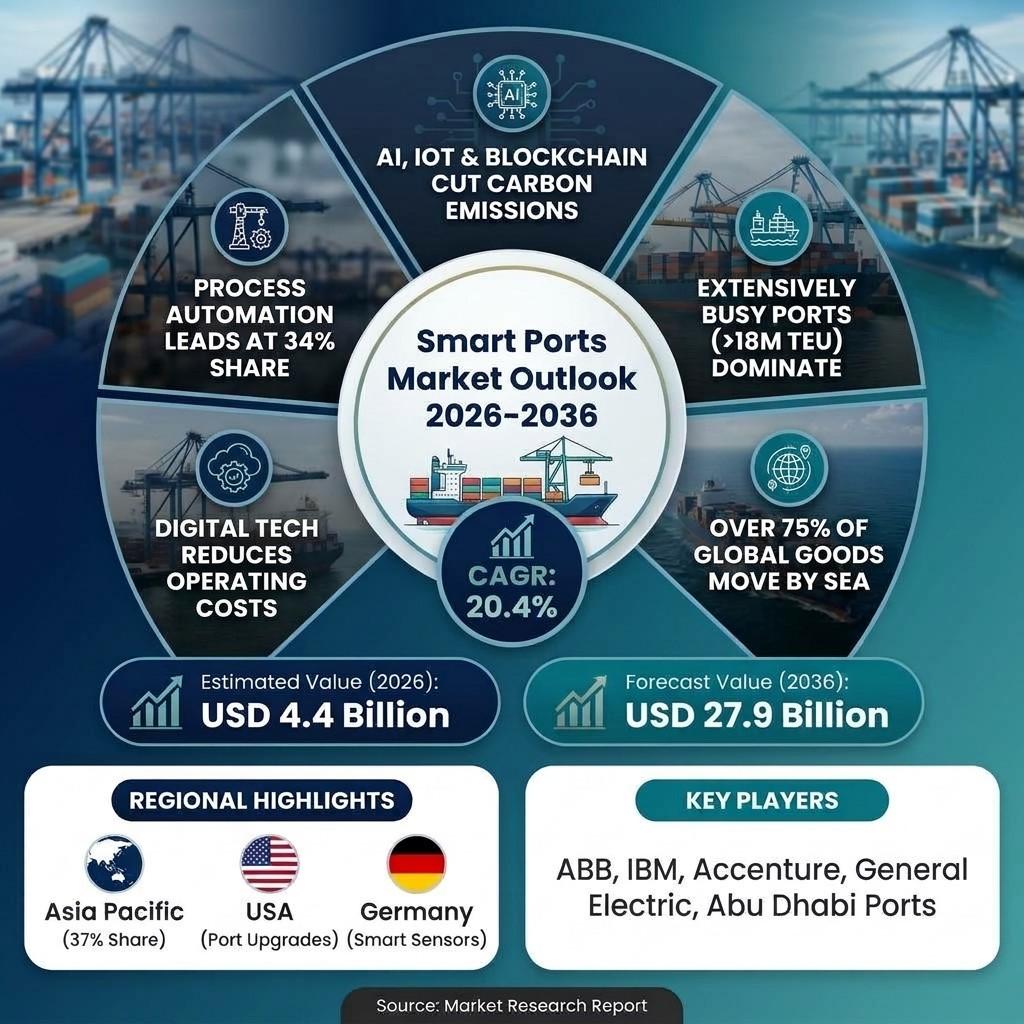
The global smart ports market is forecast to expand from USD 4.4 billion in 2026 to USD 27.9 billion by 2036, registering a 20.4% CAGR over the forecast period. Fact.MR attributes market expansion to growing maritime trade, rising port automation, and the integration of digital technologies designed to improve cargo handling, operational efficiency, safety, and port connectivity.
Port operators are increasingly deploying artificial intelligence (AI), Internet of Things (IoT) sensors, cloud platforms, robotics, blockchain, and data analytics to manage port operations. Digital transformation is helping terminals improve vessel scheduling, monitor cargo movement, optimize equipment utilization, and reduce operational delays. Growing pressure to minimize emissions and improve energy efficiency is also encouraging port authorities to modernize infrastructure and adopt smarter operating systems.
Get detailed market forecasts, competitive benchmarking, and pricing trends:
https://www.factmr.com/connectus/sample?flag=S&rep_id=8328
Process Automation Supports Smart Port Operations
By technology, process automation accounted for 34% of the smart ports market in 2022. Port authorities are increasingly using automated systems to manage routine activities, including gate operations, ship-related processes, cargo handling, and administrative tasks. Software-assisted operations can reduce manual intervention, improve workflow coordination, and help port personnel focus on more complex activities.
Artificial intelligence and IoT technologies are also gaining traction as port operators seek real-time operational visibility. Connected sensors can collect information from port equipment, cargo, vessels, and infrastructure, supporting faster decision-making and predictive maintenance. Integration of these technologies can help ports reduce equipment downtime, coordinate logistics activities, and improve the movement of goods across terminal facilities.
Ports with extensive throughput capacity are also increasingly investing in smart infrastructure. High-volume terminals manage large numbers of vessels, containers, and cargo movements, creating greater pressure to improve operating efficiency. Automation, connected infrastructure, and intelligent monitoring systems are becoming important tools for handling growing operational complexity.
China, South Korea, and Germany Strengthen Smart Port Development
China remains an important market for smart port technologies, supported by extensive maritime trade, port infrastructure investment, and the modernization of cargo-handling facilities. Port operators are increasingly integrating digital systems to improve terminal productivity, manage cargo movement, and support large-scale logistics operations. Continued investments in automation and connected infrastructure are creating opportunities for smart port solution providers.
South Korea is strengthening its position through technology-driven port development and the adoption of advanced automation systems. The country's major ports are increasingly focusing on digital infrastructure, intelligent logistics, and connected operations to improve competitiveness in international maritime trade. Investments in automated terminals and data-driven port management are supporting the transition toward smart port ecosystems.
Germany is contributing to Europe's smart port development through industrial automation expertise, digital infrastructure investments, and efforts to improve logistics efficiency. Port operators are adopting intelligent monitoring, connected equipment, and data-driven systems to improve cargo movement and operational coordination. Sustainability objectives and the need to optimize port energy consumption are also encouraging the adoption of advanced digital technologies.
Across major maritime economies, smart port development is increasingly linked with infrastructure modernization, supply chain digitization, and environmental performance improvements. The adoption pace varies according to investment capacity, existing infrastructure, regulatory requirements, and the scale of port operations.
Competitive Landscape
Competition in the smart ports market includes technology providers, engineering companies, automation specialists, and digital transformation firms offering integrated solutions for port operators. Key companies profiled in the market include ABB, Accenture, IBM, General Electric, Abu Dhabi Ports, Wipro, Royal Haskoning, and Ramboll Group.
Market participants are focusing on strategic collaborations, technology development, acquisitions, and digital infrastructure deployments to strengthen their market positions. Providers are increasingly offering solutions that combine automation software, data analytics, connected devices, and intelligent operational systems. Port authorities are evaluating vendors based on technology integration, reliability, scalability, cybersecurity, and their ability to support complex terminal operations.
Digitalization and Sustainability Shape Market Development
Smart ports are increasingly adopting digital technologies to improve operating efficiency while addressing environmental challenges. AI-powered systems and cloud computing can support energy management, optimize equipment utilization, and reduce unnecessary operational activity. Connected infrastructure is also helping port authorities monitor performance and identify inefficiencies across terminals.
However, implementation costs, infrastructure upgrades, cybersecurity risks, and concerns surrounding data privacy remain important challenges. Ports with older infrastructure may face integration difficulties when introducing modern digital systems. High capital requirements can also slow adoption among smaller port operators that have limited investment budgets.
Continued investment in automation, AI, IoT, and intelligent port management systems is expected to shape the global smart ports market through 2036. As maritime trade networks become more digitally connected, port operators are expected to prioritize technology that improves efficiency, visibility, safety, and long-term operational performance.
To View Top Reports
Power Management Controllers Market: https://www.factmr.com/report/power-management-controllers-market
High-Frequency RF Filter Banks Market: https://www.factmr.com/report/high-frequency-rf-filter-banks-market
Embedded Vision Modules Market: https://www.factmr.com/report/embedded-vision-modules-market
About Fact.MR
Fact.MR is a market research and consulting company providing market intelligence, competitive analysis, and forecasting across global industries. Its research supports businesses with data-driven insights into emerging markets, technology trends, competitive dynamics, regional opportunities, and changing demand patterns.

 English
 Arabic
 French
 Spanish
 Portuguese
 Turkish
 Dutch
 Italiano
 Russian
 Romaian
 Portuguese (Brazil)
 Greek
