
Millimeter Wave Technology Market Size, Analysis, Growth Trends & Regional Outlook 2026-2034
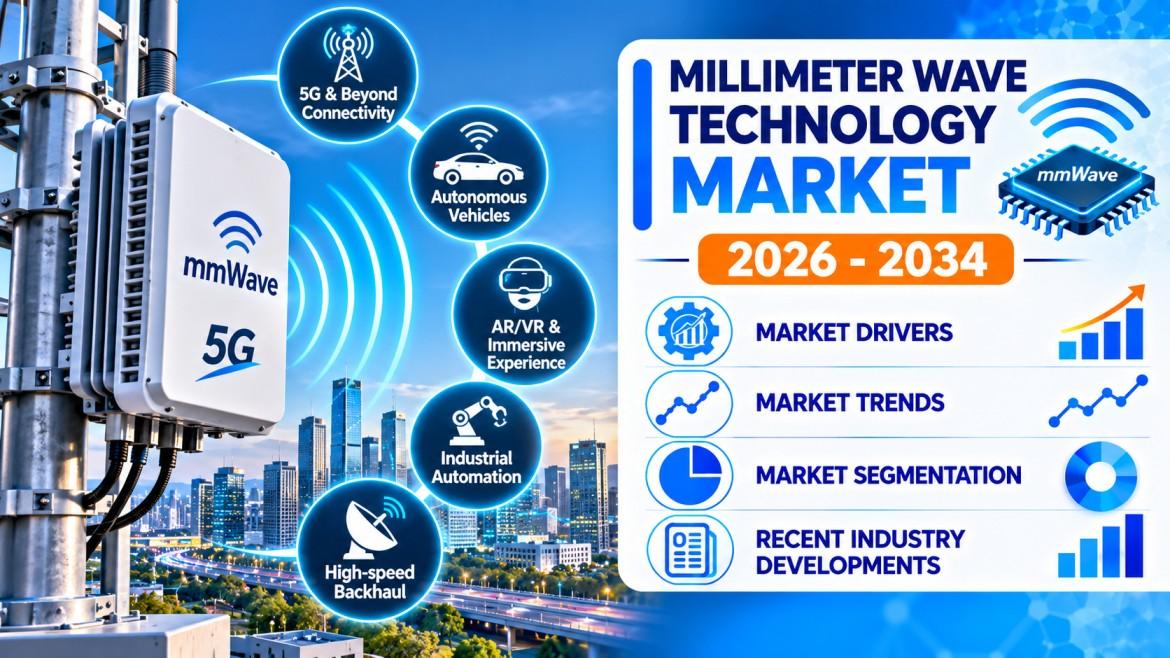
IMARC Group, a leading global market research and management consulting firm, has published its latest market intelligence report on the millimeter wave technology market. The global millimeter wave technology market size reached USD 3.6 Billion in 2025. Looking forward, IMARC Group expects the market to reach USD 15.3 Billion by 2034, exhibiting a growth rate (CAGR) of 16.88% during 2026-2034, exhibiting strong growth momentum, driven by surging demand for high-speed internet and data traffic, accelerating 5G network rollouts, rising adoption of advanced driver assistance systems and autonomous vehicles, and expanding use of connected IoT devices and security systems worldwide.
The market is experiencing rapid transformation as operators, automakers, and defense agencies move to the 24 GHz to 300 GHz spectrum for multi-gigabit speeds and ultra-low latency. Streaming, cloud computing, online gaming, and IoT applications are pushing data traffic to levels that lower-frequency bands struggle to carry. Millimeter wave spectrum offers wide channels that support fixed wireless access, dense urban 5G, wireless backhaul, automotive radar, and high-resolution imaging. According to GSMA estimates cited in the report, 5G was on track to cover roughly one-third of the world's population with about 1.2 billion connections. Each of those connections increases the need for high-capacity radio equipment.
How AI is Reshaping the Future of the Millimeter Wave Technology Market
- AI-Driven Beamforming and Network Optimization: Machine learning algorithms are improving beam steering, beam tracking, and interference management in millimeter wave networks. Short-range, line-of-sight signals are easily blocked by walls, foliage, and moving objects. AI lets radios predict blockages and switch beams in real time, which keeps connections stable in dense cities, stadiums, and apartment complexes.
- Smarter Automotive Radar and Perception: AI-enabled 77 GHz and 79 GHz radar systems classify pedestrians, cyclists, and vehicles with finer resolution than conventional processing. This supports ADAS functions such as automatic emergency braking and adaptive cruise control. Industry estimates cited in the report suggest ADAS could prevent about 14 million injuries and 37 million crashes over three decades.
- AI-Assisted Design, Testing, and Site Planning: Engineers now use AI-powered simulation and RF design flows to shorten development cycles for millimeter wave chips and antennas. Operators use machine learning on propagation data to choose small cell and customer premises equipment locations, which lowers deployment cost and speeds up fixed wireless rollouts.
Grab a sample PDF of this report: https://www.imarcgroup.com/millimeter-wave-technology-market/requestsample
Millimeter Wave Technology Market Trends and Drivers:
The global millimeter wave technology market is witnessing steady expansion, fueled by the convergence of data-hungry applications, large-scale 5G infrastructure investment, and the spread of radar and sensing across vehicles and industrial settings. Demand for high-speed internet is the foundational driver. Video streaming, cloud services, and online gaming require bandwidth and latency that millimeter wave spectrum is well placed to provide. Verizon's disclosure in October 2026 shows how operators are scaling this capability. It holds 1,700 MHz of millimeter wave spectrum and says it can deliver 1-Gig speeds to an additional 10 million to 15 million metro locations in the United States, with initial deployments underway.
Government spectrum policy is a second major force. In the United States, the FCC advanced new federal and non-federal sharing rules for the 37 GHz band in April 2025. The framework, which the FCC chairman said could unlock 600 MHz of spectrum for commercial services, supports wireless backhaul, broadband, IoT, and added mobile capacity. In Canada, the government's spectrum framework for the upcoming 26 GHz and 38 GHz auction sets a 1,200 MHz cap over five years to keep room for smaller providers. In the UAE, du and Ericsson completed a proof of concept in April 2026 using 5G Standalone with extended-range millimeter wave for residential fixed wireless access, tied to national digital economy goals.
Automotive safety and security needs are widening the application base. Millimeter wave radar is central to ADAS and autonomous driving. It works in rain, fog, and darkness, conditions where cameras struggle. Airport body scanners, perimeter security, and industrial monitoring also use millimeter wave imaging for non-contact detection. In healthcare, millimeter wave sensing is being explored for contactless vital sign monitoring and remote surgery connectivity. In factories, private 5G networks use it to link robots and automated guided vehicles with very low latency.
The report also points to rising R&D investment, strategic partnerships among equipment makers, and integration into smart city and telecom infrastructure. High implementation costs, technical complexity, short signal range, and regulatory hurdles remain the main challenges. Rapid advances in chipsets and antennas, together with the expansion of cross-industry use cases, are creating opportunities for both established vendors and new entrants.
Ask an analyst for customized report: https://www.imarcgroup.com/request?type=report&id=2737&flag=E
Millimeter Wave Technology Industry Segmentation:
The report has segmented the market into the following categories:
Breakup By Component:
- Antennas and Transceivers
- Amplifiers
- Oscillators
- Control Devices
- Frequency Converters
- Passive Components
- Others
Antennas and transceivers account for the largest component segment, as they are the core of every millimeter wave link. Beamforming and phased array designs are central to overcoming the high path loss at these frequencies in 5G radios, backhaul units, and automotive radar modules.
Breakup By Product:
- Telecommunication Equipment
- Imaging and Scanning Systems
- Radar and Satellite Communication Systems
- Services
Telecommunication equipment leads the product segment, supported by operator investment in small cells, fixed wireless access radios, and high-capacity backhaul links that carry multi-gigabit traffic.
Breakup By Frequency Band:
- 30 GHz to 57 GHz
- 57 GHz to 96 GHz
- 96 GHz to 300 GHz
The 57 GHz to 96 GHz band holds the largest share. It covers unlicensed 60 GHz applications, the E-band used for backhaul, and the 77 GHz to 79 GHz range used by automotive radar.
Breakup By License Type:
- Fully Licensed Frequency Millimeter Wave
- Light Licensed Millimeter Wave
- Unlicensed Millimeter Wave
Fully licensed millimeter wave accounts for the largest share, as operators prefer exclusive spectrum rights that guarantee interference-free, carrier-grade performance for mobile and fixed wireless services.
Breakup By Application:
- Telecommunication
- Military and Defense
- Automotive and Transport
- Healthcare
- Electronics and Semiconductor
- Others
Telecommunication is the largest application segment, driven by 5G network densification, fixed wireless broadband, and wireless backhaul demand.
Breakup By Region:
- North America (United States, Canada)
- Asia Pacific (China, Japan, India, South Korea, Australia, Indonesia, Others)
- Europe (Germany, France, United Kingdom, Italy, Spain, Russia, Others)
- Latin America (Brazil, Mexico, Others)
- Middle East and Africa
North America dominates the global millimeter wave technology market, supported by early 5G adoption, heavy operator and government investment, a strong technology and semiconductor base, and active spectrum policy. Other regions are expanding on the back of urbanization, rising demand for modern communications, and government support for digital infrastructure.
Competitive Landscape:
The report provides a comprehensive analysis of the competitive landscape in the millimeter wave technology market with detailed profiles of all major companies, including:
- Aviat Networks
- AXXCSS Wireless Solutions
- Farran Technology
- Fastback Networks
- Keysight Technologies
- L3 Technologies
- Millimeter Wave Products
- Mistral Solutions (AXISCADES)
- NEC Corporation
- Siklu Communication
- Smiths Group
- Vubiq Networks
What Does The Full Report Cover?
If you are tracking the millimeter wave technology market for investment decisions, market entry planning, competitive benchmarking, or strategic advisory, IMARC Group's report gives you everything in one place:
- Complete market sizing with revenue forecasts covering the full projection period
- Quantified growth driver analysis with impact scoring across component, product, frequency band, license type, application, and regional markets
- Sub-segment breakdowns for antennas and transceivers, telecommunication equipment, the 57 GHz to 96 GHz band, fully licensed spectrum, and telecommunication applications with individual share data
- Country-level data for the United States, Canada, Germany, France, the United Kingdom, Italy, Spain, Russia, China, Japan, India, South Korea, Australia, Indonesia, Brazil, and Mexico
- Competitive profiles of leading companies with strategic landscape assessment
- Porter's Five Forces, value chain analysis, and pricing intelligence
- Latest technology trends covering 5G fixed wireless access, automotive radar, wireless backhaul, and pre-6G spectrum developments shaping competition across key regional markets
Recent News and Developments in Millimeter Wave Technology Market
- October 2026: Verizon announced a millimeter wave "breakthrough" that it says can deliver 1-Gig speeds to an additional 10 million to 15 million metro locations in the United States. The company holds 1,700 MHz of millimeter wave spectrum, and initial deployments are starting, with a focus on scaling its multi-dwelling unit program.
- May 2026: Canada's spectrum framework for its upcoming 26 GHz and 38 GHz millimeter wave auction was reported to include a 1,200 MHz cap across both bands for five years. The cap is intended to protect competition and give smaller providers a path to acquire spectrum.
- April 2026: Ericsson and du completed a proof of concept for 5G Standalone with extended-range millimeter wave in residential areas across the UAE. It is described as the first such implementation in the country and uses Ericsson's AIR 5343 radio for multi-gigabit fixed wireless access.
- April 2025: The FCC advanced rules for federal and non-federal sharing of the 37 GHz band. The rules give the Department of Defense priority in the lower portion and co-equal access in the upper portion, with nationwide non-exclusive licenses and site-by-site coordination.
- February 2025: Keysight and Ericsson announced a pre-6G test setup using centimeter wave spectrum between 7 GHz and 15 GHz, which supports early research into the next generation of high-frequency wireless networks.
Note: If you require specific details, data, or insights that are not currently included in the scope of this report, we are happy to accommodate your request. As part of our customization service, we will gather and provide the additional information you need, tailored to your specific requirements. Please let us know your exact needs, and we will ensure the report is updated accordingly to meet your expectations.
Key Questions This Report Answers
- What is the current global millimeter wave technology market size and what is its projected value?
- Which component segment holds the largest share in the global millimeter wave technology market?
- What are the key drivers of global millimeter wave technology market growth?
- Which region dominates the global millimeter wave technology market and why?
- How are 5G rollouts, automotive radar adoption, and government spectrum policies reshaping product development and competitive strategies in the millimeter wave industry?
- Who are the top companies in the global millimeter wave technology market and what are their competitive strategies?
- What are the investment and market entry opportunities across telecommunication equipment, imaging and scanning, automotive radar, and fixed wireless access segments?
About Us:
IMARC Group is a global management consulting firm that helps the world's most ambitious changemakers to create a lasting impact. The company provides a comprehensive suite of market entry and expansion services. IMARC offerings include thorough market assessment, feasibility studies, company incorporation assistance, factory setup support, regulatory approvals and licensing navigation, branding, marketing and sales strategies, competitive landscape and benchmarking analyses, pricing and cost research, and procurement research.
Media and Sales Contact
IMARC Group
Email: sales@imarcgroup.com
United States: +1-201-971-6302
India: +91-120-433-0800
United Kingdom: +44-753-714-6104

 English
 French
 Spanish
 Portuguese
 Deutsch
 Turkish
 Dutch
 Italiano
 Russian
 Romaian
 Portuguese (Brazil)
 Greek
