
3D Technology Market Statistics: Quantifying Adoption and Operational Impact
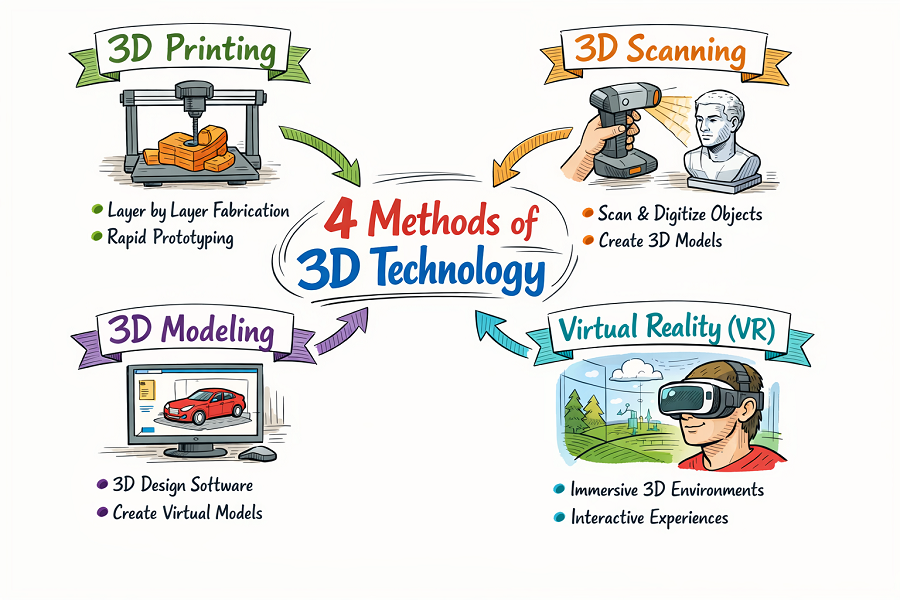
3D Technology Market Statistics provide essential context for understanding deployment patterns, segment dynamics, and the operational outcomes that drive purchasing decisions across the global landscape. While specific figures fluctuate with market conditions, the directional indicators reveal consistent themes: healthcare as the leading application, manufacturing as the fastest-growing segment, and North America as the largest regional market. These statistical patterns help organizations benchmark their own 3D technology maturity and help vendors understand where demand concentrates across application verticals, product categories, and geographic regions.
Deployment Distribution and the Industrial-Professional Split
The statistics reveal a market characterized by diverse deployment patterns across industrial, professional, and consumer segments. Industrial deployments—including production-grade systems for manufacturing, healthcare, and aerospace—represent the largest revenue share, driven by high-value applications that justify capital investment. Professional deployments—serving design firms, architectural practices, and educational institutions—represent a significant and growing segment, supported by accessible systems that deliver professional-grade capabilities. Consumer deployments—enabled by desktop systems and cloud-based services—represent an emerging segment with substantial long-term potential. The statistical trend suggests that professional and consumer segments will grow faster than industrial deployments as accessibility improves, expanding the total addressable market and broadening the base of 3D technology users.
Product Segment Insights: Printers Lead While Scanners Accelerate
Within the product landscape, 3D printers dominate market revenue due to widespread adoption across manufacturing, healthcare, education, and consumer applications. This segment benefits from ongoing advancements in printing speed, material versatility, and automation, which expand capabilities and reduce operational barriers. 3D scanners exhibit the fastest growth rate, driven by expanding applications in reverse engineering, quality inspection, heritage preservation, and medical imaging. The increasing recognition of 3D scanning for accuracy and efficiency is accelerating adoption across industries that require precise physical-to-digital conversion. 3D cameras and display technologies support immersive content creation and visualization, while 3D imaging software enables the design and simulation capabilities that drive the ecosystem. This product diversity ensures that market growth reflects broad-based demand across complementary technologies.
Application Vertical Adoption Patterns
Statistical analysis across application verticals reveals varying adoption intensity. Healthcare demonstrates the highest adoption rate, driven by surgical planning, prosthetics, implants, and bioprinting research. Manufacturing and prototyping exhibit the fastest growth, as industries adopt additive manufacturing for production-grade components and tooling. Media and entertainment show strong adoption for content creation, virtual reality, and interactive experiences. Aerospace and defense utilize 3D printing for lightweight components, spare parts, and rapid prototyping. Government applications include defense logistics, public infrastructure, and education. The common thread across verticals is the correlation between the value of customization and complexity and the intensity of 3D technology adoption.
Organizational Outcomes and Value Realization
Statistics on realized outcomes from 3D technology investments reveal that successful implementations measure value through specific operational improvements rather than abstract capability claims. Commonly reported benefits include reduced time-to-market for new products, decreased prototyping costs, improved design quality, and enhanced customization capabilities. Healthcare organizations report improved surgical outcomes and reduced procedure times. Manufacturers report reduced material waste and increased production flexibility. Organizations that establish baseline metrics before implementation and track progress against them report higher satisfaction with their investments. This outcome-focused approach contrasts with earlier implementations that pursued technology adoption without clear linkage to business results, suggesting that measurement discipline correlates with success.
➤ Featured Insights from Market Research Future:

 English
 Arabic
 French
 Spanish
 Portuguese
 Deutsch
 Turkish
 Dutch
 Italiano
 Russian
 Romaian
 Greek
