
Point-of-Care Molecular Diagnostics Market Decentralized Laboratory Growth
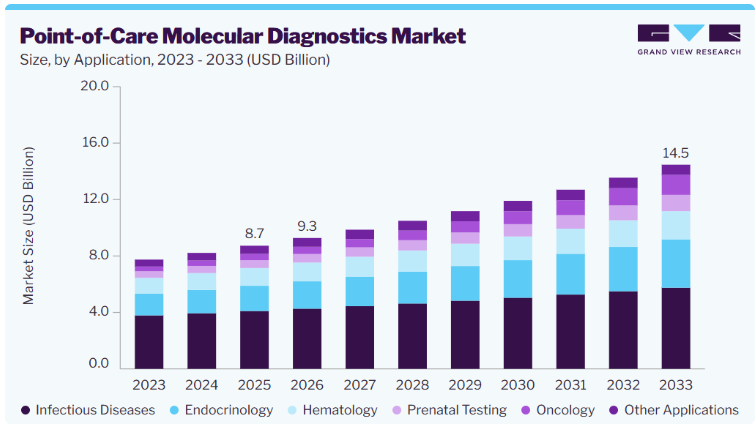
The global point-of-care molecular diagnostics market is gaining importance as healthcare providers increasingly prioritize rapid, accurate testing near the patient. These diagnostic platforms help clinicians identify infections and other medical conditions without depending entirely on centralized laboratory facilities, supporting faster clinical decisions and timely patient management. Growing demand for decentralized healthcare, advances in portable molecular testing technologies, and wider access to home-based diagnostics are creating new opportunities across healthcare environments. The global Point-Of-Care Molecular Diagnostics Market was valued at USD 8.7 billion in 2025 and is projected to grow from USD 9.3 billion in 2026 to USD 14.5 billion by 2033, registering a CAGR of 6.6% from 2026 to 2033.
Key Market Insights
- Market size in 2025: USD 8.7 billion
- Estimated market size in 2026: USD 9.3 billion
- Projected market size by 2033: USD 14.5 billion
- Forecast CAGR: 6.6% from 2026 to 2033
- Largest regional market: North America, with 45.4% revenue share in 2025
- Leading application: Infectious diseases, with 47.0% revenue share in 2025
- Leading technology: PCR-based diagnostics, accounting for 66.0% in 2025
- Leading test location: OTC, with 52.3% revenue share in 2025
- Leading end-use segment: Decentralized labs, accounting for 42.8% in 2025
Want to Understand What’s Driving Market Growth? Ask Prism AI for research-backed insights into market size, evolving opportunities
Five Technology Trends Expanding Market Applications
- Portable and cartridge-based platforms
Compact molecular testing systems with self-contained cartridges are gaining attention because they simplify testing procedures and require minimal training. Their suitability for decentralized healthcare environments supports wider deployment.
- Multiplex testing capabilities
Devices capable of detecting multiple pathogens from a single sample are becoming increasingly important. This capability supports differential diagnosis, particularly for respiratory infections that may produce overlapping symptoms.
- Digital health integration
Wireless connectivity is enabling molecular diagnostic devices to share results with electronic health records and digital healthcare systems. This supports data exchange, telemedicine, and remote patient monitoring.
- Expansion into new disease areas
Although infectious diseases remain the largest application, manufacturers are extending point-of-care molecular testing into oncology, genetic screening, and antimicrobial resistance applications.
- Testing in remote and low-resource settings
Rugged, battery-powered devices with limited infrastructure requirements are helping address diagnostic gaps in rural communities, emergency environments, and mobile healthcare settings.
Application Analysis: Infectious Diseases Lead, Oncology Accelerates
Infectious diseases accounted for 47.0% of the market in 2025, making this the largest application segment. Demand is supported by the need for rapid detection of influenza, HIV, respiratory infections, and other infectious conditions. Near-patient molecular testing allows healthcare professionals to obtain results quickly and make timely treatment decisions, particularly in emergency and outpatient settings.
The expansion of multiplex molecular assays is further improving the ability to identify multiple pathogens from a single sample. In January 2025, Abbott expanded its ID NOW molecular point-of-care platform to support rapid detection of influenza, COVID-19, RSV, and strep A.
Oncology is expected to register the fastest CAGR of 15.64% during the forecast period. Growing demand for early cancer detection, genetic mutation identification, and tumor marker analysis is supporting the adoption of molecular testing closer to patients. Portable PCR devices, microfluidic chips, and multiplex assays are improving the potential for decentralized oncology testing and supporting personalized treatment decisions.
Download a free sample report or claim your copy of this full market intelligence report
Technology Landscape: PCR-Based Testing Retains Its Dominance
PCR-based technology accounted for 66.0% of market revenue in 2025. Its high sensitivity, reliability, and established clinical utility support its leading position in molecular diagnostics. PCR is widely used for detecting infectious diseases and also has applications in cancer research, pharmacogenomics, and drug discovery.
Advancements in multiplex PCR and portable thermal cyclers are improving the usability of PCR systems outside traditional laboratories. In February 2025, Visby Medical received FDA 510(k) clearance and a CLIA waiver for its handheld Respiratory Health Test, which detects Influenza A, Influenza B, and SARS-CoV-2 in under 30 minutes.
Genetic sequencing-based point-of-care molecular diagnostics are expected to grow at the fastest rate. Real-time genetic analysis can support early disease detection and help clinicians identify treatment options suited to individual patients. Improvements in sequencing methods and the increasing emphasis on personalized medicine are supporting this segment's development.
Test Location and End-Use Patterns
The OTC segment held the largest test-location share at 52.3% in 2025. The availability of user-friendly diagnostic products is supporting greater access to testing outside healthcare facilities. Home-based testing can help individuals identify potential infections and make timely decisions without requiring an immediate clinical visit.
By end use, decentralized laboratories led the market with a 42.8% revenue share in 2025. Their adoption is supported by rapid assays, growing demand for patient-centric testing, and the integration of portable diagnostic platforms with digital health solutions.
The home care segment is expected to register the fastest growth during the forecast period. Convenience, privacy, and the ability to obtain results without visiting a hospital are supporting demand, particularly for conditions such as sexually transmitted infections.
Regional Outlook: North America Leads While Asia Pacific Gains Momentum
North America accounted for 45.4% of global market revenue in 2025. Strong healthcare infrastructure, established regulatory frameworks, and widespread adoption of rapid testing technologies support the region's leadership. The U.S. represents a major contributor, with increasing use of portable molecular platforms and self-testing solutions. In February 2024, binx health entered into a national distribution agreement with Cardinal Health to expand access to its FDA-cleared binx io molecular point-of-care platform across the U.S. healthcare network.
Europe is experiencing steady growth, supported by demand for decentralized testing and early disease detection. Germany, France, and the UK are important markets, with increasing adoption across outpatient clinics, pharmacies, and home care settings. Digital health integration and portable molecular testing are also supporting regional development.
Asia Pacific is expected to register the fastest CAGR from 2026 to 2033. Expanding healthcare access, rising awareness of early diagnosis, and investments in decentralized care are supporting demand across China, India, and Japan. Cost-effective molecular platforms and government-backed diagnostic infrastructure initiatives are improving accessibility in rural and underserved areas.
Latin America is seeing growing adoption as Brazil and Mexico invest in rapid testing solutions and primary healthcare services. In the Middle East and Africa, expanding healthcare access, public health initiatives, and mobile care programs are creating opportunities for portable diagnostic technologies.
Market Challenges and Emerging Opportunities
The high cost of molecular diagnostic systems and their implementation requirements remain important restraints. Equipment costs, operational requirements, and the need to establish suitable testing workflows can affect adoption, particularly in resource-constrained healthcare environments.
However, expanding applications in women's health and preventive screening offer new growth opportunities. Continued innovation in portable platforms, multiplex assays, and digital connectivity can further improve access to molecular diagnostics across different care settings.
Future Outlook
The point-of-care molecular diagnostics market is positioned for continued expansion as healthcare systems increasingly emphasize early detection, rapid testing, and decentralized patient care. Infectious disease testing will remain a major application area, while oncology, genetic sequencing, home care, and preventive screening are expected to create additional opportunities. Advancements in portability, multiplex testing, and digital connectivity will continue to influence product development and support broader adoption through 2033.
Explore Our Research & Intelligence Solutions
U.S. Healthcare Facility Intelligence: Make Better Decisions with Comprehensive Data – Explore the Platform

 English
 Arabic
 French
 Spanish
 Portuguese
 Deutsch
 Turkish
 Dutch
 Italiano
 Romaian
 Portuguese (Brazil)
 Greek
