
Cutlery Market Expected to Reach USD 10.38 Billion by 2033, with Top Players Cambridge Silversmiths, J.A. Henckels and Oneida in Focus
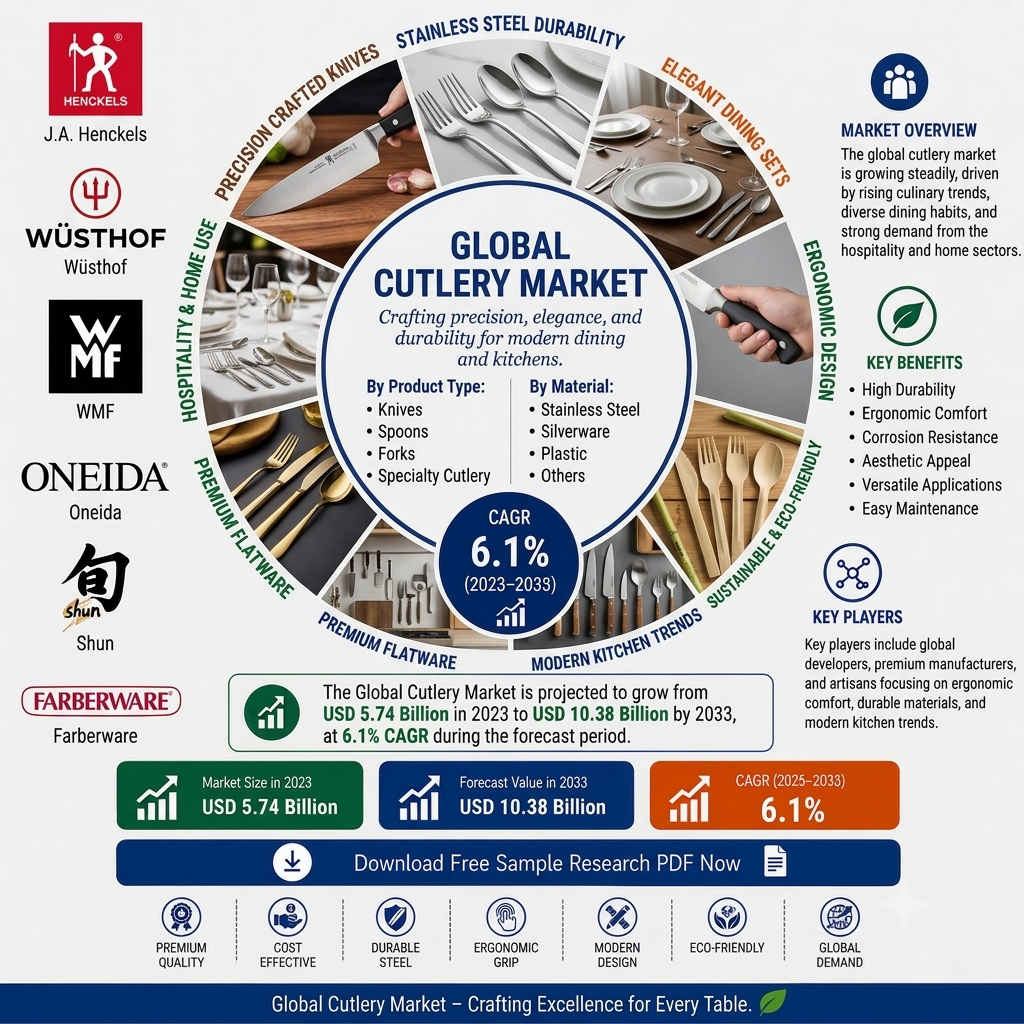
November 19, 2026 — Rockville, MD: The global cutlery market is projected to grow from USD 5.74 billion in 2023 to USD 10.38 billion by 2033, expanding at a 6.1% CAGR during the forecast period, according to Fact.MR. Rising demand for sustainable and aesthetically appealing dining products, expansion of food service establishments, and growing adoption of innovative cutlery designs are supporting market growth.
Cutlery manufacturers are responding to changing dining habits, increasing restaurant and food delivery activity, and growing consumer interest in functional and eco-friendly products. Sustainable materials such as bamboo, wood, biodegradable plastics, and edible materials are gaining attention as businesses and consumers seek alternatives to conventional plastic cutlery.
Request full Report Pricing and sample Report: https://www.factmr.com/connectus/sample?flag=S&rep_id=5201
Cutlery Market Outlook
Growing popularity of casual and social dining is supporting demand for spoons, forks, knives, sporks, chopsticks, straws, and stirrers across residential and commercial applications. Increasing urbanization and changing lifestyles are encouraging consumers to dine out more frequently, while food delivery services are creating additional demand for disposable and hybrid cutlery.
The food service industry remains an important source of demand. Cafes, hotels, restaurants, catering businesses, and institutional food services require durable and visually appealing cutlery to improve dining experiences. Manufacturers are therefore investing in premium products featuring improved designs, durability, heat resistance, antimicrobial properties, and dishwasher-safe materials.
Sustainability is also influencing product development. Growing awareness of plastic waste is encouraging manufacturers to develop cutlery from bamboo, wood, biodegradable plastics, wheat stalks, starch, and other renewable or compostable materials. Edible cutlery made from wheat bran, sorghum, rice bran, millet, and corn is emerging as another alternative to conventional disposable products.
However, the disposal of plastic-made cutlery and high raw material prices remain challenges for market participants. Premium cutlery products can also face adoption barriers in price-sensitive markets, encouraging manufacturers to focus on cost-efficient materials and scalable production methods.
Straws Create New Opportunities
The straws segment is projected to reach USD 1.32 billion by 2033, expanding at a 6.4% CAGR during the forecast period. Demand is being supported by food service outlets, beverage consumption, takeaway services, and the shift toward sustainable alternatives to conventional plastic straws.
Manufacturers are increasingly developing straws from paper, bamboo, biodegradable materials, and other sustainable alternatives. Rising restrictions on single-use plastic products are creating additional opportunities for suppliers offering environmentally friendly straw solutions.
Sporks, knorks, spifes, and other multifunctional utensils are also gaining attention as consumers seek convenience and reduced packaging requirements. Combining multiple eating functions into a single product can support demand across takeaway, travel, and casual dining applications.
Food Service Outlets and Online Retail Drive Demand
Food service outlets represent an important end-use category as restaurants, hotels, cafes, and food delivery businesses increase their use of cutlery products. Growing preference for online food ordering and home delivery is supporting demand for both reusable and disposable cutlery.
The online retail channel is also gaining importance. Cutlery sales through online retail are projected to grow at a 6.3% CAGR and reach USD 7.22 billion by 2033. Around half of overall cutlery product sales take place through online channels, reflecting growing consumer preference for price comparison, product variety, discounts, and convenient home delivery.
E-commerce platforms are enabling manufacturers and brands to reach broader consumer groups without relying entirely on traditional retail networks. Online channels are particularly useful for premium, designer, sustainable, and specialty cutlery products.
India, the United Kingdom and South Korea Offer Growth Opportunities
India is projected to expand at a 6.5% CAGR and reach USD 1.46 billion by 2033. Rising interest in exotic dining experiences, growing restaurant numbers, food blogging, cooking shows, and greater awareness of different cuisines are supporting demand for specialized cutlery.
India is expected to account for around 14% of global cutlery market revenue during the forecast period. Increasing attention to hygiene and health, combined with consumers' willingness to experiment with new cuisines, is creating opportunities for manufacturers offering specialized and aesthetically designed products.
The United Kingdom is projected to reach USD 1.31 billion by 2033, expanding at a 6.5% CAGR. Growing interest in social dining, home cooking, casual dining, and sustainable materials is supporting market development.
South Korea is expected to grow at a 6.9% CAGR and reach USD 415.24 million by 2033. The rapid expansion of food delivery services is supporting demand for disposable cutlery, while changing consumer lifestyles are creating opportunities for sustainable and convenient products.
Competitive Landscape
The global cutlery market is becoming increasingly competitive as manufacturers focus on product innovation, sustainable materials, premium designs, and expanding distribution networks. Companies are developing products that combine functionality, durability, aesthetics, and environmental considerations to meet changing consumer preferences.
Key companies profiled by Fact.MR include Cambridge Silversmiths, J.A. Henckels, Farberware, Crate and Barrel, Kate Spade, Towle, Oneida, WMF, Wallace, Multifunction Tools and Knives, Wusthof, Myabi, Shun, Hunting and Survival Knives, and Messermiester.
Companies are investing in new product designs, sustainable materials, partnerships, and acquisitions to strengthen their market positions. In December 2020, Pharrell collaborated with Pentatonic to design a cutlery set produced from recycled CDs. In November 2020, the Linden Portable Cutlery Set was introduced as an eco-friendly option featuring spoons, a knife, a fork, and chopsticks.
The growing emphasis on sustainable materials is expected to encourage further product development using bamboo, starch, recycled materials, biodegradable plastics, and edible materials. Manufacturers are also expanding online distribution to reach consumers seeking premium and environmentally conscious cutlery products.
To View Related Reports
Wellness Festival Operators Market https://www.factmr.com/report/wellness-festival-operators-market
Youth Wellness Resorts Market https://www.factmr.com/report/youth-wellness-resorts-market
Neuroarchitecture Advisory Services Market https://www.factmr.com/report/neuroarchitecture-advisory-services-market
Men’s Social Wellness Clubs Market https://www.factmr.com/report/mens-social-wellness-clubs-market
About Fact.MR
Fact.MR is a market research and competitive intelligence provider delivering market intelligence, competitive analysis, and forecasting across global industries. Its research helps businesses evaluate market demand, understand competitive developments, and identify growth opportunities.

 English
 Arabic
 French
 Spanish
 Portuguese
 Deutsch
 Turkish
 Dutch
 Russian
 Romaian
 Portuguese (Brazil)
 Greek
