
What material testing methods should Modular Gynaec OT Manufacturers follow for quality assurance?
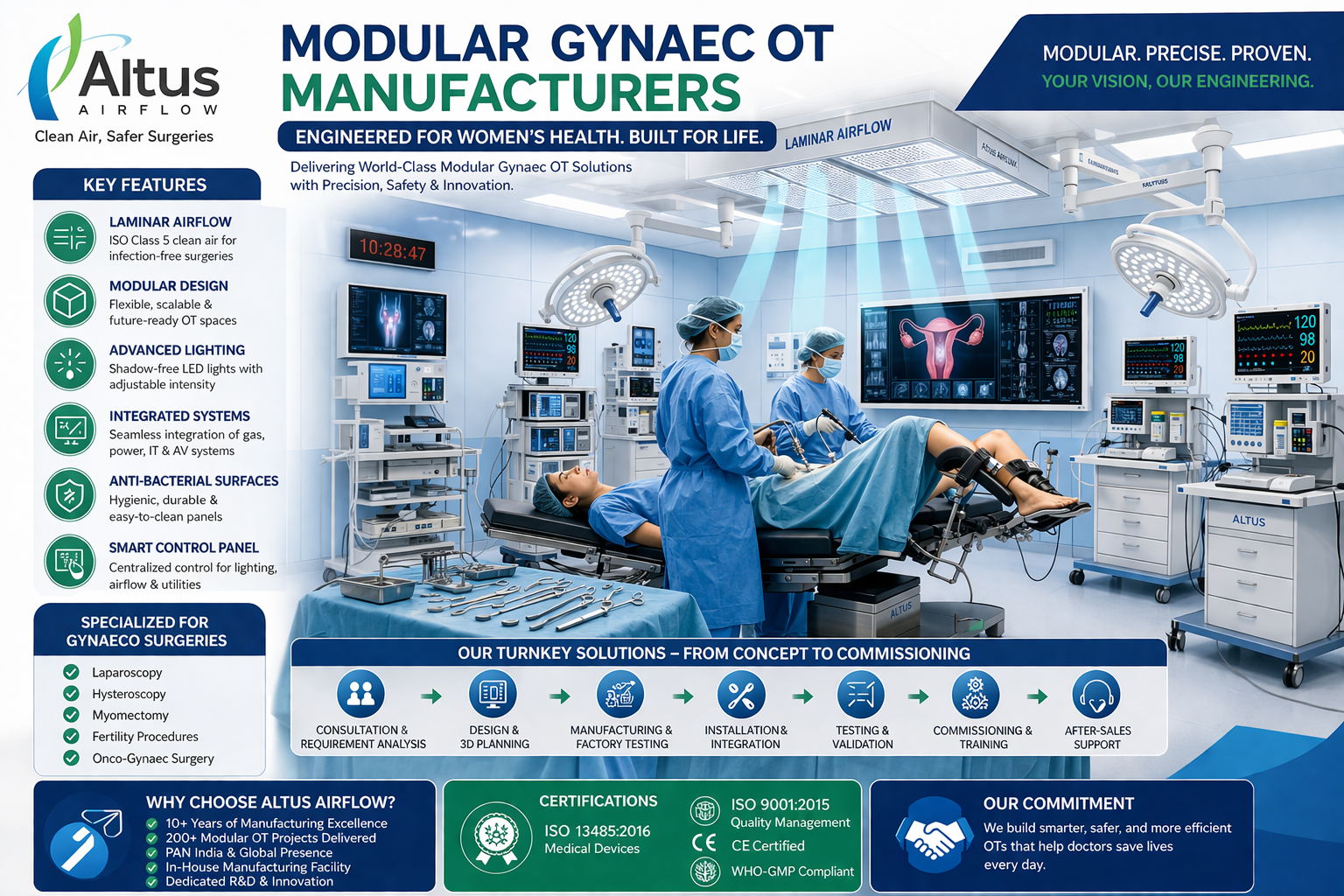
Introduction
Material quality plays an important role in the safety, hygiene, and long-term performance of a modular gynaecology operating theatre. Wall panels, ceiling systems, flooring, doors, joints, and integrated service components must withstand regular cleaning, equipment movement, moisture exposure, and daily clinical activities. Modular Gynaec OT Manufacturers should therefore follow systematic material testing and inspection procedures to verify that every component meets the approved project specifications.
Quality assurance begins before manufacturing and continues through fabrication, installation, and final handover. Testing helps identify defects such as uneven surfaces, weak joints, coating damage, dimensional variations, and poor chemical compatibility. These issues can affect cleanability, structural performance, and the durability of the completed OT.
A reliable quality assurance process should combine supplier documentation, laboratory testing where appropriate, factory inspections, and on-site verification. The testing methods selected should reflect the material type, intended application, manufacturer's specifications, and relevant engineering standards.
1. Raw Material Inspection and Specification Verification
Raw material inspection is the first step in quality assurance. Before fabrication begins, manufacturers should verify that the supplied materials match the approved technical specifications.
This process includes checking material grade, thickness, dimensions, composition, surface condition, and relevant manufacturer documentation. For metal components, material certificates and grade information help confirm whether the supplied material matches the specified requirements.
For modular wall panels, inspection may include the core material, surface layers, backing, edge construction, and bonding quality. Flooring materials should be checked for their specified composition, thickness, and intended performance characteristics.
Material identification and batch records are also important. They help manufacturers trace components to their suppliers and investigate quality issues if a defect appears during fabrication or installation.
2. Surface Finish and Cleanability Testing
Operating theatre surfaces should be smooth, durable, and suitable for routine cleaning. Surface finish testing helps identify defects that could affect hygiene or cause premature deterioration.
Visual inspection can identify scratches, dents, uneven coatings, bubbles, peeling, cracks, and other surface imperfections. Where required, surface roughness measurements can provide a more objective assessment of the finish.
Manufacturers should also assess whether the proposed surface materials are compatible with the hospital's approved cleaning and disinfection products. This is important because repeated chemical exposure can gradually damage unsuitable coatings or finishes.
The final surface should be easy to clean and should not have unnecessary grooves, exposed edges, or gaps where dirt and moisture can accumulate. Inspection criteria should be established before production so that all components are evaluated consistently.
3. Corrosion Resistance Testing
Metal components used in an operating theatre may include door hardware, frames, support brackets, fasteners, and selected equipment fixtures. These components should have appropriate resistance to corrosion under their intended operating conditions.
Salt spray testing, such as testing under ASTM B117 where applicable, may be used to evaluate the corrosion resistance of coated metal samples. It exposes test specimens to a controlled salt-fog environment and helps assess the performance of protective coatings.
However, salt spray results should not be treated as a direct prediction of service life in an operating theatre. The test method, exposure duration, acceptance criteria, and material application should be specified according to the relevant product requirements.
Visual inspection of exposed surfaces, coating thickness checks where relevant, and verification of material grade can complement laboratory testing. The purpose is to ensure that components are suitable for their intended environment and maintenance conditions.
4. Impact and Mechanical Strength Testing
Modular OT components may experience accidental contact from mobile equipment, trolleys, doors, and routine maintenance activities. Mechanical testing helps assess whether panels and associated components can withstand their expected use.
Impact testing may be performed on representative panel samples using an appropriate test method selected for the material and intended application. The assessment can identify cracking, deformation, surface damage, or separation between layers.
For components that carry equipment loads, structural verification is also important. Wall-mounted equipment supports, ceiling-mounted surgical lights, and pendants should be assessed through appropriate engineering calculations and load testing where specified.
Manufacturers should distinguish between decorative panels and structural support systems. A modular wall panel should not automatically be assumed to support heavy medical equipment unless the system has been specifically designed and verified for that purpose.
5. Chemical Resistance Testing
Operating theatre surfaces are regularly exposed to hospital-approved cleaning agents and disinfectants. Chemical resistance testing helps determine whether a material can tolerate repeated exposure without unacceptable damage.
Representative samples may be exposed to specified cleaning chemicals under controlled conditions. The inspection should evaluate changes such as discoloration, swelling, softening, cracking, peeling, loss of adhesion, or surface deterioration.
The test chemicals and exposure conditions should reflect the hospital's actual cleaning procedures. A material that performs well with one disinfectant may not be suitable for another chemical formulation.
Sealants, coatings, flooring, wall panels, door finishes, and exposed metal components should all be considered. Manufacturers should provide clear cleaning and maintenance instructions so that hospital teams can use compatible products after installation.
6. Joint Sealing and Leakage Inspection
Joints between modular panels, ceiling sections, doors, and service openings are important areas for quality inspection. Poorly finished joints can create gaps that collect dust or moisture and make routine cleaning difficult.
Inspection should examine the continuity of sealant, adhesion to adjoining surfaces, visible gaps, corner finishing, and the condition of transitions between different materials.
Where the project specification requires it, suitable leakage or water-resistance checks may be performed on representative assemblies. The test method should match the intended application rather than applying an unrelated test to every joint type.
Service openings for electrical outlets, medical gas terminals, control panels, and HVAC components should receive particular attention. Their edges and surrounding finishes must be completed carefully to preserve the integrity of the modular construction.
7. Flooring Wear, Slip Resistance, and Adhesion Testing
Flooring in a gynaecology operating theatre must support regular foot traffic, equipment movement, cleaning, and disinfection. It should be selected and tested according to the intended clinical use.
Wear-resistance testing can help evaluate how a flooring material responds to repeated abrasion. Slip-resistance testing can assess surface performance under specified test conditions. The selected method and acceptance criteria should be appropriate for the flooring type and the hospital's requirements.
Adhesion checks are also important because poorly bonded flooring may lift, blister, or separate from the substrate. Installation quality, substrate preparation, adhesive compatibility, and curing conditions can influence the final result.
The finished floor should have appropriate surface continuity and well-finished transitions. The inspection should identify cracks, uneven areas, loose edges, and gaps that could affect cleaning or equipment movement.
8. Dimensional Accuracy and Fabrication Testing
Accurate fabrication is essential for modular OT installation. Panels, doors, ceiling sections, and service cut-outs must match the approved drawings so that components fit correctly on site.
Dimensional inspections should verify panel length, width, thickness, squareness, edge alignment, opening positions, and other specified measurements. Suitable measuring instruments should be used, with calibration maintained where required.
Fabrication inspections should also examine cutting quality, edge finishing, drilled openings, assembly accuracy, and surface protection. Components with significant dimensional variations may cause installation gaps or require unnecessary site modifications.
A documented inspection process helps ensure consistency between production batches and reduces the risk of errors during installation.
9. Adhesion and Coating Thickness Testing
Coatings and surface layers protect materials and contribute to cleanability and appearance. Their quality depends on correct application, surface preparation, curing, and adhesion.
For painted or coated metal components, coating thickness can be checked using suitable thickness gauges where the coating system requires it. Adhesion testing, such as an appropriate cross-cut test under ISO 2409, may be used for compatible coating systems.
The test method should be selected according to the coating type and substrate. Not every surface finish can be evaluated using the same adhesion test.
Inspection should identify peeling, blistering, inconsistent coverage, exposed substrate, and other defects. Test results should be compared with the coating manufacturer's requirements and the approved project specifications.
10. Testing HVAC and Integrated Technical Components
Material quality assurance must also consider how modular components interact with the OT's technical systems. Wall panels and ceiling assemblies need suitable openings, supports, and finishing details for HVAC, filtration, electrical, and medical gas installations.
Air diffusers, HEPA filter housings where specified, return-air grilles, and duct connections should be installed according to approved drawings. Their surrounding joints and access arrangements should be inspected for correct finishing.
The HVAC system requires separate performance testing, including relevant airflow measurements, pressure verification, and filter integrity checks where applicable. These are system commissioning activities rather than material tests, but they are essential to verifying the completed OT.
Electrical installations and medical gas systems also require their own specified inspection and testing procedures by qualified personnel. Modular construction quality should not be considered complete until these interfaces have been checked.
11. Factory Quality Control and On-Site Inspection
Quality assurance should take place at both the manufacturing facility and the project site. Factory inspections help identify material or fabrication defects before components are transported. Site inspections verify that the components have been installed correctly and match the approved drawings.
At the factory, quality teams should review incoming materials, fabrication dimensions, surface finishes, coating quality, joint details, and packaging condition. Inspection records should identify the product, batch, test method, result, and any corrective action.
At the site, the team should check panel alignment, joint sealing, door operation, flooring finish, ceiling installation, and service integration. Damaged components should be repaired or replaced using approved methods.
A coordinated inspection process between manufacturers, contractors, and hospital representatives helps maintain consistent quality throughout the project.
12. Documentation, Standards, and Quality Assurance Records
Testing is useful only when its results are properly documented and reviewed. Manufacturers should maintain material certificates, supplier documents, laboratory reports, inspection checklists, calibration records, and corrective-action reports.
Testing methods should be selected according to the material and application. Relevant standards may include ASTM or ISO methods for specific coating, corrosion, dimensional, or surface-performance tests. The applicable standard and its current edition should be confirmed during project specification.
A test certificate alone does not establish that an entire OT installation is compliant. Quality assurance must also include design review, installation inspection, system commissioning, and verification against the hospital's approved requirements.
Clear documentation supports traceability and gives hospital engineering teams useful information for future repairs, replacement, and maintenance.
Conclusion
Material testing is essential for maintaining the quality and durability of a modular gynaecology operating theatre. Raw material verification, surface finish inspection, corrosion resistance testing, impact assessment, chemical compatibility checks, joint sealing inspection, flooring evaluation, and dimensional verification help identify defects before they affect the completed facility.
Quality assurance should continue from supplier selection through manufacturing, installation, commissioning, and handover. Altus Airflow supports modular operating theatre projects with attention to material selection, fabrication quality, technical coordination, and functional healthcare infrastructure.
Frequently Asked Questions
1. What material testing methods should Modular Gynaec OT Manufacturers follow for quality assurance?
Modular Gynaec OT Manufacturers should use appropriate methods for raw material verification, surface finish inspection, corrosion resistance, impact strength, chemical compatibility, joint sealing, flooring performance, dimensional accuracy, and coating adhesion. Testing should follow the material specifications and relevant standards.
2. Why is chemical resistance testing important for modular OT materials?
Chemical resistance testing helps determine whether wall panels, flooring, coatings, and sealants can withstand repeated exposure to the hospital's approved cleaning and disinfecting agents without unacceptable deterioration.
3. How is the corrosion resistance of modular OT components evaluated?
It can be assessed through material verification, coating inspection, thickness measurements where applicable, and suitable laboratory methods such as salt spray testing for specified coated metal components.
4. Why should modular OT wall panels undergo impact testing?
Impact testing helps evaluate how representative panel samples respond to accidental contact and expected operational loads. It can identify cracking, deformation, or surface damage that may affect durability.
5. What documents should manufacturers provide after material quality testing?
Relevant documents include material certificates, supplier specifications, laboratory test reports, inspection records, calibration information, non-conformance reports, corrective-action records, and applicable installation and maintenance instructions.
Read Our Previous Blog---->How do Modular Major Orthopedic OT Manufacturers ensure durable OT construction?

 English
 Arabic
 Spanish
 Portuguese
 Deutsch
 Turkish
 Dutch
 Italiano
 Russian
 Romaian
 Portuguese (Brazil)
 Greek
