
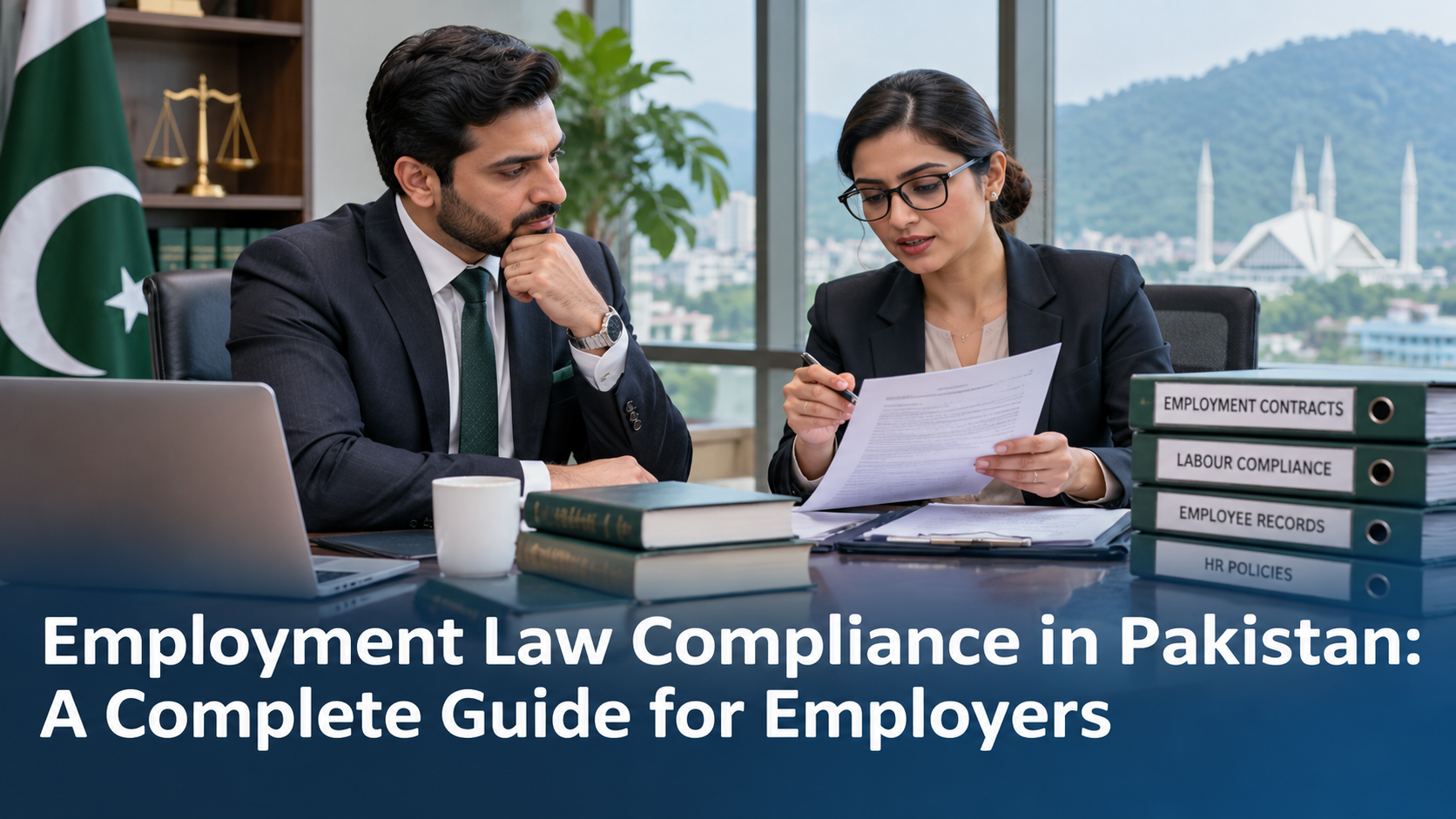
Employment Law Compliance in Pakistan: A Complete Guide for Employers
Introduction
Managing employees is one of the most important responsibilities of running a business. From preparing employment contracts and calculating salaries to managing workplace complaints and handling employee terminations, employers must make decisions that comply with applicable labour and employment laws. Even a small mistake in these areas can lead to financial losses, employee dissatisfaction, legal disputes, or regulatory complications.
In Pakistan, employment requirements can vary depending on the province, industry, nature of the establishment, and category of employees. Businesses must understand their obligations rather than relying entirely on informal workplace practices. This is where employment law advisory pakistan becomes valuable. Professional legal guidance helps employers understand applicable regulations, prepare appropriate documentation, establish fair HR procedures, and manage employment-related risks before they turn into serious problems.
Whether you operate a startup, software house, manufacturing company, retail business, or established organisation, a structured approach to employment law compliance can protect your business while supporting a professional and productive working environment.
1. Understand the Employment Laws Applicable to Your Business
One of the first responsibilities of an employer is understanding which employment laws apply to the organisation. Pakistan has a framework of labour legislation covering wages, working conditions, employment relationships, workplace safety, social security, and employee protection.
Following the 18th Constitutional Amendment, many labour-related legislative responsibilities were devolved to provincial governments. Consequently, businesses operating in Punjab, Sindh, Khyber Pakhtunkhwa, and Balochistan may need to follow different provincial requirements. Certain federal laws and requirements also remain relevant.
For example, Punjab enacted the Punjab Labour Code 2026, introducing a consolidated framework covering employment conditions, workplace safety, remuneration, and workers' rights. Employers should review its commencement notifications, implementing rules, and applicable transitional provisions when determining their current obligations.
A legal professional can assess the organisation's location, workforce, operational activities, and employee categories to identify relevant requirements. This labour law compliance Pakistan review gives management a clearer understanding of its responsibilities and reduces the possibility of applying outdated or inappropriate employment policies.
2. Prepare Proper Employment Contracts and Appointment Letters
A verbal employment agreement might seem convenient when a business is hiring quickly. However, informal arrangements can create serious misunderstandings when disagreements develop over responsibilities, salary, working hours, notice periods, or termination conditions.
A properly prepared employment contract establishes the expectations of both parties from the beginning. It should clearly explain the employee's designation, job responsibilities, compensation, working arrangements, probation conditions, leave entitlements, confidentiality obligations, and termination procedures, subject to applicable law.
Professional employment contract drafting helps businesses prepare documents that reflect their actual working arrangements rather than relying on generic templates downloaded from the internet.
Employers should also maintain signed copies of appointment letters, updated contractual terms, employee identification records, and relevant HR documentation. When an employee receives a promotion, changes departments, or moves into a different role, the organisation should document the updated conditions appropriately.
Clear written agreements help prevent avoidable arguments and provide useful evidence if an employment dispute arises.
3. Maintain Accurate Payroll and Salary Compliance
Salary-related disagreements are among the common issues that affect employer-employee relationships. Delayed payments, incorrect deductions, unclear salary calculations, and missing payroll records can damage employee confidence and create legal exposure.
Employers should establish a consistent payroll system that records basic salaries, allowances, overtime, bonuses, deductions, and other applicable payments. Salary structures must comply with relevant minimum wage requirements and other applicable statutory rules.
Businesses should pay particular attention to the following areas:
-
Minimum wage compliance: Ensure employee compensation meets the applicable government-notified minimum wage requirements.
-
Payroll documentation: Maintain accurate salary registers, payment records, payslips, and attendance information.
-
Overtime payments: Apply the relevant working-hour and overtime rules according to the employee category and applicable legislation.
-
Lawful salary deductions: Make deductions only where legally permitted and properly documented.
-
Timely salary payments: Establish payment schedules and follow the relevant statutory deadlines.
Professional payroll compliance services can help businesses review their salary structures, identify inconsistencies, and coordinate employment-related statutory obligations.
Companies should also review applicable registration and contribution requirements relating to EOBI and provincial social security institutions. These responsibilities should not be treated as optional administrative tasks.
4. Establish Clear HR Policies and Workplace Regulations
As a business grows, managing employees through verbal instructions becomes increasingly difficult. Different managers may interpret workplace rules differently, creating confusion about attendance, leave, discipline, performance expectations, and employee responsibilities.
A written HR manual provides a consistent framework for managing these matters. It should explain workplace expectations in language employees can understand and should remain consistent with applicable employment legislation.
A comprehensive employee handbook may address attendance procedures, working hours, leave applications, workplace conduct, confidentiality, disciplinary procedures, performance reviews, and grievance reporting.
Employers should also consider the following policies:
Attendance and punctuality policy: Explain reporting times, attendance recording, late arrivals, absences, and approval procedures.
Leave management policy: Define how employees request annual, casual, sick, maternity, and other applicable leaves.
Confidentiality policy: Explain how employees must protect customer information, business records, financial information, and trade secrets.
Disciplinary policy: Establish a fair process for addressing misconduct, repeated performance concerns, and breaches of workplace rules.
Well-designed HR policies and procedures reduce uncertainty and help management apply workplace standards consistently across departments.
5. Protect Employees From Workplace Harassment and Discrimination
A legally compliant workplace must provide employees with a professional environment where harassment, intimidation, and unlawful discrimination are not ignored.
Workplace harassment can damage employee confidence, reduce productivity, and expose an organisation to complaints and legal proceedings. Employers should understand their responsibilities under the Protection Against Harassment of Women at the Workplace Act, 2010, as amended in 2022, along with other applicable legal requirements.
Under the relevant framework, organisations must establish an internal inquiry committee, designate a competent authority, and display the required code of conduct. The Federal Ombudsperson Secretariat for Protection Against Harassment provides official compliance guidance for public and private organisations.
A proper workplace harassment policy should explain unacceptable conduct, complaint submission procedures, confidentiality expectations, investigation responsibilities, and protection against retaliation.
Management should also ensure that complaints are assessed fairly rather than dismissed as ordinary workplace disagreements.
Professional workplace harassment legal advice can help employers establish appropriate procedures, conduct legally informed internal reviews, and respond to complaints while protecting the rights of everyone involved.
6. Follow Proper Procedures for Employee Termination
Employee termination requires careful consideration because an employer cannot simply ignore contractual obligations or applicable statutory protections when ending an employment relationship.
Businesses may need to terminate employment because of misconduct, unsatisfactory performance, redundancy, organisational restructuring, or other legitimate reasons. However, the appropriate procedure depends on the employee's legal classification, employment agreement, and relevant legislation.
Before taking action, employers should review the employment contract, previous warnings, performance records, disciplinary history, and any relevant workplace policies.
A structured employee termination procedure may involve:
-
Identifying and documenting the reason for the proposed action.
-
Reviewing the applicable contractual and legal requirements.
-
Providing the employee with an appropriate opportunity to respond where required.
-
Following the relevant disciplinary or performance management process.
-
Issuing a properly documented decision or termination notice.
-
Calculating and settling outstanding salary and other lawful employee dues.
Employers should avoid dismissing employees through informal messages or undocumented conversations. Professional wrongful termination legal advice can help management assess the situation and reduce the risk of employment disputes.
7. Understand Employee Benefits, Social Security, and EOBI Requirements
Employee benefits are another important part of employment compliance. Depending on the applicable laws and employee eligibility, businesses may have responsibilities relating to social security, old-age benefits, workplace compensation, maternity benefits, gratuity, provident funds, and other statutory entitlements.
The Employees' Old-Age Benefits Institution (EOBI) provides an important social protection framework for eligible employees and registered employers. Businesses should understand whether registration and contribution requirements apply to their establishments and workforce.
Similarly, employers must review relevant provincial social security legislation and registration procedures. For organisations operating in multiple locations, these responsibilities may require additional coordination.
A professional EOBI registration and compliance review can help identify missing registrations, incorrect contribution records, and documentation gaps.
Companies should not assume that offering private health insurance or additional employee benefits automatically replaces their statutory obligations. Each requirement must be assessed separately under the applicable framework.
8. Manage Remote Employees, Contractors, and Outsourced Workers
Modern businesses increasingly rely on remote employees, freelancers, consultants, independent contractors, and outsourced service providers. Although these arrangements offer operational flexibility, they can also create employment classification and contractual risks.
One important mistake is assuming that describing someone as an independent contractor automatically removes all employment-related responsibilities. The actual relationship, working arrangements, degree of control, contractual terms, and applicable legal definitions may influence how that relationship is treated.
Businesses should review their arrangements before engaging workers and ensure that agreements accurately describe the relationship.
Professional independent contractor agreements should explain payment terms, deliverables, responsibilities, intellectual property ownership, confidentiality, and termination conditions.
Software houses, digital marketing agencies, call centres, and technology companies should pay particular attention to these arrangements because their workforce models often involve remote and project-based engagements.
A legal review can help businesses structure these relationships appropriately while reducing uncertainty about employment rights and contractual responsibilities.
9. Maintain Employment Records and Prepare for Labour Inspections
Accurate recordkeeping is essential for demonstrating that an organisation follows its employment responsibilities. Missing appointment letters, incomplete attendance registers, inconsistent payroll records, and outdated HR policies can make it difficult to respond to regulatory questions or employee complaints.
Employers should establish an organised system for maintaining employee-related documentation. Depending on applicable requirements, records may include:
-
Employment agreements and appointment letters.
-
Employee attendance and working-hour records.
-
Payroll registers and salary payment evidence.
-
Leave records and employee benefit information.
-
EOBI and social security registration documents.
-
Disciplinary notices and relevant investigation records.
-
Workplace policies and employee acknowledgements.
An effective labour law compliance audit can identify missing information and areas requiring improvement.
Businesses should also ensure that employees responsible for HR and administration understand recordkeeping requirements and know how to respond to formal requests from relevant authorities.
10. Train HR Managers and Department Heads on Legal Responsibilities
Employment compliance is not solely the responsibility of the HR department. Department heads, supervisors, payroll managers, and senior management also make decisions that can affect employee rights and organisational liabilities.
For example, a supervisor who changes an employee's working hours without following the appropriate process may create an avoidable problem. Similarly, an HR manager who handles a harassment complaint incorrectly can expose the company to further legal complications.
Regular training helps managers understand their responsibilities, apply workplace policies consistently, and recognise situations that require professional legal advice.
Businesses should consider HR compliance training covering employment agreements, employee classification, disciplinary procedures, workplace harassment, salary administration, and lawful termination.
A properly trained management team can address ordinary workplace matters more confidently and involve legal professionals when an issue requires specialist attention.
Why Professional Employment Law Advisory Matters
Employment regulations can become complicated when businesses expand, introduce new workforce arrangements, or operate across different provinces. Relying on outdated documents or informal HR practices can expose organisations to unnecessary risks.
Professional employment law consultancy services provide businesses with practical guidance on contracts, employee rights, HR documentation, regulatory responsibilities, workplace disputes, and employment-related decisions.
For businesses seeking employment law advisory pakistan support, professional guidance can help establish a stronger relationship between management and employees. It also allows business owners to identify potential legal problems before they affect operations.
Pakistan's First Online Consultants (PFOC) provides legal consultancy support covering employment contracts, HR policies, EOBI registration, lawful termination, regulatory compliance, and labour dispute matters. With appropriate legal guidance, businesses can improve their internal procedures and make employment decisions with greater confidence.
Final Thoughts
Employment law compliance should be treated as an essential part of responsible business management, not simply an administrative requirement. Employers must understand the rules governing their workforce, maintain accurate documentation, protect employee rights, and follow proper procedures when making important workplace decisions.
From hiring the first employee to managing an expanding workforce, every stage of the employment relationship deserves attention. Reviewing contracts, updating HR policies, monitoring payroll obligations, and addressing workplace complaints properly can help prevent disputes and protect the organisation's reputation.
Investing in professional legal advice is a practical way to strengthen workplace management. With the right employment law compliance strategy, businesses can create a more transparent working environment, fulfil their legal responsibilities, and focus on sustainable growth.

 English
 Arabic
 French
 Spanish
 Deutsch
 Turkish
 Dutch
 Italiano
 Russian
 Romaian
 Portuguese (Brazil)
 Greek
