
Long-Term Cognitive Computing Technology Market Forecast Shaped by Autonomous Agents and Multimodal AI
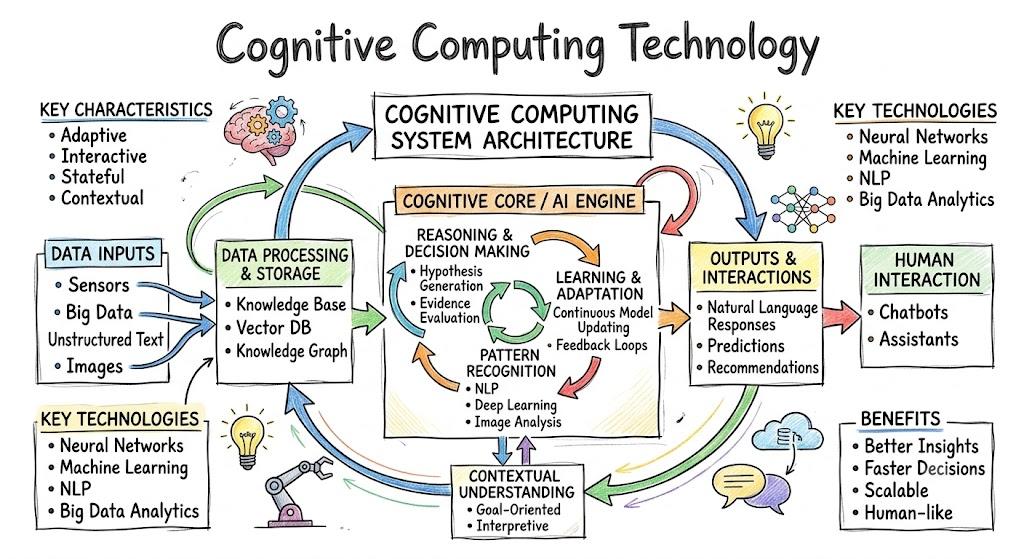
Accelerating Digital Intelligence Sustains Multi-Year Trajectory Across Industries
The long-term Cognitive Computing Technology Market Forecast points toward sustained, multi-year expansion as artificial intelligence and cognitive technology solidify their positions as indispensable enterprise infrastructure. Over the coming decade, commercial and technical behaviors will grow increasingly digital, automated, and data-driven, requiring organizations to adopt advanced cognitive platforms to remain competitive. Organizations that rely on manual data processing, static spreadsheets, and legacy search tools will experience severe disadvantages in operational velocity and analytical depth. Consequently, chief executive officers and chief technology officers will continue prioritizing multi-year investments in unified cognitive platforms, autonomous AI agents, and semantic knowledge graphs. Rather than treating artificial intelligence software as discretionary operational overhead, corporations increasingly view automated cognitive operations as the primary engine driving digital innovation and market share expansion ly.
Autonomous AI Agents Will Redefine Corporate Workforce Structures Over the Coming Decade
Looking toward the next decade, advancements in agentic artificial intelligence and machine reasoning will fundamentally transform corporate department structures and daily job roles. Manual document sorting, routine customer service triage, standard contract review, and basic report writing will steadily transition to fully autonomous software agents operating around the clock. Future platforms will allow business leaders to define high-level strategic objectives while autonomous agents execute research, draft deliverables, analyze financial statements, and coordinate cross-departmental projects automatically. Human professionals will focus almost exclusively on high-level strategic planning, ethical oversight, creative innovation, and stakeholder relationship governance. This operational evolution will dramatically compress enterprise workflows, reduce administrative costs, and enable organizations to manage exponentially larger operational footprints without proportional headcount increases.
Rapid Digital Growth in Asia-Pacific and Latin America Propels Expansion
Geographically, future industry expansion will be increasingly propelled by rapid enterprise digitalization, expanding technical talent pools, and modern AI commerce growth across emerging economies. While North America and Europe will continue generating substantial platform upgrade, AI integration, and enterprise licensing investments, the Asia-Pacific region is projected to exhibit the fastest expansion momentum ly. Rapidly digitizing economies across India, China, Southeast Asia, and Japan are experiencing explosive growth in software-as-a-service adoption, tech startup creation, and enterprise artificial intelligence procurement. Domestic enterprises and multinational corporations operating across Asia must deploy scalable, multi-language cognitive platforms capable of orchestrating complex business operations across diverse regional markets. Parallel digital modernization across Latin America will further broaden demand for advanced cloud cognitive suites.
Regulated Sectors and Knowledge-Intensive Industries Accelerate Complex Adoption
Across industry verticals, traditionally knowledge-intensive and heavily regulated sectors—including legal services, government defense, biopharmaceutical research, and higher education—are projected to accelerate their cognitive computing investments significantly over the forecast horizon. Modern enterprise workflows within these complex sectors rely heavily on millions of unstructured pages of case law, clinical trials, regulatory filings, and scientific research, requiring rigorous semantic search and automated compliance auditing. Advanced cognitive platforms equipped with multimodal document intelligence, semantic knowledge graphs, and strict data security compliance enable specialized professional teams to manage intricate information repositories flawlessly. Simultaneously, financial institutions and healthcare providers will expand secure, compliant AI adoption while adhering strictly to industry data privacy standards. Synchronizing complex knowledge workflows across distributed technical teams ensures consistent operational excellence and accelerates time-to-market.
Ethical AI Governance and Trust Frameworks Will Define Next-Generation Enterprise Success
Ultimately, the long-term outlook indicates that ethical artificial intelligence governance, algorithmic explainability, and transparent data provenance practices will define next-generation enterprise success. As artificial intelligence automates decision-making and operational execution at massive scale, business organizations will increasingly value authentic, secure, and resilient cognitive tools. Organizations that misuse automated AI tools or fail to protect sensitive proprietary data from cyber intrusion will face severe reputational damage, legal liabilities, and regulatory penalties. Concurrently, emerging ambient touchpoints—including spatial computing interfaces, connected automotive systems, and advanced wearable tools—will expand enterprise computing beyond traditional laptop screens. Organizations building robust, ethical AI governance frameworks and agile, cloud-native cognitive foundations today will adapt effortlessly to future enterprise interfaces while cultivating enduring innovation and sustainable growth.
➤ Featured Insights from Market Research Future:

 English
 French
 Spanish
 Portuguese
 Deutsch
 Turkish
 Dutch
 Italiano
 Russian
 Romaian
 Portuguese (Brazil)
 Greek
