
Global Super Absorbent Polymer Market Set to Hit USD 9.03 Billion by 2034, Led by South Korea's 7.2% CAGR
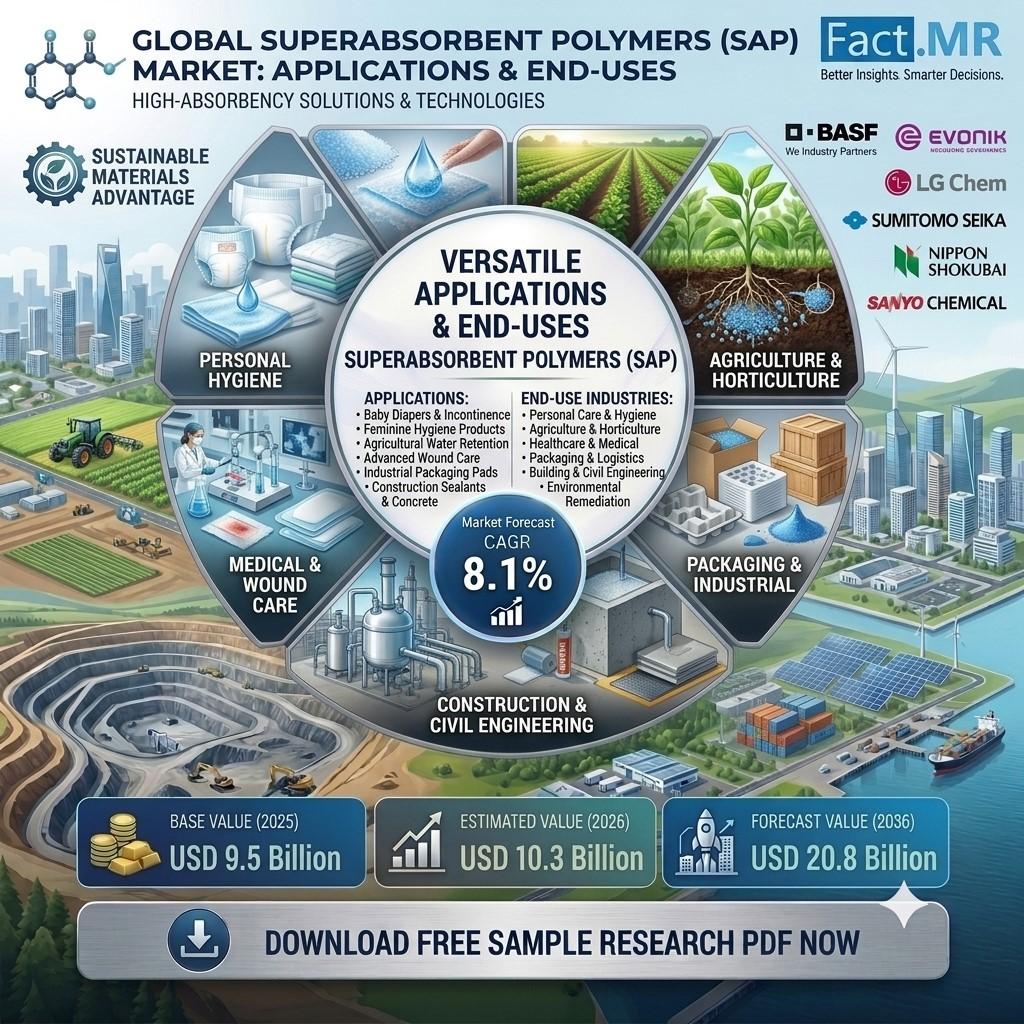
The global super absorbent polymer market is expected to expand from USD 6.4 billion in 2024 to USD 9.03 billion by 2034, registering a 3.5% CAGR during the forecast period. Fact.MR attributes this growth to increasing demand for personal hygiene products, growing agricultural applications, and rising interest in sustainable absorbent materials. Super absorbent polymers (SAPs) are widely used in baby diapers, feminine hygiene products, adult incontinence products, and industrial applications because of their ability to absorb and retain large quantities of liquid.
Growing awareness of personal hygiene and changing demographic patterns are creating sustained demand for high-performance absorbent materials. Aging populations are increasing the need for adult incontinence products, while hygiene manufacturers continue to improve absorbency, comfort, and moisture management. Agricultural producers are also exploring super absorbent polymers to improve soil water retention and reduce irrigation requirements. These developments are encouraging manufacturers to expand production capabilities and invest in more efficient polymer technologies.
Get detailed market forecasts, competitive benchmarking, and pricing trends:
https://www.factmr.com/connectus/sample?flag=S&rep_id=7177
Petroleum-Based Super Absorbent Polymers Retain Dominant Position
By type, petroleum-based super absorbent polymers are projected to account for 62.5% of the global market by 2034, reaching USD 5.64 billion. Their established manufacturing processes, comparatively lower production costs, and dependable absorption performance support their continued adoption across hygiene and industrial applications.
Petroleum-based polymers are widely used in baby diapers, feminine hygiene products, and adult incontinence products because they provide strong liquid retention and consistent performance. Their compatibility with existing production infrastructure also supports large-scale manufacturing. Although bio-based alternatives are attracting attention, conventional petroleum-based polymers continue to benefit from established supply chains and cost advantages.
Agriculture represents another important application, with the segment projected to reach USD 3.37 billion by 2034, expanding at a 3.4% CAGR. Super absorbent polymers help retain moisture in soil and growing media, gradually releasing water to plant roots. This capability is particularly relevant in water-scarce regions where efficient irrigation and improved soil moisture management are becoming increasingly important.
Industrial applications are also contributing to market development. SAPs are used in wastewater treatment, soil stabilization, spill containment, and other processes requiring controlled liquid absorption. Their versatility is creating additional opportunities beyond conventional personal care applications.
South Korea, China, and the United States Show Growth Opportunities
South Korea is projected to register a 7.2% CAGR through 2034, reflecting its growth potential within the global super absorbent polymer industry. The country's outlook provides an important comparison with more established markets, although the report does not provide a detailed country-specific explanation of its growth drivers.
China is expected to expand at a 3.7% CAGR from 2024 to 2034, with market revenue reaching USD 1.37 billion. Demand is supported by the country's large consumer base, expanding personal care manufacturing activities, and increasing consumption of adult incontinence products. The presence of domestic and international manufacturers is also supporting access to advanced polymer technologies and cost-effective production.
The United States is forecast to advance at a 3.4% CAGR, reaching USD 801.1 million by 2034. Its aging population is contributing to increasing demand for adult incontinence products, while continued consumption of baby diapers and feminine hygiene products supports established applications. Growing interest in biodegradable and bio-based materials is also encouraging product innovation.
Canada is projected to grow at a 1.9% CAGR over the forecast period. At the regional level, East Asia is expected to account for 26.9% of global market revenue by 2034, reaching USD 2.43 billion. The region's substantial manufacturing capabilities and demand for hygiene products support its position in the global industry.
European markets, including Germany, France, and the United Kingdom, are included in the report's geographic coverage. However, the publicly available analysis does not specify individual CAGR figures for these countries, so numerical growth rates have not been assigned.
Competitive Landscape
Competition in the super absorbent polymer market includes established chemical manufacturers with extensive production capabilities, distribution networks, and polymer development expertise. Key companies profiled by Fact.MR include BASF SE, Evonik Industries AG, Nippon Shokubai Co. Ltd., LG Chem, Sanyo Chemical Industries Ltd., and Songwon. Other companies identified in the report include Chase Corp., Chemtex Speciality Limited, and Gel Frost Packs Kalyani Enterprises.
Manufacturers are focusing on product quality, production efficiency, and competitive pricing to strengthen their positions. Product development is increasingly influenced by demand for improved absorption performance and materials with reduced environmental impact.
In 2021, BASF initiated super absorbent polymer production at its Superabsorbent Excellence Center in Antwerp, Belgium. The company invested USD 26 million to support polymer development and improve product performance. This investment illustrates the importance of manufacturing capabilities and technical development within the competitive landscape.
Technology and Sustainability Trends Shape the Market
Sustainability is becoming an important consideration in super absorbent polymer development. Manufacturers are exploring bio-based and biodegradable alternatives to conventional petroleum-derived materials as consumers and industrial buyers increasingly consider environmental performance.
Advancements in polymer synthesis and manufacturing technologies are also improving production efficiency and supporting cost optimization. Access to raw materials, including acrylic acid and polyacrylic acid, remains important for conventional SAP production.
However, fluctuations in raw material prices and regulatory requirements present challenges. Manufacturers must balance performance expectations, production costs, and environmental considerations while developing products for hygiene, agriculture, and industrial applications.
As demand for moisture-retaining materials increases across personal care and agricultural applications, super absorbent polymer manufacturers are expected to prioritize product performance, cost efficiency, and sustainable material development. Fact.MR's report provides detailed market forecasts, segment analysis, regional opportunities, and competitive insights through 2034.
To View Top Reports
https://adamaamresearch.blogspot.com/2026/11/ammonium-thiosulfate-market-set-for-usd.html
https://net-pals.com/blogs/73876/Ammonium-Thiosulfate-Industry-Forecast-to-Reach-USD-1-047-83
https://acmingle.com/blogs/38491/Ammonium-Thiosulfate-Market-2036-Forecast-USD-1-047-83-Million
About Fact.MR
Fact.MR is a market research and consulting company providing market intelligence, competitive analysis, and forecasting across global industries. Its research supports businesses with data-driven insights into emerging markets, technology trends, competitive dynamics, regional opportunities, and changing demand patterns.

 English
 Arabic
 French
 Spanish
 Portuguese
 Deutsch
 Turkish
 Dutch
 Russian
 Romaian
 Portuguese (Brazil)
 Greek
