
Global Agriculture Drone Industry Projected to Reach USD 24.8 Billion
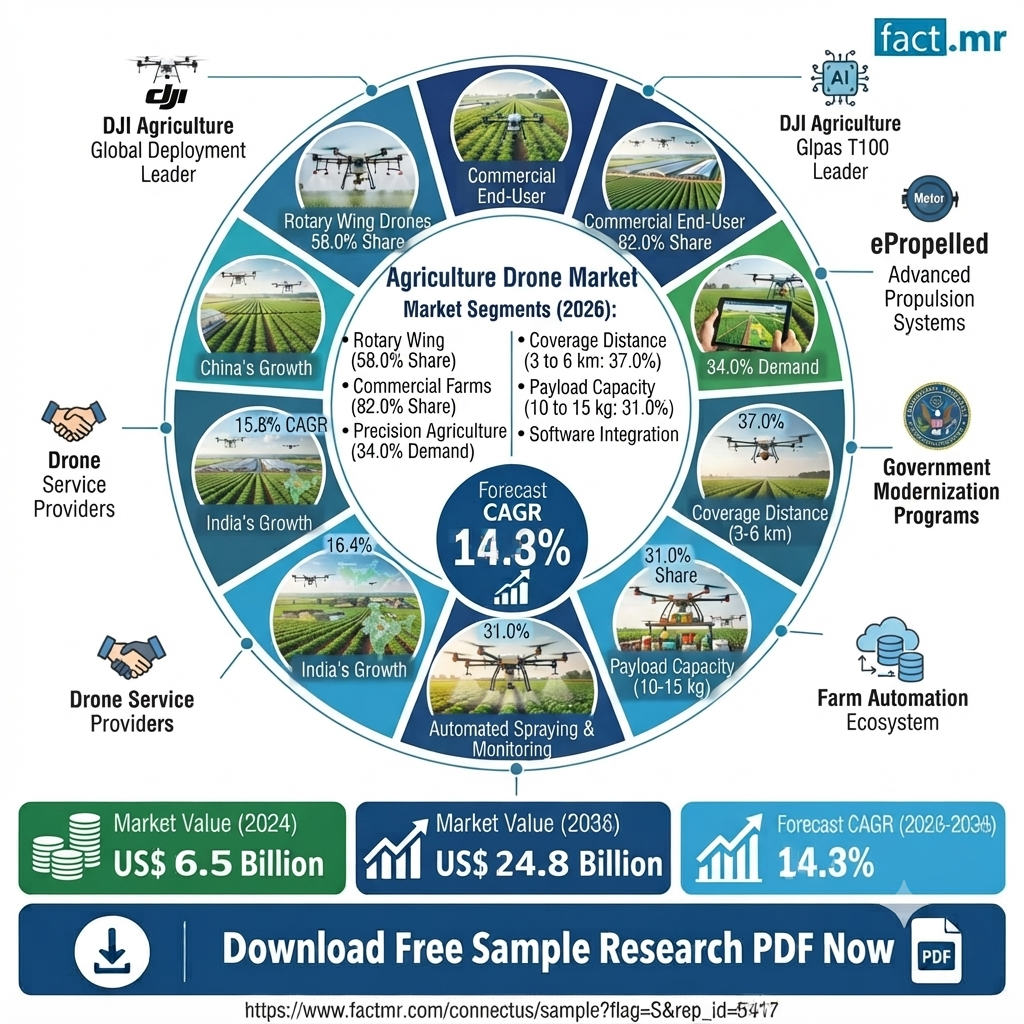
Precision agriculture and farm automation are driving the global agriculture drone market at a projected CAGR of 14.3% through 2036.
November 12, 2026 — The global agriculture drone market is projected to reach USD 24.8 billion by 2036, increasing from USD 6.5 billion in 2026 at a CAGR of 14.3%, according to Fact.MR. Valued at USD 5.7 billion in 2025, the market is expected to generate an additional USD 18.3 billion in revenue over the next decade as commercial farms increase investment in precision agriculture, automated spraying, and aerial crop monitoring. Rising labor shortages and government-backed agricultural modernization programs are accelerating the adoption of drone-based farming technologies.
Agricultural producers are increasingly using unmanned aerial vehicles to manage field operations and improve crop assessment. Traditional manual monitoring methods face growing pressure from labor availability challenges and operational efficiency requirements. Drone-based systems provide aerial imaging, field mapping, irrigation assessment, and targeted spraying capabilities, supporting more informed farm management decisions.
Request a FREE Sample Report : https://www.factmr.com/connectus/sample?flag=S&rep_id=5417
The financial outlook reflects this transition. Fact.MR estimates that the market will increase from USD 6.5 billion in 2026 to USD 24.8 billion in 2036. Adoption is also gaining momentum across major agricultural economies. India is projected to record the highest country-level CAGR at 16.4% during the forecast period, followed by China at 15.8% and Brazil at 15.2%.
Commercial farming operations remain the primary source of demand. These businesses increasingly deploy drones to monitor extensive cultivation areas and manage agricultural inputs with greater precision.
Rotary Wing Drones Maintain Leading Position
Rotary wing drones are expected to account for 58.0% of the agriculture drone market by offering in 2026. Their vertical takeoff capability and operational flexibility make them suitable for spraying and crop monitoring across different farm conditions. Their ability to operate in relatively confined agricultural spaces also supports commercial deployment.
An industry-specific indicator highlights the scale of adoption. DJI Agriculture reported that more than 600,000 agricultural drones had been deployed across over 100 countries by the end of 2025. The company's 2025/2026 industry report also estimated that drone-enabled farming practices helped save approximately 410 million tons of water and reduce 51 million tons of carbon emissions globally.
These figures illustrate how agricultural drones are moving beyond experimental applications into established farming operations. [LINK: Fact.MR Agriculture Drone Market Report]
Commercial Farms Account for 82.0% Market Share
The commercial end-user segment is projected to represent 82.0% of the market in 2026. Large agricultural enterprises are driving this concentration through investments in automated field operations and technology-supported crop management.
By coverage distance, the 3 to 6 km segment is expected to hold 37.0% share. This range supports routine spraying and monitoring requirements across commercial farm sizes.
Precision agriculture is projected to contribute 34.0% of application demand. Farmers are increasingly using aerial data to assess crop conditions, allocate resources, and monitor field performance. Meanwhile, drones with payload capacities of 10 to 15 kg are expected to account for 31.0% share in 2026, reflecting their suitability for spraying applications and flight endurance requirements.
Product development is reinforcing these market trends. DJI introduced the Agras T100, T70P, and T25P agricultural drones globally in July 2025, offering higher payload capacities and automated spraying and spreading capabilities. In May 2026, the company also presented the Agras T55 and T100 Dual Battery Spraying System at AGRITECHNICA Asia in Thailand.
India Leads Country-Level Growth
India is projected to expand at a CAGR of 16.4% through 2036, supported by agricultural drone incentive programs and precision farming investment. Government-backed initiatives promoting drone adoption are encouraging technology deployment across farming regions.
China follows with an estimated CAGR of 15.8%, supported by smart agriculture investments and domestic drone manufacturing capabilities. Brazil is expected to register 15.2% growth, with large-scale soybean and corn cultivation supporting aerial monitoring requirements.
Indonesia is projected to grow at 14.7%, driven by plantation modernization and drone applications across palm oil operations. The United States is expected to record a 14.1% CAGR as commercial farms increase investment in precision farming technologies. Australia is forecast to expand at 13.6%, supported by remote farm management requirements and extensive agricultural land areas.
Agricultural Automation Creates Opportunities for Manufacturers
Manufacturers are increasingly competing through product reliability, flight performance, payload capacity, and software integration. Companies with established agricultural distribution networks can reach commercial farm operators and agricultural service providers more effectively.
Technology development is also extending beyond drone platforms. In May 2026, ePropelled introduced an integrated propulsion and power solution combining brushless motors, electronic speed controllers, and intelligent power management. The system was designed for high-payload spraying, spreading, crop monitoring, and autonomous field operations.
Regulatory requirements remain a constraint. Airspace restrictions and operator certification procedures can influence deployment timelines, particularly in markets where agricultural drone regulations continue to develop.
Shambhu Nath Jha, Principal Consultant at Fact.MR, said, "Future demand will be influenced by precision farming investment and agricultural automation activity."
He added, "Organizations aligned with farm technology ecosystems are positioned to strengthen market presence."
Agriculture Drone Market Outlook Through 2036
Manufacturers can pursue emerging opportunities by expanding production capacity and strengthening agricultural distribution networks. Service providers also have opportunities to develop drone operation capabilities as commercial farming businesses increase technology adoption.
Fact.MR defines the agriculture drone market as the market for unmanned aerial vehicles used across crop production and agricultural management activities. These systems support crop monitoring, field mapping, irrigation assessment, spraying, and livestock management through aerial data collection and automated applications.
The research covers fixed wing, rotary wing, and hybrid wing platforms across consumer/civil and commercial end users. It evaluates market demand by coverage distance, application, and payload capacity, with regional assessments covering North America, Latin America, Asia Pacific, and Oceania.
As precision farming investment increases, agricultural drones are expected to become a more established component of commercial farm operations through 2036.
About Fact.MR
Fact.MR is a market research and consulting firm providing market intelligence, industry analysis, and strategic insights across global industries. Its research combines primary interviews, secondary data analysis, and market-sizing methodologies to assess industry developments, emerging opportunities, and competitive dynamics.

 English
 French
 Spanish
 Portuguese
 Deutsch
 Turkish
 Dutch
 Italiano
 Russian
 Romaian
 Portuguese (Brazil)
 Greek
