
Cleanroom Supplies Market Revenue, Demand and Business Outlook Through 2032
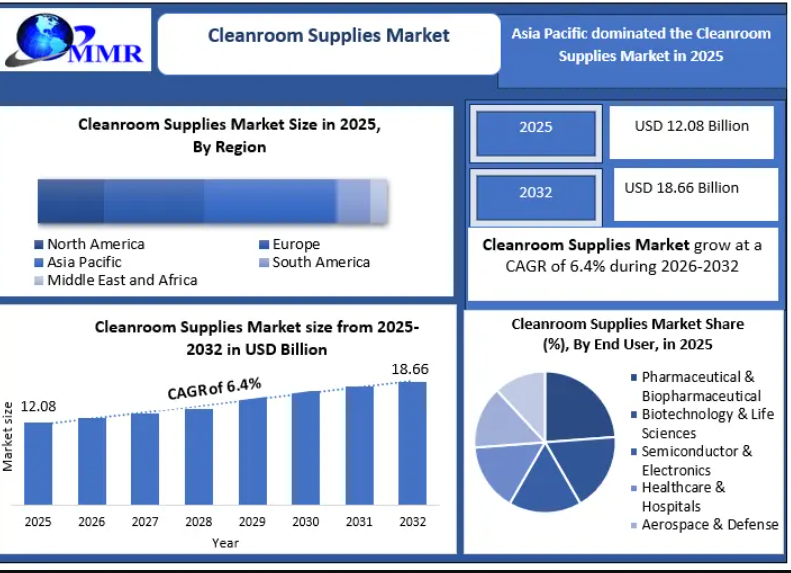
Cleanroom Supplies Market Expected to Reach USD 18.24 Billion by 2032, Driven by Semiconductor Fabrication Expansions and Stringent Biopharmaceutical Compliance Mandates
The Global Cleanroom Supplies Market which was valued at USD 11.23 Billion in 2025, is structurally positioned to expand to USD 18.24 Billion by 2032. This robust market evolution represents a calculated Compound Annual Growth Rate (CAGR) of 7.15% during the forecast horizon from 2026 to 2032.
As multi-layered technological systems and biological therapeutics become increasingly complex, even a microscopic airborne particle or localized microbial contaminant can result in multi-million-dollar product failures. To prevent these catastrophic yield losses, enterprise buyers across the semiconductor, pharmaceutical, aerospace, and medical device sectors are scaling up their recurring investments in advanced cleanroom consumables. This steady market momentum is further accelerated by rigorous international regulatory standards, including the updated European Union Annex 1 guidelines for sterile medicinal products and evolving International Organization for Standardization (ISO) cleanroom classifications.
𝐃𝐨𝐰𝐧𝐥𝐨𝐚𝐝 𝐅𝐫𝐞𝐞 𝐏𝐃𝐅 𝐁𝐫𝐨𝐜𝐡𝐮𝐫𝐞 @https://www.maximizemarketresearch.com/request-sample/303369/
Strategic Market Vision: Contamination Control as a Mission-Critical Infrastructure
The transition of cleanroom protocols from basic protective apparel to data-validated, specialized containment ecosystems has redefined the procurement priorities of modern enterprise facilities. Historically, cleanroom consumables like gloves, wipes, and coveralls were treated as general industrial commodities, with procurement decisions driven almost entirely by unit cost. Today, the focus has shifted toward material purity, particle shedding metrics, chemical resistance profiles, and supply chain tracing.
Technical Innovation: Material Integrity and Automated Packaging Solutions
The core engine powering the 7.15% CAGR of the global cleanroom supplies market is the continuous advancement of polymer science and textile engineering. Leading global manufacturers are actively investing in advanced materials that minimize outgassing and electro-static discharge (ESD), while maximizing comfort and breathability for operators working long shifts inside controlled environments.
Key technical breakthroughs reshaping the competitive landscape include:
-
Ultra-low Particle Shedding Continuous-Filament Polyesters: Traditional blended fabrics often degrade over long usage cycles, releasing micro-fragments into the cleanroom air. Next-generation cleanroom wipes and coveralls utilize continuous-filament, laser-sealed polyester knits that provide superior tensile strength and virtually zero structural particle shedding.
-
Validated Sterile, Ergonomic Nitrile Gloves: Advanced accelerator-free nitrile formulations eliminate the risk of chemical allergies for operators, while maintaining thin, high-tactile sensitivity. These gloves are washed in multi-stage deionized water systems and packed inside sterile, vacuum-sealed bags in ISO Class 4 environments to ensure pristine out-of-the-box cleanliness.
-
Biocompatible and Eco-Friendly Green Cleanroom Apparel: Historically, single-use cleanroom garments created significant plastic waste. In response, innovative life-science suppliers are introducing validated, compostable, or completely recyclable non-woven fabrics that meet strict sterile parameters while matching corporate environmental sustainability initiatives.
Recent regulatory reviews emphasize this clear shift toward total system contamination control. Global health authorities are increasingly verifying not only the cleanliness of the manufacturing line itself, but also the packaging and sterilization certificates of the underlying supplies, driving automated cleaning and tracking processes across the entire manufacturing sector.
Comprehensive Market Segmentation Analysis
The global cleanroom supplies landscape is highly segmented across product categories, material compositions, cleanroom classifications, and end-user verticals.
By Product Type: Consumables Secure the Commanding Share
-
Cleanroom Apparel: This segment captures the largest volume share of the market. Encompassing coveralls, boot covers, hoods, face masks, and bouffant caps, apparel is the primary line of defense against human contamination, which accounts for greater than 70% of all cleanroom particle excursions. Modern designs emphasize full-body encapsulation with breathable, fluid-resistant barriers.
-
Cleanroom Wipes: Operating as a high-frequency recurring revenue segment, cleanroom wipes are expanding rapidly due to their heavy usage in daily equipment sanitization and spill management. Wipers pre-saturated with sterile isopropyl alcohol (IPA) are experiencing significant demand because they eliminate manual mixing errors and reduce airborne volatile organic compound (VOC) emissions inside enclosed spaces.
-
Cleanroom Gloves: This category maintains consistent growth driven by the expansion of automated pick-and-place electronics assembly lines and manual handling requirements in pharmaceutical compounding laboratories. Nitrile and neoprene formulations continue to displace traditional latex due to superior puncture resistance and chemical tolerance.
-
Cleaning Solutions & Disinfectants: Driven by strict sterile processing mandates, this segment focuses heavily on rotational biocides, sporicides, and sterile detergents designed to systematically eliminate microbial bioburden without encouraging bacterial resistance.
By End-User Industry: High-Tech Manufacturing and Life Sciences Lead Demand
-
Pharmaceutical and Biotechnology Companies: Holding a dominant position in market valuation, this vertical requires high-tier validation. The production of injectable medicines, biologics, and vaccines demands absolute sterility, ensuring a stable, non-cyclical procurement framework for sterile cleanroom supplies.
-
Semiconductor and Electronics Fabricators: Emerging as the fastest-accelerating growth vector, semiconductor fabs require immense volumes of non-sterile, ultra-low-particle consumables. The global rollout of regional mega-fabs across North America, Europe, and East Asia is creating massive, multi-year supply contracts for high-purity cleanroom supplies.
-
Medical Device Manufacturers: This segment is experiencing steady growth as regulatory bodies enforce stricter particulate limits on implantable orthopedic, cardiovascular, and ophthalmic medical devices.
Comparative Assessment of Core Cleanroom Consumable Categories
To assist procurement officers, corporate quality assurance directors, and cleanroom operators in selecting appropriate materials, the operational metrics of primary cleanroom supplies are systematically compared below:
| Cleanroom Supply Category | Core Material Configurations | Primary Contamination Target | Standard Sterilization Method | Main Implementation Environment |
| Cleanroom Apparel | Tyvek, SMS Non-Woven, Microporous PE Film | Human skin flakes, hair, clothing fibers | Gamma Irradiation (SAL $10^{-6}$) | Biopharma sterile suites, cell therapy labs |
| Cleanroom Wipes | Continuous-filament polyester, Polypropylene | Surface particulates, process residues | Autoclaving / Gamma Irradiation | Equipment wiping, tool maintenance |
| Cleanroom Gloves | High-purity Nitrile, Neoprene, Natural Latex | Dermal oils, sweat, static discharge | E-beam / Gamma Sterilization | Semiconductor handling, aseptic filling |
| Cleaning Liquids | USP-grade 70% Isopropyl Alcohol, Sporicides | Microorganisms, bacterial endospores | 0.22-micron filtration & irradiation | Wall, ceiling, and floor decontamination |
| Cleanroom Stationery | Synthetic polymer-bonded clean paper | Cellulose fibers, ink outgassing | Non-sterile / Autoclave compatible | Batch record logging, cleanroom documentation |
Gown-Up Operational Protocol in Sterile Cleanroom Environments
To maximize the efficiency and longevity of protective cleanroom apparel while preventing contamination, facilities must implement a strict, chronological gowning sequence. Deviation from this process can cause particles from non-sterile garments to transfer onto the exterior of cleanroom suits.
The standard industry gowning sequence is outlined below:
Cleanroom Supplies Market Economics: Regional Pricing and Procurement Realities
Navigating the financial realities of the cleanroom consumables marketplace requires a clear understanding of tiered volume pricing structures. Because these items are treated as recurring operational expenditures, cost configurations fluctuate based on material certifications, packaging environments, and cleanroom compatibility ratings:
-
Sterile Disposable Coveralls (Per Case of 25): USD 150 – USD 450 (Dependent on fluid-barrier chemistry and integrated hood options).
-
Ultra-Pure Nitrile Cleanroom Gloves (Per Pack of 100 pairs): USD 45 – USD 120 (Reflecting extensive deionization washing and cleanroom packaging costs).
-
Pre-Saturated 9"x9" Polyester Wipes (Per Tub of 100): USD 25 – USD 75 (Based on solvent concentration and laser-knit border treatments).
-
Sterile Rotational Sporicides (Per Gallon): USD 60 – USD 180 (Required for validated regulatory bioburden control programs).
-
Reusable Cleanroom Garment Lease & Laundry Services (Per Operator/Year): USD 1,200 – USD 3,500 (Representing a key alternative operational model for large-scale pharmaceutical facilities).
Regional Dominance and Geographic Growth Drivers
North America: Leading in Biologics and Aerospace Technology
North America held the leading share of the global cleanroom supplies market in 2025 and is projected to maintain its financial dominance through 2032. The region’s strong position is reinforced by a highly advanced pharmaceutical cluster in the United States, heavy capital investments in cell and gene therapy manufacturing, and deep-space aerospace engineering facilities. Furthermore, the aggressive enforcement of safety guidelines by the US Food and Drug Administration (FDA) compels continuous institutional purchasing of high-tier sterile consumables. The localization of advanced microchip manufacturing through massive federal infrastructure funding is opening up extensive new supply lines across the region.
Asia-Pacific: The Epicenter of Semiconductor and Component Manufacturing
The Asia-Pacific region is analyzed to achieve the highest compound growth rate through the 2026–2032 forecast horizon. This commercial surge is driven by the unparalleled concentration of semiconductor foundries, electronics assembly plants, and display panel operations in Taiwan, South Korea, Japan, and mainland China. In addition, countries like India and China are rapidly expanding their domestic biopharmaceutical and generic drug manufacturing bases to meet growing global demand. Government incentives for local medical device manufacturing are lowering production costs, helping regional suppliers capture major market share in both sterile and non-sterile cleanroom consumable segments.
Key Commercial Restraints and Strategic Solutions
Despite a very positive long-term growth outlook, the cleanroom supplies market must address structural challenges to optimize operational efficiency:
-
Supply Chain Disruptions and Raw Material Vulnerability: Cleanroom consumables depend heavily on high-grade polypropylene, nitrile rubber, and specialized polyester fibers. Disruptions in petrochemical refining can instantly choke manufacturing pipelines. The Solution: Tier-one suppliers are diversifying their manufacturing footprints and building localized buffer inventories near major semiconductor and biotech clusters.
-
High Environmental Costs of Single-Use Products: The massive volume of single-use cleanroom apparel and wipes disposed of daily creates challenges for corporate sustainability programs. The Solution: Specialized laundries are developing closed-loop recycling systems that safely convert spent non-hazardous cleanroom garments into industrial polymers.
-
Complex Regulatory Validation Processes: Introducing a new cleanroom wipe or garment to a validated pharmaceutical facility can require up to a year of testing. The Solution: Innovators are providing complete validation data packages, cleanroom certifications, and extractable/leachable profiles upfront to simplify the procurement transition for cleanroom managers.
Clear Market Vision: Future Strategic Recommendations
For venture capital groups, institutional procurement committees, and manufacturing directors, the global cleanroom supplies market represents a stable, highly recurring revenue category within the industrial life-sciences and high-technology sectors. Navigating this landscape effectively over the forecast period requires focusing on three core strategies:
-
Establish Multi-Year Integrated Supply Contracts: To protect against raw material shortages and sudden pricing jumps, facility managers should move away from transactional spot-purchasing and establish integrated supplier agreements with guaranteed inventory buffers.
-
Transition to Pre-Saturated Cleanroom Consumables: Adopting pre-saturated wipes and ready-to-use blended disinfectants reduces chemical preparation errors, limits chemical waste, and standardizes validation procedures across multiple manufacturing lines.
-
Leverage RFID-Tracked Reusable Garment Systems: For non-sterile environments or large-scale facility maintenance operations, integrating radio-frequency identification (RFID) tags into high-performance reusable apparel optimizes garment life tracking and lowers long-term procurement overhead.
Competitive Landscape:-
Cleanroom Supplies Market Key Players
1. DuPont
2. Kimberly-Clark Professional
3. Contec Inc.
4. Avantor (VWR International)
5. Thermo Fisher Scientific
6. 3M
7. Valutek
8. Texwipe (ITW)
9. Ansell
10. Ecolab
11. Berkshire Corporation
12. Micronova Manufacturing
13. Nitritex (Ansell Healthcare)
14. KM Purely Creative
15. Cleanroom World
16. Alpha Pro Tech
17. Prudential Overall Supply
18. UniFirst (UniClean)
19. Dastex Group
20. Micronclean
21. ITW Contamination Control
22. Riverstone Resources
23. CT International
24. Valutek Asia
25. Aramark Cleanroom Services
26. High-Tech Conversions
27. Foamtec International
28. Presco Cleanroom Products
29. KleanLabs
30. Blue Thunder Technologies
31. Others
For full access to the comprehensive strategic report, visit:https://www.maximizemarketresearch.com/market-report/cleanroom-supplies-market/303369/
About Maximize Market Research
Maximize Market Research is a high-growth market research and strategic business consulting firm serving more than 1,400 corporate, academic, and institutional clients globally. Leveraging advanced analytics, proprietary data models, and a worldwide network of dedicated industry analysts, we deliver highly accurate market sizing, supply-chain analysis, competitive assessments, and technical forecasting across diverse industrial verticals. Our specialized Healthcare, Life Sciences, and Advanced Materials division focuses on providing clear, actionable market insights to medical device manufacturers, electronics OEMs, and global polymer chemical suppliers.
Contact Maximize Market Research
3rd Floor, Navale IT Park, Phase 2
Pune Bangalore Highway, Narhe,
Pune, Maharashtra 411041, India
sales@maximizemarketresearch.com
+91 96071 95908, +91 9607365656

 English
 Arabic
 French
 Spanish
 Portuguese
 Deutsch
 Turkish
 Dutch
Dutch
 Italiano
 Romaian
 Portuguese (Brazil)
 Greek
Greek
