
Low Code Development Market Outlook: Global Value to Reach US$ 241.9 Billion
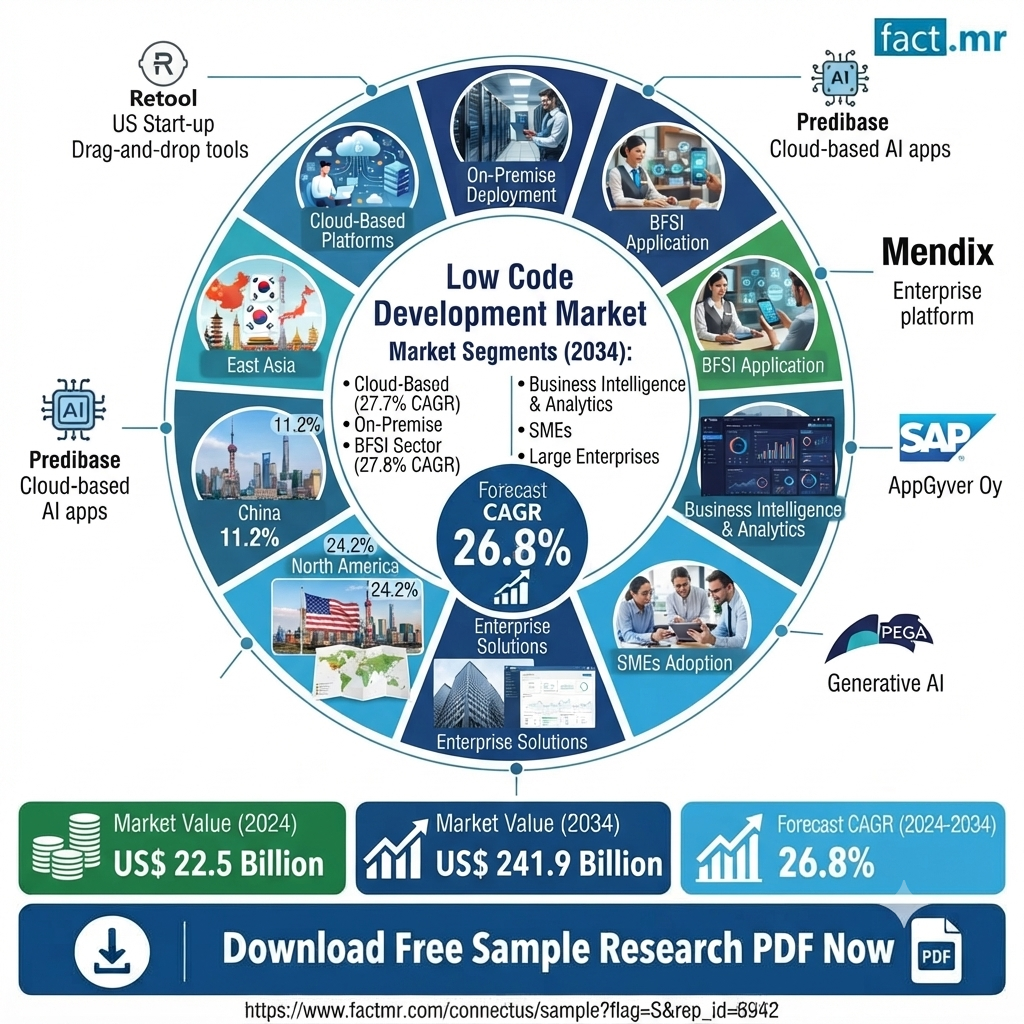
The global low code development market is projected to reach US$ 241.9 billion by 2034, increasing from US$ 22.5 billion in 2024 at a compound annual growth rate (CAGR) of 26.8%, according to Fact.MR. Growing demand for faster software development, limited availability of skilled programmers and expanding digital transformation initiatives are supporting the adoption of low-code development platforms across industries. Businesses are increasingly using these solutions to create applications with minimal manual coding, reduce development expenses and respond to changing operational requirements.
The market's expansion reflects a practical challenge facing organizations: conventional software development requires considerable time and specialized programming resources. Low-code platforms offer an alternative by providing visual development environments and ready-made components. This approach is particularly relevant for small and medium-sized enterprises (SMEs), which often need customized applications without maintaining large software development teams. Fact.MR estimates that cloud-based low-code platforms will account for US$ 169.3 billion in market value by 2034.
Request a FREE Sample Report : https://www.factmr.com/connectus/sample?flag=S&rep_id=6942
Cloud-Based Platforms Lead the Low Code Development Market
Cloud-based low-code development platforms are gaining traction as organizations seek flexible application development and deployment options. The segment was valued at US$ 14.6 billion in 2024 and is projected to reach US$ 169.3 billion by 2034, advancing at a CAGR of 27.7%. These platforms allow developers and business users to build, monitor and modify applications without depending extensively on conventional coding processes.
Cloud deployment also helps businesses manage IT infrastructure requirements. Organizations can develop and introduce applications across departments while reducing the need for extensive in-house technical resources. This model is particularly relevant for companies pursuing digital transformation while managing development budgets.
On-premise deployment is also expected to maintain demand. Fact.MR projects this segment to expand at a CAGR of 24.9% between 2024 and 2034, reflecting continued interest among organizations seeking greater control over their application environments.
BFSI Sector Emerges as a Major Application Area
The banking, financial services and insurance (BFSI) segment accounted for US$ 4.5 billion in 2024 and is forecast to reach US$ 52.2 billion by 2034, registering a CAGR of 27.8%. Financial institutions are adopting low-code development platforms to improve back-office operations, customer onboarding, client origination and self-service applications.
These applications help financial organizations address changing service requirements while reducing the time required to develop internal software. The increasing integration of digital technologies across financial services is supporting further adoption.
Business intelligence and analytics represent another application area. Low-code solutions provide ready-made development components that help technical teams manage workflows and modify applications. This can reduce the programming workload associated with building analytical tools.
North America and East Asia Present Regional Opportunities
North America is projected to account for 24.2% of the global low code development market by 2034. The United States remains an important contributor, with its market valued at US$ 2.5 billion in 2024. Fact.MR forecasts the United States market to reach US$ 26.7 billion by 2034, expanding at a CAGR of 26.7%.
According to Mendix, four out of every five companies in the United States use low-code development platforms. The presence of established technology companies and demand for business software solutions support the country's market position. [LINK: cloud computing market]
China is another important growth market. Its low-code development market was valued at US$ 2.5 billion in 2024 and is projected to reach US$ 27 billion by 2034, growing at a CAGR of 26.7%. More than 90% of IT professionals in China favor low-code development, according to the supplied market research. Mendix made its enterprise low-code platform available in China in January 2021.
East Asia's overall market was valued at US$ 5.2 billion in 2024. South Korea is also expected to register substantial expansion, with its market projected to reach US$ 13.1 billion by 2034.
Integration and Customization Remain Adoption Challenges
Despite increasing adoption, low-code development providers face technical limitations. Some platforms cannot integrate effectively with every existing software solution, creating difficulties for organizations operating complex IT environments.
Limited customization is another concern. Businesses requiring specialized application features may find predefined development components restrictive. These limitations can influence purchasing decisions, particularly among enterprises with specific workflow and integration requirements.
Companies are therefore expected to assess platform compatibility and customization capabilities before selecting low-code solutions.
Start-ups and Established Technology Providers Shape Competition
The competitive environment includes established software companies and emerging technology providers. Retool, a United States-based start-up, offers drag-and-drop tools for developing internal applications, including dashboards and administrative panels.
Predibase focuses on cloud-based AI applications and low-code development. Its platform supports AI developers working on model development, training, analysis and deployment for applications such as fraud detection, demand forecasting and data analytics.
Established companies are also introducing new capabilities. SAP acquired AppGyver Oy in 2021 to strengthen its application development capabilities. In 2023, Pega announced the use of generative AI technology to support low-code application development and customer engagement.
Fact.MR is a market research and consulting company that provides industry analysis, market forecasts and competitive intelligence across global business sectors. Its low code development market report examines deployment models, application categories, enterprise segments, use cases and key industry participants.

 English
 Arabic
 French
 Portuguese
 Deutsch
 Turkish
 Dutch
 Italiano
 Russian
 Romaian
 Portuguese (Brazil)
 Greek
