
How White Label On Demand App Development Supports Business Growth
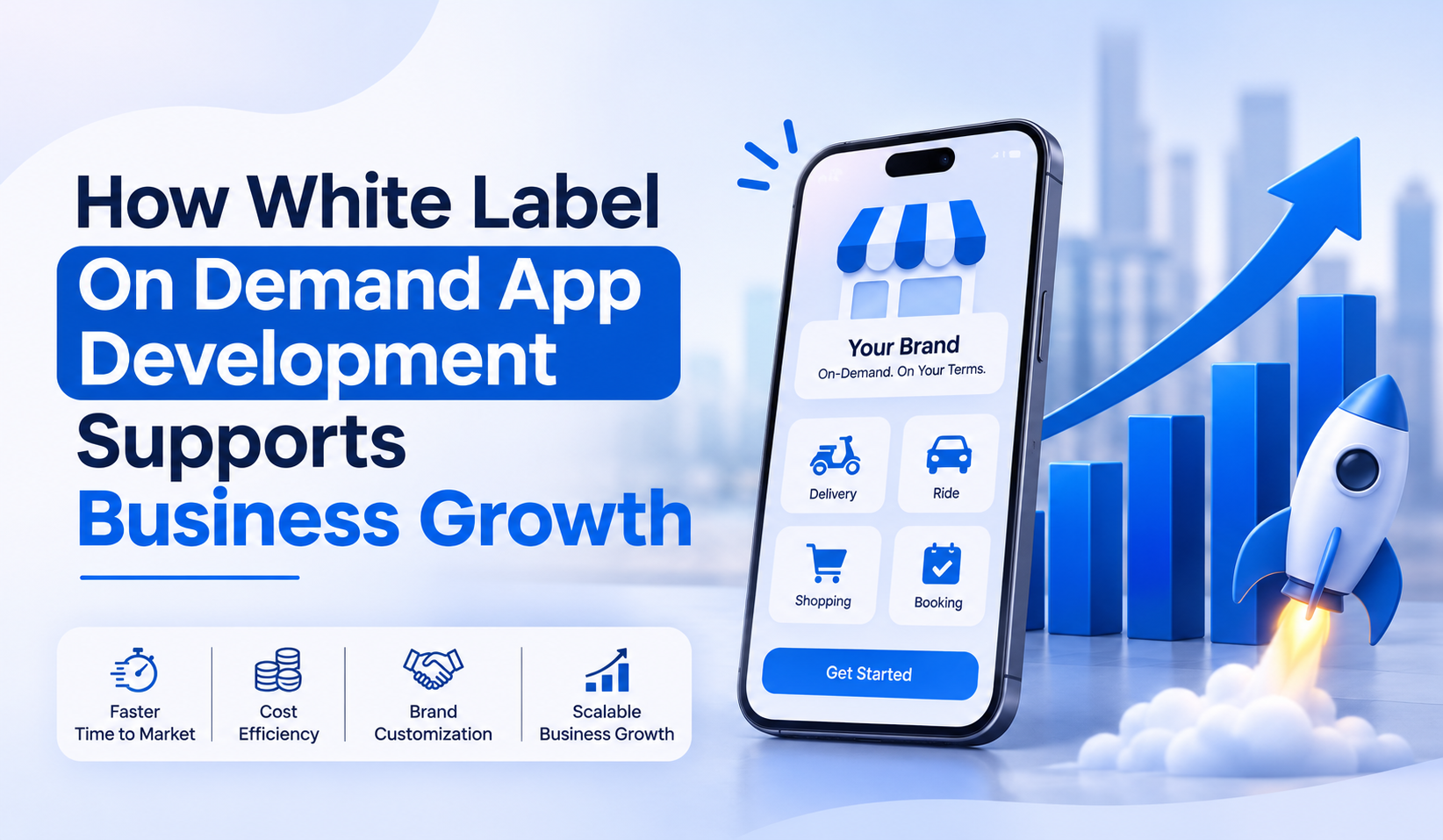
Businesses today are constantly looking for ways to reach more customers, improve service delivery, and create convenient digital experiences. As customer expectations continue to change, on-demand services have become an important part of everyday life. From food delivery and transportation to healthcare, home services, and online shopping, people increasingly prefer platforms that allow them to access products and services whenever they need them.
This shift has encouraged businesses to invest in mobile applications that simplify service discovery, booking, payments, and communication. However, building an application from scratch can require significant time, technical resources, and financial investment. This is where On Demand App Development through a white label approach becomes a practical option for businesses looking to expand their digital presence.
White label applications provide a ready-made technological foundation that businesses can customize with their branding, features, and business requirements. Instead of developing every component independently, companies can use an existing application framework and adapt it to their operational needs.
Understanding how this approach supports business growth can help organizations make more informed decisions about their digital strategies.
1. Faster Market Entry and Business Expansion
Timing can play an important role in business growth. When a company takes too long to launch a digital platform, it may miss opportunities to attract customers or respond to changing market demands.
Traditional app development often involves several stages, including planning, designing, coding, testing, and deployment. Each stage requires time and coordination between different teams.
White label on-demand applications can simplify this process by providing pre-developed features and reusable components. Businesses can customize the existing framework instead of building everything from the beginning.
For example, a startup planning to enter the food delivery market may need customer registration, restaurant listings, order placement, payment integration, and delivery tracking. A white label solution can provide many of these essential features within an existing framework.
This approach helps businesses reduce development timelines and focus more on launching their services, attracting customers, and establishing their market presence.
2. Reduced Initial Development Costs
Budget management is one of the major considerations when introducing a new digital service. Developing a completely customized application requires investment in developers, designers, infrastructure, quality assurance, and ongoing technical maintenance.
For startups and growing businesses, these expenses can create financial pressure before the application even reaches its target audience.
White label solutions offer an alternative by allowing businesses to use an existing application structure. Since the core functionality has already been developed, companies may avoid some of the costs associated with building standard features from scratch.
The saved resources can be allocated to other important business activities, such as marketing, customer acquisition, service improvements, and operational expansion.
However, the overall cost still depends on customization requirements, third-party integrations, licensing arrangements, and maintenance needs. Businesses should evaluate the complete pricing structure rather than focusing only on initial development expenses.
3. Improved Customer Convenience and Engagement
Customer convenience directly influences how people interact with a business. If customers find it difficult to book services, make payments, or track their orders, they may look for alternatives.
On-demand applications simplify these interactions by bringing essential services together in one digital platform.
Depending on the business model, an application may include:
- Simple user registration and login.
- Easy service browsing and searching.
- Real-time booking and order management.
- Multiple payment options.
- Push notifications and service updates.
- Customer reviews and ratings.
- In-app communication and support.
For instance, a home service business can allow customers to explore available professionals, compare service details, schedule appointments, and receive booking confirmations through a single application.
These features reduce unnecessary communication and make the customer journey more convenient.
When customers can access services without complicated processes, businesses have better opportunities to improve engagement, encourage repeat usage, and build long-term relationships.
4. Flexible Customization for Different Business Models
Every business operates differently. A food delivery company has different operational requirements from a taxi service, healthcare platform, or home maintenance business.
A major advantage of white label on-demand applications is the ability to adapt existing functionality to specific industry requirements.
Businesses can customize several elements, including:
- Application branding, colors, and interface design.
- Service categories and product listings.
- Booking and scheduling workflows.
- Payment methods and pricing structures.
- User roles and administrative permissions.
- Notifications and communication settings.
- Reporting and management dashboards.
For example, a healthcare service provider may require appointment scheduling, doctor profiles, consultation options, and patient notifications. Meanwhile, a transportation business may need driver allocation, GPS tracking, fare calculations, and trip management.
Customization allows businesses to build an application that reflects their service model without necessarily investing in a completely new technological foundation.
This flexibility also makes it easier to adjust the platform as customer expectations and operational requirements change.
5. Better Operational Efficiency Through Automation
Business growth is not only about attracting more customers. It also involves managing increasing demand without making daily operations unnecessarily complicated.
Manual processes can create delays, communication gaps, and administrative challenges. On-demand applications help reduce these issues by automating several routine activities.
For example, businesses can automate booking confirmations, payment notifications, order assignments, appointment reminders, and service updates.
An administrative dashboard can also help managers monitor orders, manage users, track transactions, and review business activities from a centralized location.
Consider a grocery delivery company handling hundreds of daily orders. Without an organized digital system, employees may spend considerable time coordinating orders, confirming availability, and communicating with delivery partners.
An on-demand application can streamline these activities through automated order management and status updates.
Automation reduces repetitive administrative work and allows employees to concentrate on customer service, quality control, and business development.
6. Opportunities to Reach More Customers
Mobile applications can help businesses connect with customers beyond their traditional geographical or operational boundaries.
A physical business may depend heavily on walk-in customers, phone bookings, or local advertising. An on-demand platform creates another channel through which people can discover and access its services.
For example, a restaurant can receive orders from customers who prefer home delivery rather than visiting the location. Similarly, a transportation provider can connect passengers with available drivers through a mobile platform.
As the business grows, the application can support expansion into additional service areas, provided the operational infrastructure is capable of handling increased demand.
Digital platforms can also help businesses understand customer preferences through usage patterns, booking histories, and service interactions.
These insights can support better marketing decisions and help companies identify opportunities for new services or geographical expansion.
7. Scalability as Business Requirements Increase
A business application should not only meet current requirements but also support future growth.
As customer numbers increase, companies may need additional features, improved infrastructure, more administrative controls, and integrations with external services.
A well-planned white label application can provide a foundation for gradual expansion. Businesses can introduce additional functionality based on their changing needs rather than redesigning the entire platform immediately.
For example, a startup initially offering local taxi booking may later introduce scheduled rides, corporate transportation, multiple payment options, or additional service locations.
Similarly, a food delivery platform may expand into grocery delivery or other local services.
However, scalability depends on the application's architecture, hosting infrastructure, database design, and integration capabilities. Businesses should confirm that their chosen solution can accommodate expected user growth and transaction volumes.
8. Data Insights for Smarter Business Decisions
Making decisions based only on assumptions can limit business growth. Companies need reliable information about customer behavior, service performance, and operational efficiency.
On-demand applications can provide useful data through analytics and reporting features.
Depending on the platform, businesses may monitor:
- Number of active users.
- Booking and order frequency.
- Customer retention patterns.
- Popular services and products.
- Revenue and transaction trends.
- Service completion rates.
- Customer ratings and feedback.
For example, if analytics show that a particular service receives more bookings during weekends, a business can adjust staffing and resource allocation accordingly.
Similarly, identifying frequently abandoned bookings may help companies understand where customers experience difficulties.
These insights support informed decisions about pricing, marketing, service improvements, and resource planning.
Businesses should also follow appropriate data protection practices and ensure customer information is collected, stored, and processed responsibly.
9. Competitive Advantage in a Digital Marketplace
As more industries adopt digital platforms, customers increasingly expect businesses to provide convenient online experiences.
Companies that rely entirely on traditional service processes may find it difficult to meet these expectations, particularly when competitors offer faster booking, transparent pricing, and real-time updates.
An on-demand application can help businesses modernize their service delivery and create a more accessible customer experience.
It can also support differentiation through personalized features, loyalty programs, multiple service options, and responsive customer support.
However, launching an application alone does not guarantee a competitive advantage. Its success depends on service quality, application usability, reliability, pricing, and the overall customer experience.
Businesses need to combine technology with a clear understanding of their target audience and market requirements.
Conclusion
White label on-demand applications can provide businesses with a practical way to enter digital markets, improve customer experiences, streamline operations, and support long-term expansion. By using an existing technological foundation, companies can reduce some development complexities while focusing on customization, customer acquisition, and service quality.
However, selecting the right solution requires careful consideration of business objectives, scalability, security, integration requirements, and ongoing maintenance. A platform should be flexible enough to support current operations while accommodating future changes.
Businesses exploring this approach can consider experienced development providers such as White Label Apps to understand the available options for building customized on-demand platforms. With suitable features, thoughtful implementation, and a customer-focused strategy, white label solutions can become a useful part of a sustainable business growth plan.

 English
 Arabic
 Spanish
 Portuguese
 Deutsch
 Turkish
 Dutch
 Italiano
 Russian
 Romaian
 Portuguese (Brazil)
 Greek
