
Aerospace Parts Manufacturing Market Forecast to Reach USD 235.1 Billion by 2036, with Boeing, Airbus and Safran in Focus
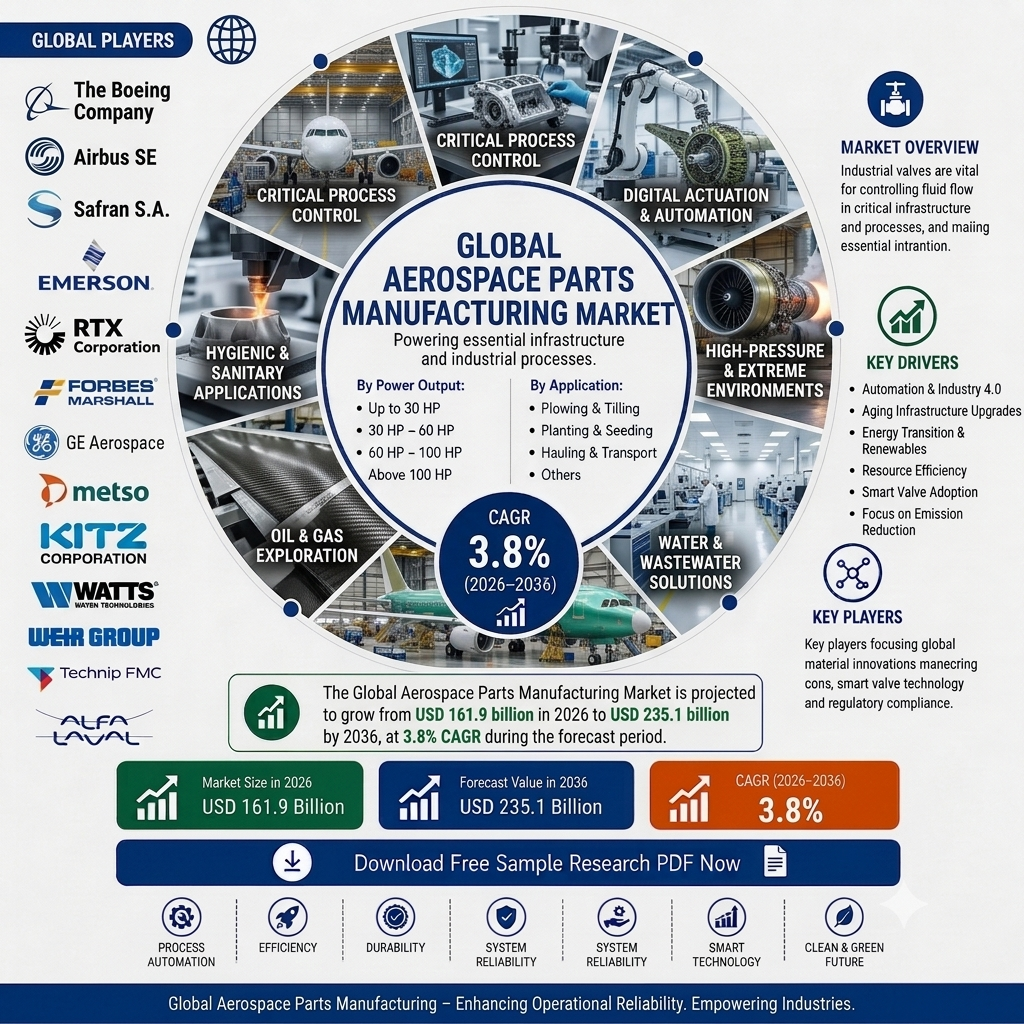
The global Aerospace Parts Manufacturing Market is projected to increase from USD 161.9 billion in 2026 to USD 235.1 billion by 2036, expanding at a 3.8% CAGR during the forecast period, according to Fact.MR. The market was valued at USD 156.0 billion in 2025. Recovery in aircraft production, higher build-rate requirements, and demand for certified components are creating opportunities for aerospace parts manufacturers with proven quality and production capabilities.
Aircraft OEMs increasingly require suppliers that can maintain tight tolerances, traceability, and consistent delivery as production programs scale. Defense programs add demand for machined parts and systems housings, while engine manufacturers require precision components and forgings capable of performing under high temperatures and stress.
Request full Report Pricing and sample Report: https://www.factmr.com/connectus/sample?flag=S&rep_id=4552
Aerospace Parts Manufacturing Market Snapshot
Structural airframe components are projected to account for 42.0% of market share in 2026, supported by the high value of fuselage and empennage components within aircraft manufacturing. Machining and forgings are expected to hold 44.0% share, reflecting continued reliance on established metal-processing methods for safety-critical components.
OEMs are projected to represent 58.0% of demand in 2026, as aircraft production programs consume large volumes of newly manufactured certified parts. By material, aluminum alloys are expected to hold 37.0% share, while commercial aircraft account for 61.0% of the market.
Certified Production Capacity Becomes a Competitive Priority
Aircraft production recovery is the primary driver of aerospace parts manufacturing demand. OEMs need suppliers capable of supporting planned build-rate increases without compromising quality or delivery schedules. The long-term expansion of the global aircraft fleet is expected to sustain demand for structural components, systems parts, and replacement components.
Certification and process discipline are becoming increasingly important as aerospace supply chains face capacity constraints. Suppliers must maintain qualified materials, controlled production environments, trained personnel, inspection records, and audit-ready quality systems.
Machining and forgings remain important because landing gear, structural fittings, and other critical metal components require repeatable tolerance control and certified material traceability. At the same time, composite manufacturing and additive manufacturing are creating opportunities for lighter components and complex geometries.
United States Leads Country Growth
The United States is projected to record a 4.2% CAGR through 2036, the fastest growth among the countries analyzed by Fact.MR. Aircraft production programs, defense demand, and supplier reshoring are supporting domestic manufacturing opportunities.
Mexico follows with a projected 4.0% CAGR, benefiting from aerospace clusters serving North American OEM supply chains. Germany is expected to expand at 3.6%, supported by precision engineering and Airbus-linked activity. France and the United Kingdom are projected to record CAGRs of 3.5% and 3.4%, respectively.
Analyst Perspective
Shambhu Nath Jha, Principal Consultant at Fact.MR, states, “Aerospace parts manufacturing is becoming a capacity trust market. OEMs are checking more than price. They are checking whether suppliers can hold tolerance and deliver parts without disrupting aircraft flow. Suppliers with quality discipline and program-specific capacity will gain better long-term contracts.”
Competitive Landscape
The competitive landscape includes The Boeing Company, Airbus SE, Safran S.A., RTX Corporation, and GE Aerospace. These companies participate across commercial aircraft programs, propulsion systems, avionics, landing systems, and other high-value aerospace component activities.
Competition centers on certification depth, manufacturing precision, delivery reliability, and the ability to maintain quality as production volumes change. Engine component suppliers face particularly high entry barriers because advanced alloys, heat treatment, and inspection requirements increase qualification demands.
Boeing's completed acquisition of Spirit AeroSystems in 2025 also signals greater OEM control over critical aerostructure supply. Specialized suppliers can strengthen their market position through machining expertise, composite capabilities, repair support, digital inspection records, and regional production capacity.
Supply-chain pressure remains a key restraint. Shortages of skilled inspection, machining, and quality-engineering personnel, together with delays involving forgings, castings, electronic systems, and precision-machined components, can affect aircraft delivery schedules.
To View Related Reports
https://sportgalax.com/create-blog/
https://afgbfh.blogspot.com/2026/11/air-conditioning-system-market-heads.html
About Fact.MR
Fact.MR is a market research and competitive intelligence provider delivering market intelligence, competitive analysis, and forecasting across global industries. Its research helps businesses evaluate market demand, understand competitive developments, and identify growth opportunities.

 English
 Arabic
 French
 Spanish
 Portuguese
 Deutsch
 Turkish
 Italiano
 Russian
 Romaian
 Portuguese (Brazil)
 Greek