
Molecular Diagnostics Market Analysis Highlights Increasing Demand for Reagents
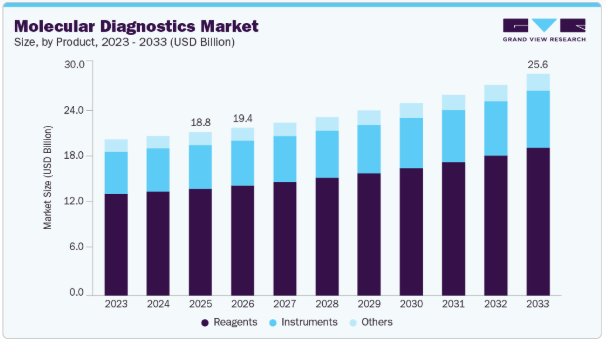
The global molecular diagnostics market is witnessing steady expansion as healthcare providers increasingly prioritize early disease detection, accurate diagnosis, and personalized treatment. The Molecular Diagnostics Market was valued at USD 18.8 billion in 2025 and is projected to increase from USD 19.4 billion in 2026 to USD 25.6 billion by 2033, registering a CAGR of 4.1% from 2026 to 2033. Growing demand for advanced testing technologies, rising cases of infectious and chronic diseases, and increasing applications in oncology and genetic testing are supporting this growth. North America dominated the market with a 44.1% revenue share in 2025, while Asia Pacific is expected to record the fastest growth during the forecast period.
What Are the Key Factors Driving the Molecular Diagnostics Market?
The growing prevalence of infectious diseases, cancer, genetic disorders, and chronic conditions is increasing the need for reliable molecular testing. These technologies help identify pathogens, detect disease-associated biomarkers, and support treatment decisions through accurate genetic analysis. PCR, next-generation sequencing (NGS), and digital PCR are becoming increasingly important across clinical diagnostics, oncology, and precision medicine.
Technological advancements are another major growth driver. Developments in multiplex PCR, real-time PCR, transcription-mediated amplification (TMA), loop-mediated isothermal amplification (LAMP), and sequencing technologies are improving diagnostic accuracy, sensitivity, and testing efficiency. New product introductions and continued research and development are also expanding the range of available diagnostic applications.
Want to Understand What’s Driving Market Growth? Ask Prism AI for research-backed insights into market size, evolving opportunities
How Are Technological Advancements Transforming Diagnostic Testing?
Innovation is reshaping molecular diagnostics through the development of faster, more sensitive, and increasingly accessible testing platforms. Companies are expanding their diagnostic portfolios through advanced amplification techniques, automated systems, and disease-specific assays.
NGS is gaining importance as genomic research and precision medicine expand, particularly in oncology. It supports biomarker identification, cancer classification, treatment selection, and disease monitoring. Digital PCR is also creating opportunities through precise DNA and RNA quantification, including applications in liquid biopsy and minimal residual disease testing.
Other technologies, including Fluorescence In Situ Hybridization (FISH), Enzyme-Linked Immunosorbent Assay (ELISA), microarrays, and microfluidics, are broadening the diagnostic landscape. Product developments such as Thermo Fisher's 5500x1 genetic analyzer, Illumina's NextSeq CN500, and QIAGEN's EpiTect Methyl II PCR illustrate the continued expansion of molecular testing capabilities.
Which Market Segments Are Leading the Industry?
The market is segmented by product, technology, application, and test location, with each category serving different diagnostic requirements.
Product: Reagents dominated the market with a 65.5% share in 2025 and are projected to grow at the fastest CAGR of 4.3% during the forecast period. Enzymes, probes, primers, and buffers are essential components of PCR, NGS, and digital PCR workflows. Their recurring use across diagnostic procedures supports consistent demand. The instruments segment is also expected to experience significant growth as healthcare providers invest in advanced testing systems for oncology, infectious diseases, and genetic disorders.
Technology: PCR accounted for the largest share of 62.2% in 2025. Its established applications in infectious disease testing, cancer diagnostics, and genetic analysis support its leading position. Multiplex and real-time PCR are expanding testing capabilities, while digital PCR is contributing to improvements in laboratory workflows. Meanwhile, the ISH segment is projected to register the fastest CAGR, supported by advanced probes for applications such as B-cell lymphoma and HPV detection.
Download a free sample report or claim your copy of this full market intelligence report
Application: Infectious diseases represented the largest application segment in 2025. PCR and NGS technologies support the detection of tuberculosis, HIV, viral infections, and sexually transmitted infections. The oncology segment is expected to grow at the fastest rate as molecular testing becomes increasingly important for identifying cancer biomarkers, selecting targeted treatments, and monitoring therapeutic responses.
Test location: Central laboratories held the largest market share in 2025 due to their ability to process high sample volumes and deliver accurate results. Automation and system integration are improving laboratory efficiency and throughput. In contrast, self-test and over-the-counter solutions are expected to grow at the fastest CAGR as consumers increasingly seek convenient, accessible, and private diagnostic options.
Why Is Point-of-Care Testing Creating New Opportunities?
The growing adoption of point-of-care testing (POCT) is supporting the decentralization of molecular diagnostics. Healthcare providers and consumers increasingly seek convenient testing solutions that deliver rapid results without requiring every sample to be processed through centralized laboratory facilities.
Manufacturers are developing portable and application-specific testing platforms to improve accessibility, accuracy, and cost efficiency. In November 2024, Texas introduced a pilot program for self-collected HPV screening at Su Clinica Federally Qualified Health Center in collaboration with The University of Texas MD Anderson Cancer Center. The initiative uses the FDA-approved BD Onclarity HPV Assay to evaluate approaches for improving cervical cancer screening access in underserved communities.
Liquid biopsy is another emerging opportunity, particularly in cancer detection and monitoring. These developments demonstrate how decentralized testing and advanced molecular technologies can broaden diagnostic access and support more timely clinical decisions.
What Challenges Could Restrict Market Expansion?
High molecular diagnostic testing costs remain a major restraint, particularly in healthcare settings with limited financial and technological resources. Complex workflows, regulatory requirements, specialized infrastructure, and shortages of skilled professionals can also affect adoption.
Regulatory developments may influence product availability and development timelines. A February 2024 article from Yale School of Medicine highlighted concerns about proposed FDA regulation of laboratory-developed tests, with experts noting potential implications for diagnostic access, costs, and responses to public health emergencies.
Alternative approaches, including immunoassays and conventional microbiology testing, also create competition. However, the accuracy and specificity of molecular diagnostics continue to support their role in early disease detection and personalized treatment.
Which Regions Offer the Strongest Growth Opportunities?
North America led the global market with a 44.1% revenue share in 2025. Advanced healthcare infrastructure, established research capabilities, favorable reimbursement conditions, and strong adoption of molecular testing technologies support regional leadership. The U.S. accounted for 84.3% of the regional market revenue in 2025. Increasing demand for genetic testing, oncology diagnostics, and companion diagnostics is further contributing to growth.
Asia Pacific is expected to register the fastest CAGR from 2026 to 2033. Rising healthcare expenditure, unmet diagnostic needs, infectious disease prevalence, and expanding access to advanced testing technologies are supporting regional opportunities. China and India are important contributors due to investments in healthcare infrastructure and diagnostic capabilities.
Europe is experiencing increasing demand for molecular testing amid the burden of cardiovascular and genetic disorders and growing investment in genomic research. In Latin America, improvements in diagnostic infrastructure and greater adoption of advanced testing technologies are supporting market development. Meanwhile, the Middle East and Africa present opportunities associated with rising chronic disease prevalence and unmet diagnostic requirements.
What Is the Future Outlook for the Molecular Diagnostics Market?
The molecular diagnostics market is expected to progress through continued technological innovation and broader clinical adoption. Increasing applications in infectious disease detection, oncology, genetic testing, and precision medicine will support demand for advanced diagnostic solutions. Growth in NGS, digital PCR, liquid biopsy, and point-of-care testing is likely to create additional opportunities. Although testing costs and regulatory complexities remain challenges, investments in research, product development, and decentralized diagnostic platforms are expected to contribute to the market's projected growth to USD 25.6 billion by 2033.
Explore Our Research & Intelligence Solutions
U.S. Healthcare Facility Intelligence: Make Better Decisions with Comprehensive Data – Explore the Platform

 English
 Arabic
 French
 Portuguese
 Deutsch
 Turkish
 Dutch
 Italiano
 Russian
 Romaian
 Portuguese (Brazil)
 Greek
