
North America Big Data Platform Market: Key Players, Forecast by 2034
The Big Data Platform space in North America is shaped by a strong focus on data security, governance, and regulatory compliance. Enterprises are choosing integrated platforms that support advanced analytics while protecting sensitive information.
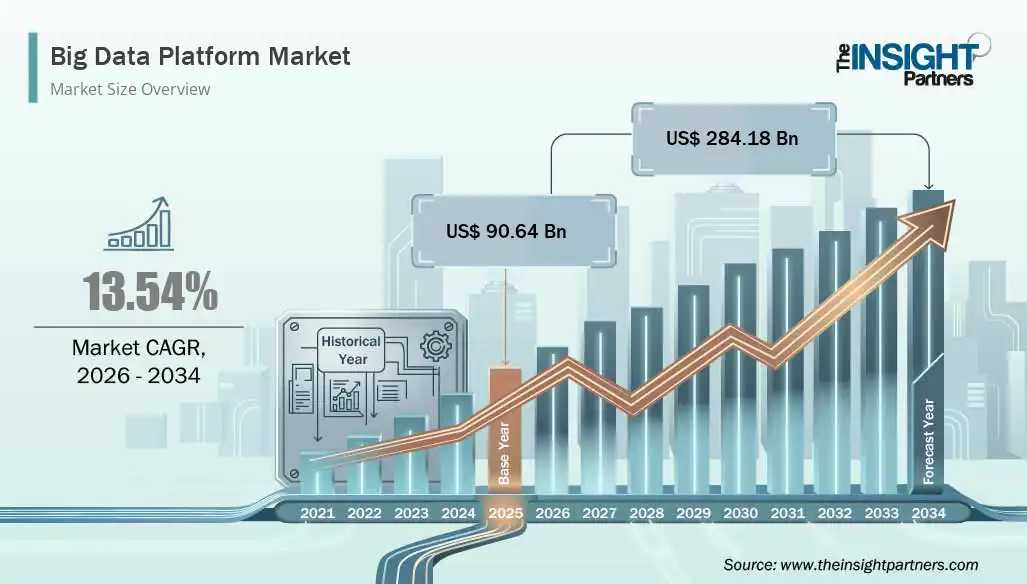
The Big Data Platform Market size is expected to reach US$ 284.18 Billion by 2034 from US$ 90.64 Billion in 2025. The market is estimated to record a CAGR of 13.54% from 2026 to 2034.
Market Overview
A big data platform is a comprehensive technology framework designed to handle large-scale data processing and analytics workloads. It enables organizations to manage diverse datasets from multiple sources while ensuring data accessibility, scalability, governance, and security.The rapid growth of digital ecosystems has led to an explosion in data generation worldwide.
Get Sample PDF@ https://www.theinsightpartners.com/sample/TIPRE00009015
Key Market Drivers
- Rapid Growth in Data Generation:-One of the primary factors driving the Big Data Platform Market is the exponential growth of digital data. Businesses today generate and collect enormous volumes of information on a daily basis. Customer transactions, online activities, machine-generated data, and enterprise records contribute to rapidly growing data ecosystems.As organizations continue expanding their digital operations, the need for platforms capable of storing and processing large datasets efficiently becomes increasingly important. Big data platforms address this challenge by providing scalable architectures capable of handling enterprise-level workloads.
- Increasing Adoption of Artificial Intelligence and Machine Learning:-Artificial intelligence and machine learning technologies rely heavily on high-quality data. Big data platforms serve as the foundation for AI and ML initiatives by providing centralized access to large datasets and advanced analytics capabilities.Organizations use AI-powered analytics to identify trends, automate decisions, forecast outcomes, optimize operations, and improve customer experiences. The growing deployment of AI solutions across industries is significantly driving demand for robust big data infrastructure.Machine learning applications such as predictive maintenance, fraud detection, recommendation engines, and intelligent automation further increase the need for sophisticated data management platforms.
- Expansion of Cloud Computing:-Cloud technology has revolutionized the big data landscape by providing flexible and cost-effective infrastructure. Cloud-based big data platforms allow organizations to scale resources according to business needs without significant investments in physical hardware.Cloud deployment offers advantages such as reduced operational costs, faster implementation, improved accessibility, and enhanced collaboration. Public cloud providers, private cloud solutions, and hybrid cloud environments continue to expand opportunities for big data platform adoption.The increasing preference for Software-as-a-Service (SaaS), Platform-as-a-Service (PaaS), and Infrastructure-as-a-Service (IaaS) models has further accelerated market growth.
- Growing Focus on Data-Driven Decision Making:-Businesses are increasingly recognizing data as a strategic asset. Executives and decision-makers rely on analytics to guide investments, optimize processes, and improve customer engagement.Big data platforms provide real-time intelligence and advanced reporting capabilities that support informed decision-making. Organizations that leverage data effectively can identify emerging opportunities, reduce risks, and respond proactively to market changes.This growing emphasis on analytics-driven business strategies continues to fuel investments in big data technologies worldwide.
Emerging Market Trends
- Rise of Real-Time Data Analytics:-Real-time analytics is becoming a major trend within the big data ecosystem. Organizations increasingly require immediate insights to respond to operational events, customer activities, and market fluctuations.Big data platforms now incorporate real-time processing capabilities that enable businesses to analyze streaming data from websites, mobile applications, IoT devices, and transaction systems.Real-time intelligence supports use cases such as fraud detection, supply chain monitoring, customer engagement optimization, and predictive maintenance.
- Integration of Artificial Intelligence:-Modern big data platforms are increasingly integrating AI and machine learning functionalities directly into their architectures. Embedded AI capabilities enable organizations to automate analytical processes and generate actionable insights more efficiently.Advanced platforms can automatically detect anomalies, identify patterns, perform predictive analysis, and generate recommendations without extensive manual intervention.This convergence of AI and big data technologies is transforming the way organizations manage and utilize enterprise information.
- Data Lake and Data Fabric Adoption:-Many enterprises are investing in data lake and data fabric architectures to overcome data silos and improve accessibility.Data lakes allow organizations to store vast quantities of raw structured and unstructured information in its native format. Meanwhile, data fabric solutions create integrated environments that connect and manage distributed data assets across cloud, on-premises, and hybrid infrastructures.These modern architectures are becoming increasingly important as enterprises pursue digital transformation initiatives and seek greater flexibility in data management.
- Enhanced Data Governance and Compliance:-As data volumes grow, organizations face increasing pressure to maintain data quality, privacy, security, and regulatory compliance.Big data platform vendors are incorporating advanced governance tools that support data lineage, access controls, auditing, metadata management, and compliance monitoring.These capabilities help organizations meet regulatory requirements while ensuring trust and reliability across data ecosystems.
Market Challenges
- Data Security and Privacy Risks:-Data security remains one of the most significant challenges in the Big Data Platform Market. Organizations often manage sensitive information, including financial records, personal customer data, intellectual property, and operational intelligence.Cybersecurity threats continue to evolve, making it essential for businesses to implement robust security measures. Data breaches can result in financial losses, reputational damage, legal consequences, and regulatory penalties.As enterprises expand their data environments, maintaining security across diverse infrastructures becomes increasingly complex.
- Complexity of Data Integration:-Modern enterprises operate numerous applications and systems that generate data in different formats. Integrating information from multiple sources presents significant technical challenges.Organizations must address issues related to data quality, consistency, duplication, and compatibility to maximize the value of big data initiatives.Successful implementation often requires sophisticated integration frameworks, skilled personnel, and strategic planning.
- High Implementation Costs:-Although cloud-based platforms have reduced barriers to entry, implementing a comprehensive big data environment may still require substantial investment.Costs may include infrastructure deployment, software licensing, integration services, security enhancements, employee training, and ongoing maintenance.For small and medium-sized enterprises, these expenses can present adoption challenges despite the long-term benefits of data analytics.
Industry Applications
Banking and Financial Services
Financial institutions use big data platforms for fraud detection, risk management, customer analytics, compliance monitoring, and algorithmic trading.Advanced analytics helps banks identify suspicious transactions, assess creditworthiness, and deliver personalized financial products to customers.
Healthcare
Healthcare providers leverage big data platforms to analyze patient records, support clinical decision-making, accelerate medical research, and improve operational efficiency.Population health management and predictive healthcare analytics represent major growth areas for big data adoption.
Retail and E-commerce
Retailers utilize big data platforms to enhance customer experiences, optimize pricing strategies, manage inventory, and personalize marketing campaigns.Data-driven insights help businesses better understand consumer preferences and improve profitability.
Manufacturing
Manufacturers deploy big data solutions for predictive maintenance, quality control, production optimization, and supply chain management.Industrial IoT devices generate significant amounts of operational data that can be analyzed to improve performance and reduce downtime.
Regional Analysis
North America
North America remains a dominant market due to its strong technology ecosystem, extensive cloud adoption, and early implementation of advanced analytics solutions.The region benefits from the presence of major technology companies, innovation centers, and substantial investments in AI and digital transformation initiatives.
Europe
Europe continues to experience strong market growth driven by increasing enterprise digitalization and analytics adoption. Organizations across various sectors are investing in data platforms to improve efficiency and competitiveness.The region's emphasis on data privacy and regulatory compliance further supports investments in governance-focused solutions.
Asia-Pacific
Asia-Pacific is expected to witness significant growth due to rapid industrialization, expanding internet connectivity, growing cloud adoption, and increasing digital transformation initiatives.Countries such as China, India, Japan, South Korea, and Singapore are investing heavily in advanced analytics infrastructure to support economic development and technological innovation.
Middle East, Africa, and South America
Emerging economies across these regions are gradually increasing investments in digital technologies and data-driven business models.Government initiatives supporting smart cities, digital infrastructure, and economic diversification are creating opportunities for big data platform providers.
Competitive Landscape
- 1010data, Inc.
- Cloudera, Inc.
- IBM
- Microsoft Corporation
- Oracle Corporation
- Pivotal Software, Inc.
- SAP SE
- Sisense
- Teradata Corporation
- Vertica Systems
Future Outlook
The future of the Big Data Platform Market is highly promising as organizations continue to embrace digital transformation and advanced analytics strategies. The growing importance of AI, machine learning, cloud computing, IoT, and real-time intelligence will further expand the role of big data platforms across industries.Businesses are increasingly recognizing that competitive advantage depends on their ability to extract meaningful insights from data and translate them into actionable business outcomes.
About The Insight Partners
The Insight Partners delivers market intelligence and consulting services to help clients make informed decisions. The firm covers industries such as Aerospace and Defense, Automotive and Transportation, Semiconductor and Electronics, Biotechnology, Healthcare IT, Manufacturing, Medical Devices, Technology, Media, and Chemicals and Materials.
Contact Us:
If you have any queries about this report or if you would like further information, please contact us:
Contact Person: Ankit Mathur
E-mail: sales@theinsightpartners.com
Phone: +1-646-491-9876
Also Available in :

 English
 Arabic
 French
 Spanish
 Portuguese
 Deutsch
 Turkish
 Italiano
 Russian
 Romaian
 Portuguese (Brazil)
 Greek
