
Optical Coherence Tomography Angiography Equipment Market Expected to Reach USD 1.17 Billion by 2036 as Japan Emerges as the Fastest-Growing Market
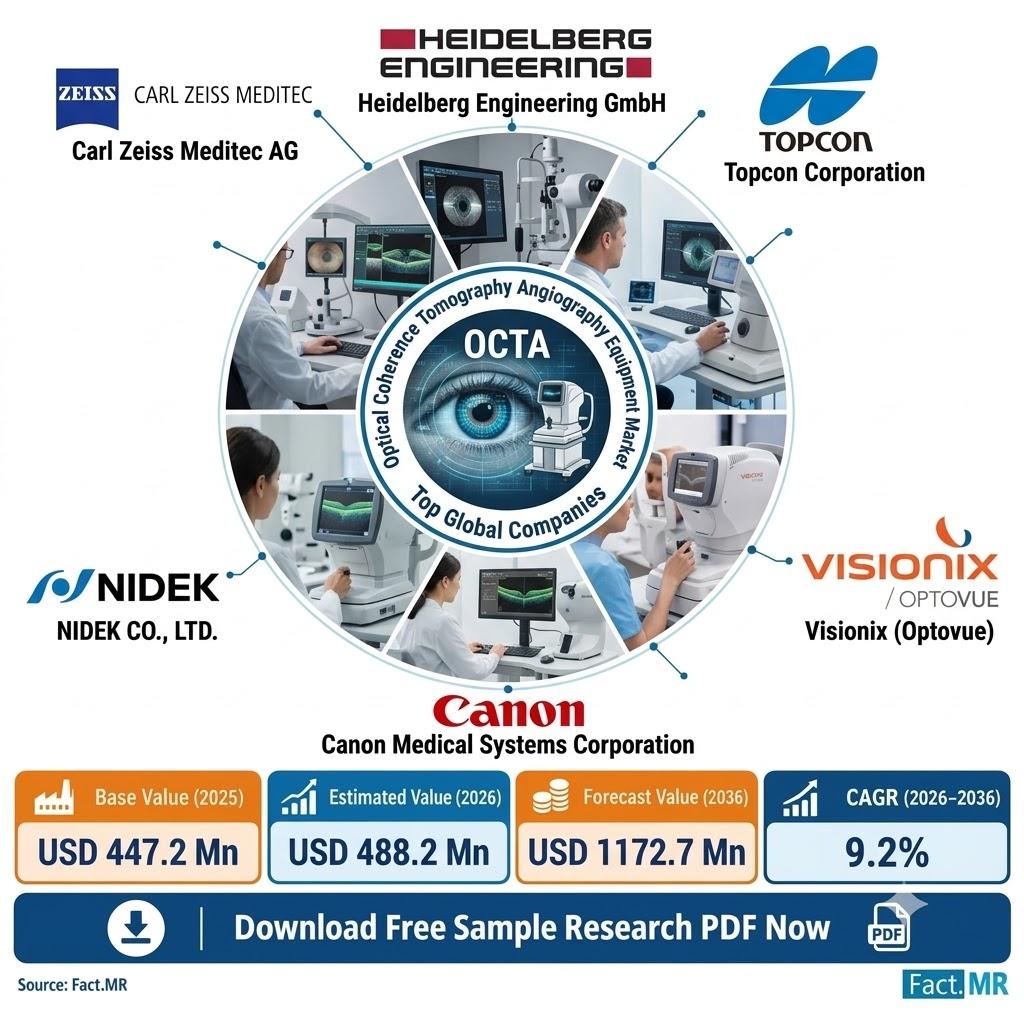
The global optical coherence tomography angiography (OCTA) equipment market is projected to increase from USD 488.2 million in 2026 to USD 1,172.7 million by 2036, expanding at a compound annual growth rate (CAGR) of 9.2%, according to Fact.MR analysis updated October 12, 2026. The market was valued at USD 447.2 million in 2025. The forecast represents an absolute opportunity of USD 684.5 million between 2026 and 2036.
Demand is linked to the need for detailed retinal blood-vessel imaging in specialist eye care. OCTA systems capture information about retinal and choroidal blood flow without injected dye, allowing clinicians to assess vascular patterns alongside structural retinal scans. Equipment suppliers are also evaluating opportunities to integrate angiography capabilities into existing optical coherence tomography (OCT) workflows.
Get detailed market forecasts, competitive benchmarking, and pricing trends:https://www.factmr.com/connectus/sample?flag=S&rep_id=16693
Where Growth Is Fastest
Japan and Germany are projected to record the fastest growth among the five profiled countries through 2036, according to the supplied Fact.MR analysis.
- Japan: 11.9% CAGR. Hospital eye departments and research centres represent potential areas of demand for equipment used in repeated retinal imaging and patient follow-up.
- Germany: 11.0% CAGR. Specialist retinal imaging and upgrades to existing ophthalmic equipment create opportunities for suppliers serving clinics and university hospitals.
- United Kingdom: 8.8% CAGR. Specialist referrals and established eye-care pathways support demand for imaging systems used in selected retinal examinations.
- Brazil: 7.4% CAGR. Specialist retinal services and diabetes-care referrals provide opportunities for suppliers serving major urban hospitals.
- United States: 6.6% CAGR. Equipment upgrades and the need to evaluate vascular imaging alongside structural OCT scans are relevant purchasing considerations for retinal clinics.
What Leads the Market
Handheld equipment and hospital applications account for the leading shares of their respective segments in 2026.
- Product type: Handheld OCTA equipment is projected to account for 58.3% of the market. Portable designs can make patient positioning easier when fixed imaging systems are less suitable.
- Application: Hospitals are projected to account for 42.7% of the market. Hospital eye departments handle specialist referrals and examinations requiring detailed retinal imaging.
These shares reflect different segmentation categories and should not be added together. The analysis distinguishes equipment with actual OCT angiography functionality from standard structural OCT systems and fundus cameras that lack this capability.
What Is Driving Demand?
The need for retinal vascular assessment is a key demand driver. The World Health Organization reported that 3.9 million people experienced vision loss from diabetic retinopathy in its February 2026 fact sheet. Separately, the U.S. Centers for Disease Control and Prevention reported in January 2026 that 40.1 million Americans had diabetes in 2023.
These figures provide context for the need for retinal care but do not, on their own, measure demand for OCTA equipment. Purchasing decisions also depend on clinical requirements, image quality, equipment costs and compatibility with existing systems.
The analysis identifies several additional growth factors:
- Follow-up imaging for retinal vascular disorders.
- Integration of OCTA capabilities into routine OCT systems.
- Hospital referrals for specialist retinal examinations.
- Improvements in scan processing and image quality.
- Clinical and research interest in retinal blood-flow mapping.
The Hurdle: Equipment Costs and Image Quality
High initial equipment and software costs remain a constraint, particularly for cost-sensitive clinics. Movement artefacts and segmentation errors can also affect scan interpretation, while differences in staff training and specialist availability may limit adoption.
For buyers, the total cost of ownership extends beyond the purchase price. Software support, staff training, maintenance and the time required to obtain usable scans can influence the value of an OCTA system.
Suppliers therefore need to explain the practical differences between available imaging configurations, including whether a device provides OCT angiography or only structural OCT and fundus photography.
Multimodal Imaging and Competitive Positioning
Equipment providers are incorporating angiography into broader retinal imaging workflows. Heidelberg Engineering offers the SPECTRALIS OCT Angiography Module with eye tracking, while ZEISS provides the CIRRUS AngioPlex system for examining retinal blood vessels without injected dye. The supplied analysis also identifies products from NIDEK, Canon, Topcon and Visionix (Optovue).
Key companies profiled include:
- Carl Zeiss Meditec AG
- Heidelberg Engineering GmbH
- Topcon Corporation
- Visionix (Optovue)
- NIDEK CO., LTD.
- Canon Medical Systems Corporation
Competition centres on scan quality, image processing, ease of use, software support and the ability to upgrade existing imaging systems. Buyers comparing suppliers need to establish which imaging functions are included in each configuration and whether those capabilities match their clinical workflows.
The supplied report references a ZEISS product-related development dated October 7, 2025. It does not provide two additional clearly dated, market-specific developments suitable for inclusion as separate investment announcements.
What This Means for Equipment Buyers
- Evaluate image quality against clinical requirements. Compare motion correction, segmentation performance and the consistency of usable scans before selecting a system.
- Assess compatibility with existing imaging infrastructure. Hospitals and clinics should determine whether OCTA capabilities can be integrated into current OCT workflows or require a separate equipment investment.
- Include training and ongoing software support in procurement decisions. Purchase price alone may not reflect operating costs, staff requirements or the time needed to obtain interpretable scans.
For manufacturers and distributors, the country forecasts indicate where demand may grow more quickly, while segment shares highlight the importance of handheld equipment and hospital applications. Commercial plans should also account for affordability, local specialist capacity and the specific imaging requirements of target customers.
About the Market Analysis
The supplied Fact.MR analysis covers equipment with optical coherence tomography angiography functionality for imaging retinal or choroidal blood-flow patterns without injected dye. Its scope includes handheld and tabletop equipment and applications in hospitals, clinics, ambulatory surgical centres and research institutes. The analysis draws on more than 120 sources, over 35 company portfolios, more than 25 countries and over 20 industry interviews, according to the source material.
Top Trending Reports:
Alpha Emitters Market https://www.openpr.com/news/4531175/alpha-emitters-market-to-reach-usd-47-9-billion-by-2036-as
Venipuncture Procedure Market https://www.openpr.com/news/4531192/venipuncture-procedure-market-to-reach-usd-2-3-billion-by-2036-as
Top-Blown Rotary Converter Market https://www.openpr.com/news/4532942/top-blown-rotary-converter-market-to-reach-usd-802-7-million
Europe Box Spreader Market https://www.openpr.com/news/4532960/europe-box-spreader-market-to-reach-usd-611-million-by-2036-as
Analyst Opinion
Shambhu Nath Jha, Principal Consultant at Fact.MR, states:
“Eye-care teams choose equipment based on how consistently they can capture useful blood-vessel images. Fact.MR's survey research will examine whether reliable scans and easy-to-read results matter more to buyers than having additional imaging modes.”
About Fact MR
Fact MR is an ESOMAR-certified market research and consulting firm headquartered in Delaware, USA, with offices in the United Kingdom, the United Arab Emirates and India. Fact MR delivers syndicated and custom research across food and beverage, healthcare, chemicals, technology, packaging, consumer goods and industrial sectors.

 English
 Arabic
 French
 Spanish
 Portuguese
 Deutsch
 Turkish
 Dutch
 Italiano
 Russian
 Portuguese (Brazil)
 Greek
