
Microprocessor Market Developments in Automotive Processing
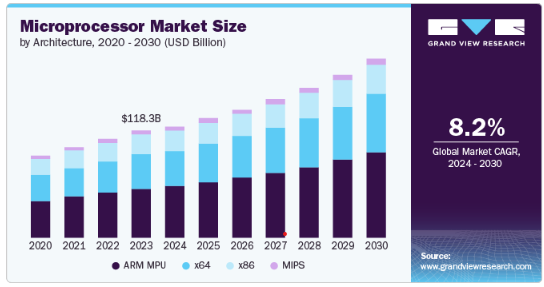
The global Microprocessor Market was valued at USD 118.3 billion in 2023 and is projected to grow from USD 141.3 billion in 2026 to USD 196.5 billion by 2030, registering a CAGR of 8.2% from 2024 to 2030. In terms of volume, the market accounted for 2.66 billion units in 2023 and is expected to reach 3.90 billion units by 2030. Asia Pacific dominated the global market with a revenue share of 58.0% in 2023. Increasing demand for smartphones, personal computers, laptops, servers, and connected devices is supporting market expansion. Furthermore, advancements in artificial intelligence (AI), the Internet of Things (IoT), and automotive electronics are creating new opportunities for microprocessor adoption across industries.
What Is Driving the Growth of the Microprocessor Market?
The growing use of consumer electronics is one of the primary factors driving the microprocessor market. Microprocessors are essential components of personal computers, smartphones, tablets, laptops, and other electronic devices. They perform critical functions such as data processing, storage management, timing, and communication with peripheral devices. As consumers increasingly adopt advanced electronic products, demand for high-performance and energy-efficient microprocessors continues to increase.
The rapid expansion of smartphones and tablets is further contributing to market growth. Microprocessors improve device speed, processing efficiency, and the ability to run complex applications. Increasing demand for smart televisions, digital cameras, wearable devices, and other connected electronics is also supporting the need for advanced integrated circuits.
Another important growth factor is the increasing application of microprocessors in automotive systems. Modern vehicles use these components in infotainment systems and Advanced Driver-Assistance Systems (ADAS), supporting improved connectivity and high-speed processing. Their growing integration into industrial equipment, medical devices, networking systems, gaming consoles, and IoT applications is expanding the market's reach.
How Are AI and IoT Creating New Market Opportunities?
The development of AI-enabled and IoT-connected technologies is creating additional demand for advanced microprocessors. Server processors and embedded microprocessors are increasingly being used in connected devices, data centers, and public cloud infrastructure. These technologies help organizations manage data movement and support advanced computing requirements across IT networks.
Want to Understand What’s Driving Market Growth? Ask Prism AI for research-backed insights into market size, evolving opportunities
AI and IoT developments are also making server processors more suitable for certain applications compared with standard desktop processors. Their integration into advanced devices can support improved operational efficiency and reduced unit costs. As organizations continue incorporating connected technologies into their operations, demand for processors capable of handling complex workloads is expected to strengthen.
Product innovation is another important market development. Manufacturers are focusing on research and development to improve processor performance, power efficiency, and security. New processor launches are expanding applications across edge computing, critical networks, smart meters, home gateways, and tracking devices.
Which Microprocessor Architecture Holds the Largest Market Share?
The ARM MPU segment dominated the microprocessor market, accounting for over 46.0% of revenue in 2023. Its leading position is supported by the growing adoption of ARM processors in smartphones and personal computers. ARM architecture offers advantages such as simple design, power efficiency, and easier management, making it suitable for portable and low-power embedded devices, including notebooks and smartphones.
The x64 segment is projected to grow at a CAGR of 8.4% from 2024 to 2030. Based on the x86 architecture, x64 processors provide higher memory and processing capabilities compared with traditional 32-bit x86 processors. They are used across mobile processing, gaming consoles, supercomputers, and virtualization technologies. These capabilities are supporting their adoption in applications requiring advanced computing performance.
Why Are Personal Computers and Smartphones Important Applications?
Personal computers accounted for over 37.0% of the microprocessor market revenue in 2023, making them the leading application segment. Microprocessors support important PC functions, including storage management, memory operations, logical processing, and operating system tasks. Increasing demand for advanced computing devices and the introduction of processors designed for improved performance and energy efficiency continue to support this segment.
Download a free sample report or claim your copy of this full market intelligence report
The smartphone segment is expected to register the fastest CAGR of 9.6% from 2024 to 2030. Microprocessors enable smartphones to perform multiple functions, including communication, internet browsing, application usage, and multimedia processing. Improvements in processor technology have increased smartphone capabilities and supported the development of more sophisticated applications. Growing demand for internet connectivity, social media, online shopping, and other digital services is further strengthening the segment's growth prospects.
What Challenges Could Restrict Market Expansion?
Despite strong demand, high manufacturing costs remain a significant challenge for the microprocessor market. Expensive circuit design, high raw material prices, and manufacturing requirements can increase production costs. The growing sales of low-cost mobile devices and declining shipments of personal computers may also affect market expansion.
Manufacturers must additionally comply with labor, employment, quality, safety, and environmental regulations. Field Programmable Gate Arrays (FPGAs) and microcontrollers represent alternative technologies, creating a moderate threat of substitutes. However, increasing demand across healthcare, automotive, consumer electronics, and industrial manufacturing continues to support opportunities for specialized microprocessor solutions.
Which Regions Are Leading the Microprocessor Market?
Asia Pacific dominated the global microprocessor market with a revenue share of 58.0% in 2023. The region's growth is supported by rising demand for smartphones, laptops, desktops, and tablets. Increasing digitization, automotive electronics development, IoT adoption, government IT spending, and cloud-based services are further strengthening regional demand. China is projected to register a CAGR of 9.4% from 2024 to 2030, supported by its electronics manufacturing ecosystem, developed supply chain, skilled workforce, and large-scale production of electronic products.
North America is projected to grow at a CAGR of 8.0% from 2024 to 2030. Demand for smart devices and automotive electronics, alongside the presence of established technology manufacturers, supports regional growth. The U.S. market is expected to register a CAGR of 8.1% during the same period, driven by developments in consumer electronics, healthcare monitoring systems, and electric and hybrid vehicles.
Europe's microprocessor market was valued at USD 18.43 billion in 2023. Government initiatives focused on domestic semiconductor production are supporting regional development. Germany is projected to grow at a CAGR of 7.9% from 2024 to 2030, driven by its industrial base, Industry 4.0 adoption, and investments in research and development.
What Is the Future Outlook for the Microprocessor Market?
The microprocessor market is expected to experience continued growth through 2030 as demand for advanced computing, connected electronics, and high-performance processing increases. Expanding applications in smartphones, personal computers, automotive systems, servers, and IoT devices will remain important growth contributors. At the same time, developments in AI-enabled processors, server computing, and energy-efficient architectures are expected to create further opportunities. With the market projected to reach USD 196.5 billion by 2030, continued product innovation and growing adoption across industries will play an important role in shaping its future.

 English
 Arabic
 French
 Spanish
 Portuguese
 Deutsch
 Turkish
 Dutch
 Russian
 Romaian
 Portuguese (Brazil)
 Greek
